Case study: Implementing DSpace at Ballarat Heath Services

This blog by Gemma Siemensma, Library Manager at Ballarat Health Services describes the thinking and processes behind the introduction of their DSpace repository, the Ballarat Health Services Digital Repository.

Ballarat Health Services (BHS) is the major hospital for western Victoria. Located an hour west of Melbourne it is the principal referral centre for the Grampians region, which extends from Bacchus Marsh to the South Australian border, covering a catchment of 48,000 square kilometres, and providing services to almost 250,000 people.

Why a digital repository?

There were two reasons why we decided to head down the repository path:

  1. The BHS Library kept hardcopy folders of research publications. There was no access or knowledge of what hospital staff had produced except the occasional mention in an Annual Report. Using an Endnote library was not an option as the organisation doesn’t license it.
  2. Piles and piles of “historical stuff” was dumped in the library. People didn’t want to throw out anything of value so they kindly gave it to us. We had no idea what we had and were often asked if we had old photos etc. that were of past staff or old buildings.

I liked the idea of a repository as I could chase the copyright for researchers and make the items freely and publicly available. A repository was clearly in line with my organisation’s values as it would allow staff to be recognised as researchers and enhance the research reputation of the organisation.

Where I started…

It didn’t take me long to realise that I needed to go down the repository path. I had explored the functionality of our existing catalogue but it wouldn’t suffice. I spoke with several vendors to hear about their products and had a bit of a play with these online. For me (and my miniscule budget) the costs were extremely prohibitive. I also spoke to repository staff at universities to garner their ideas and opinions (thanks to staff at the University of Ballarat and Swinburne University of Technology whom I pestered on several occasions).

I put a call out to the aliaHEALTH e-list to see what other hospitals were doing. There were few responses however one did mention that they were heading in the same direction and were looking at using DSpace which could be hosted externally by Prosentient Systems based in Sydney. Hospital IT Departments can be restrictive and Prosentient could provide the support and training I would require. I also read lots and lots about different repositories and played around with them to see if they would suit our needs.

DSpace

We decided to use DSpace for a variety of reasons. It was a lot cheaper than other systems and Peninsula Health were also looking to head down this path so we figured we could work in tandem. DSpace (through Prosentient Systems) would come configured and hosted and they would look after the technical side. These are skills that no one is our library (EFT of 3.2) possessed at a high end level. This included helping us set up an IT sub-domain; configuring the site; Handle registration; Google analytic set up; indexing on Trove; training; and helping to test, re-test and tweak the system. It also included on-going support and maintenance which we pay for annually. We had worked with Prosentient before (they look after Gratisnet ILL system for health libraries) so we were confident in their abilities to help us. DSpace was also very popular with universities so for me it had credibility and lots of support out there which I could tap into when required.

What’s included?

Our repository is divided into two sections:

  1. Research – this contains published journal articles, books, book chapters, conference papers and theses. We chase copyright from publishers for all completed works. We are yet to chase authors for pre-publication versions as we are still getting a feel for how this all works. This is something we hope to do more of in 2014. We currently sit at about 20% of full text research but expect this to rise.
  2. Historical content – so far this includes Annual Reports from BHS. These have been scanned and indexed in Trove. In the future we aim to add in newspapers articles, photographs, internal reports and recordings.

Promotion

Before beginning the repository it was put to both the BHS & St John of God Human Research and Ethics Committee (HREC) and the BHS Research Advisory Committee to garner support. Both were keen to see the repository implemented as it highlighted what research was undertaken within BHS and the region. The repository was also added to organisation wide policies. This included the “Rules for Publication/Presentation” policy as well as embedding it in HREC documentation. Each year BHS hold a Research Symposium and I am asked to speak about where we are up to and encourage people to deposit works into the repository. I also promote the repository in the internal staff newsletter. There is also the possibility for external promotion in the local newspaper in relation to the historical documents. The historical components also open up opportunities to work with local historical groups, the research room at the local public library and other local archives.

Response

The BHS Digital Repository has just ticked over its first birthday. In that time we have managed to add just over 400 items. Three-quarters of these relate to research and we have many more to add. The researchers we worked closely with in the initial stages of the project are very keen to alert us to new publications and we are finding that when we approach staff about publications they are happy to give us a list of all their work for inclusion.

Library value

In its vision to provide excellence in health care, BHS is strongly committed to the values of research, continuing education and collaboration with other service providers and is committed to sharing its knowledge and experiences to build a better health system. The BHS Library supports these values through a number of library initiatives (literature searching; database training; electronic journals and books etc.)

Over the last three years, the majority of health libraries have remained static or experienced a decrease in their budget, staff hours and space. As a manager I know that I need the library to add value to the organisation for them to recognise that we are a resource worth keeping. I feel that implementing a repository has done this. Not only has it shown us that we have transferable skills, but it has opened up professional visibility for both the organisation and the library. We communicate more widely across the organisation and in doing so are promoting the library and showing staff that we are more than just books. When we talk to researchers it puts the library in their head space and they approach us more frequently for help. It’s a win-win situation.

Gemma Siemensma
Library Manager
gemmas@bhs.org.au

This is a version of a paper being presented at the 10th HLi conference: #vital on October 18th 2013

BIS Report part two – Information & observations

The BIS report Open Access: Fifth Report of Session 2013–14 was heavily researched and offers a wide-ranging insight into the current state of open access. This blog cherry picks some of the useful aspects of the report with additional commentary if relevant.

This blog is the second of two looking at the BIS Report. The other – “BIS Report part one: Finding & implications” – is available here.

The blog covers under the headings: Supporting arguments for open access, Amount of research being made available, and Does green open access threaten subscriptions?

We would like to note that the AOASG has had some (indirect) input to the BIS report. The report referred to “reports of a UK publisher in social sciences switching from a zero embargo policy to require a 24 month embargo, citing its accordance with the recent change to UK open access policy” (par 46).

That evidence was the Richard Poynder article ‘Emerald’s green starts to fade‘ which in turn was triggered by the AOASG blog ‘Walking in quicksand keeping up with copyright agreements’  Heady days indeed.

Supporting arguments for open access

The report contains some useful information that could be employed in various discussions around open access.

The first was the statement that public funds are used three times in the research process:
• “to pay the academics who conduct the research
• to pay the salaries of the academics who conduct the peer review process, and finally
• to pay for access to this research through institutional journal subscriptions, which is the dominant business model in the scholarly publishing market”. (par 12)

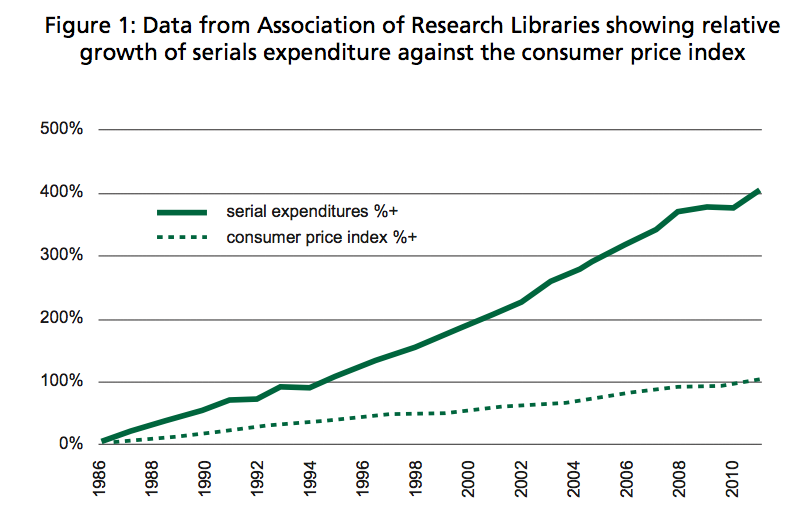
There is also a very useful graph comparing the growth of serials expenditure mapped against the consumer price index from 1986 – 2010:

Screen Shot 2013-09-14 at 6.09.16 PM

Given the concern that the money being invested by the government in research is being diverted into publisher profits, the report notes the increase in Elsevier’s profit margin, which was 34% at the time of the original 2004 House of Commons Science and Technology Committee Report on open access. It was 37% by the time of this BIS report. (par 15)

Amount of research being made available

There were some interesting facts and figures relating to the percentage of work available open access in the UK.

The first fact was that compared to a worldwide average of 20% of research available open access, “the proportion of the UK’s total annual research output that was available through open access in 2012 was about 40%” (par 20).

COMMENT: This is excellent for the UK. We do not have comparative information in Australia, although we are working on a method for determining this. Currently there is information collected that indicates the total number of items that are available, but this does not answer the question: ‘what percentage of work published in the previous year is available in a repository open access the following year’.

Even more illuminating was the fact that “Green currently provides seven-eighths of the 40% of the UK’s research outputs that are open access” (par 22).

COMMENT: This is very interesting. We have known for a while that more research is being made available open access thro ugh green rather than gold open access – the 2010 Bjork study concluded 11.9% of research is available through green as opposed to 8.5% via gold http://www.plosone.org/article/info:doi/10.1371/journal.pone.0011273. That study showed that of the work being made available open access 58% was through green open access.

The BIS report is stating that 87.5% of UK research is being made available in this manner. It also states that the Committee: “received strong evidence that Green is dominant internationally, with the latest data showing that Green accounts for about 75% of all open access worldwide” (par 33). This is a dramatic and impressive endorsement for the efficiency of green open access.

Note the UK numbers are dwarfed by the “University of Liège in Belgium (collecting 83% of its annual outputs in its OA repository)” (par26). This is because the university has directly aligned open access to their promotion system. The report noted that compliance with mandates is higher if it is “a condition of funding compliance and if deposit is linked to institutional performance evaluation, research grant applications and research assessment” (par 26).

Does green open access threaten subscriptions?

Far from threatening subscriptions, it might be the case that having work in a repository acts as a promotional tool for the subscription journal: “The €4 million EU funded PEER (Publishing and the Ecology of European Research) project (2012) showed that traffic to journal websites increased when articles were made available through a publicly accessible repository, possibly because interest grew as articles were disseminated more widely” (par 44).

The BIS report noted that “there is no available evidence base to indicate that short or even zero embargoes cause cancellation of subscriptions” (par 44).

COMMENT: Indeed, the only ‘evidence’ to support the claim that immediate green open access threatens the ‘sustainability’ (read: profit) of commercial publishers comes in the form of the exceptionally questionable ALPSP survey sent out early last year to librarians http://www.publishingresearch.net/documents/ALPSPPApotentialresultsofsixmonthembargofv.pdf . Heather Morrison wrote a piece on the methodological flaws with that survey http://poeticeconomics.blogspot.com.au/2012/06/publishers-association-survey-on.html

And yet, when questioned earlier this year by Richard Poynder, this is what Springer referred to as their ‘evidence’.

There are, however currently two clear opportunities for the industry to collect some actual evidence either way (as opposed to opinions on a badly expressed hypothetical):

1. Taylor & Francis have decided to indefinitely expand their trial of immediate green permissions to articles in their Library & Information Science journals. If they were to run a comparison of those titles against the titles in, say , three other disciplinary areas over two to three years they would be able to ascertain if this decision has made any difference to their subscription patterns.
2. Earlier this year (21 March) SAGE changed their policy to immediate green open access – again this offers a clean comparison between their subscription levels prior to and after the implementation of this policy.

If it is the case that immediate green open access disrupts subscriptions then we can have that conversation when the evidence presents itself. Until then we are boxing at shadows.

Dr Danny Kingsley
Executive Officer
Australian Open Access Support Group

BIS Report part one – Findings & implications

A report released last week by the UK government has given open access advocates the world over something to cheer about. The recommendations of the report are particularly welcome to those who advocate for open access by deposit of work in an open access repository (which is the AOASG’s position).

The UK House of Commons Business Innovations & Skills (BIS) Committee has been looking into open access and the report, Open Access: Fifth Report of Session 2013–14  from this investigation suggests that the position that the country has taken on open access should be readdressed.

The current UK position is that research should be made available. While this is welcomed by the open access community, the method by which this is achieved is disputed. The UK supports the expensive and unsustainable method of paying for articles to be published open access.

This position, reflected in the Research Councils of the UK (RCUK) open access policy , resulted from a report released last June by the Finch committee on open access to UK-funded research. There was considerable disquiet in the open access community at the time of the Finch Report.

The AOASG wrote a story about some of the effects the Finch Report and the subsequent RCUK open access policy has had on research accessibility in Australia “UK’s open access policies have global consequences”  – this was published 17 September in The Conversation UK.

This blog will highlight some of the more interesting sections of the BIS Report with some commentary around it. There is also reference to some of the ensuing commentary that has emerged in the UK. The blog has the headings Report purpose, The system is broken, Problems with hybrid, Different embargo periods and Other notable blog commentary.

Note this doesn’t mean the remainder of the BIS Report is of no interest. As an excellent summary of many aspects of the open access debate currently, it is worth a read in full if you have the time.

This blog is the first of two looking at the BIS Report. The other – “BIS Report part two: Information & observations” – is available here.

Report purpose

The BIS Report begins with the observation that it is necessary to transition to open access, but there needs to be a discussion about the best way to achieve it (par 2). However it notes that current policy raises the risk that “the Government’s current open access policy will inadvertently encourage and prolong the dysfunctional elements of the scholarly publishing market, which are a major barrier to access” (par 3).

The BIS Report does not hold back in criticism of the Finch Report and the RCUK policy in terms of the focus on gold open access through article processing charges. It notes that “Neither the Government nor RCUK undertook public consultation before announcing their policies” (par 6). Of course this could be interpreted as saying that the current report is fulfilling that remit…

The BIS Report recommends that the Government and RCUK should reconsider the importance of repositories and green open access in the move to full open access (par 70).

The system is broken

The BIS Report notes: “A recurring theme in this inquiry has been that elements of the scholarly publishing market are dysfunctional” (par 73). The primary issue is that of price.

There are two problems – one is the separation of the value of services provided by publishers compared to what they charge. “The costs of publishing services are increasingly disassociated from the value of the actual services provided. We heard evidence that costs of peer review, formatting, editing and other publisher services are exaggerated by publishers, keeping prices artificially high” (par 74).

The second issue has long been recognised. The library role in negotiating the price for subscriptions means that “authors are desensitised to the prices of journals in which they publish” (par 75) and this hampers the development of a functional market.

Problems with hybrid

The BIS Report discussed the issue of hybrid journals in some depth. Many submissions had said that the current policy had the unintended consequences of pushing up the cost of article processing charges and: “allowing ‘double dipping’ by hybrid publishers” (par 36). The report noted that Reed Elsevier had provided evidence that publishers were responding to the RCUK policy by increasing the amount of hybrid open-access publishing (par 37).

The problem is that gold open access is very expensive compared to green. Work undertaken by Australian Professor John Houghton (with Dr Alma Swan) was cited, stating “adopting Gold would cost UK universities 12 times the cost of adopting Green, and for the more research intensive universities, Gold could cost 25 times as much as going Green” (par 61). A second concern was that the universities and research organisations are expected to find the funds for this (par 64).

A recommendation arising from this was that “the Finch working group commissions an independent report on APC pricing, which should include average APC prices of pure Gold journals and hybrid journals, domestically and internationally” (par 58). This would be very welcome.

Different embargo periods

The BIS Report noted “the absence of evidence that short embargo periods harm subscription publishers” (par 49). This relates to the observation that immediate green open access affects subscription rates, which is discussed in the sister blog to this one.

What is interesting, however, was the observation that the Committee did not receive any evidence that Humanities, Arts and Social Sciences (HASS) disciplines needed longer embargoes than Science, Technical, Engineering and Medical (STEM) disciplines. In general this idea comes form the longer ‘shelf life’ of HASS articles.

The result of this distinction is that the Finch Report recommended “embargoes for HASS subjects of 24 months and for STEM subjects of 12 months” (par 45). In light of any evidence to support the position, the BIS Report recommended a revision of the Government and RCUK policies to “place an upper limit of 6 month embargoes on STEM subject research and up to 12 month embargoes for HASS subject research” (par 50).

The Russell Group of universities released a statement  that argued pulling back the length of acceptable embargo periods means that researchers will have to pay for open access because publishers have longer embargoes (so the only way to comply is to pay for gold). They then go on to say that the amount of funding available for publication would only cover 10% of their output.

COMMENT: This is a back to front argument. The concerns should be directed at publishers, demanding they reduce their embargoes, not at the BIS Report. It is the current status quo that supports this unsustainable situation. The BIS Report offers ways to turn that back.

Other notable blog commentary

Not surprisingly the release of the BIS Report has resulted in considerable commentary in the UK. Below is a list of more prominent online discussions.

Richard Poynder, Open and Shut, 10 September 2013, “UK House of Commons Select Committee publishes report criticising RCUK’s Open Access Policy

Heather Morrison, The Imaginary Journal of Poetic Economics, 12 September 2013, “Kudos to the UK Business, Innovation & Skills Committee: important steps in the right direction

Ann McKechin MP, Impact of Social Sciences, 12 September 2013, “The Government’s policy on open access and scholarly publishing is severely lacking

Dr Danny Kingsley
Executive Officer
Australian Open Access Support Group

An OA publisher’s perspective on CC-BY

As the Director of the University of Adelaide Press, I am participating in the Humanities and Social Sciences session in the OASPA (Open Access Scholarly Publishers Association) conference in Latvia, Riga later this month.

OASPA was initially set up to group together Open Access journal publishers, and now is keen to include book publishers, in all disciplines.

At present, which is why I am speaking, OASPA require that their members not only have published at least one Open Access book, but also that it is published with a licence that allows the “broadest re-use of published material possible”.

Their preference is the ‘CC-BY’ licence, now required by the United Kingdom funding bodies if they fund research, the European Union, and increasingly other funding bodies around the world.

I do not believe this licence is automatically appropriate for Humanities and Social Sciences which generally publish in books. 

‘Open Access’ as a term was formally adopted in the Budapest Open Access Initiative in December 2001, with the aim of assisting faster advances in Sciences, Medicine and Health. 

Subsequently, the six Creative Commons licences were created, to provide globally coherent copyright licences.

I do not have a quibble with the most open licence of all, the CC-BY licence, when it is used in Sciences, Medicine and Health.  Or for that matter, if any author in the Humanities and Social Sciences wishes to use it.

My quibble is when it is mandated to all of us to use.  I disagree flatly and categorically that when there are six different Creative Commons licences that only one must be used.

The CC-BY licence not only allows all readers the free, open access to the text, and to share it and quote it, but also to adapt it and create what they call, mysteriously, “derivative works”.

There is no requirement for these derivative works to be subjected to the same rigorous peer-reviewing before publishing that the original work had to pass.

It also allows them to commercialise their derivative work, without needing to share the profits with the original author, the only condition being that they attribute the original work.

No one yet has explained what a derivative work is to me, and even in the legal language of the licence itself, it remains a vague term.

This licence is undoubtedly perfect when applied to the results of fast-moving medical research, for example in genetics.

But it could equally allow an unscrupulous publisher to patch together a very good textbook and make a killing, probably selling it back to the same institutions that produced the original scholarly texts.

We already are more than aware of the way institutions are forced to buy back their own research in journal packages, in which they did not pay for the content, indeed charged a fee to publish it, then took ownership of the copyright, and also receive subsequent copyright use payments – like through the Copyright Agency Limited (CAL).

As an author of books myself, I am concerned about a licence allowing someone to take the results of years of original research, largely written in donated time, reword it, change it, and then turn a profit from it.

Of the people I have talked to who insist on the single use of the CC-BY licence, I wonder how many of them have published a book? 

On the other hand, I believe that the Creative Commons licences are essential for Open Access publishing to work efficiently and effectively.  The University of Adelaide Press will be introducing them in future titles, but will allow authors to choose which one suits their work.

John Emerson
Director, University of Adelaide Press

Assessing research impact: AOASG submission

Measuring the impact of research has been on and off the government’s agenda for many years now. Originally part of the Research Quality Framework, impact was removed from the 5880919002_b92743b247_mExcellence in Research for Australia during its trial in 2009.

Due to its increasing relevance, measuring impact was trialled again in 2012 by the Australian Technology Network and the final report from this study: “Excellence in innovation: Research impacting our nation’s future – assessing the benefits” was released in November 2012.

Plans to assess impact

The Department of Innovation is currently exploring options for the design and development of an impact assessment program. It intends to pilot this in 2014.

As part of this process, the Department released a Discussion Paper in July 2013– “Assessing the wider benefits arising from university-based research

The Paper seeks the “views of interested parties regarding a future assessment of the benefits arising from university-based research”.

Before research administrators throw their hands up at yet another assessment program, the Discussion Paper does recognise the overwhelming compliance burden on universities and the need to simplify this burden. . The Preamble states that plans include “scaling back and streamlining a number of current data collection and analysis exercises”.

Overall, the Government believes that a research benefit assessment will:

  1. demonstrate the public benefits attributable to university-based research;
  2. identify the successful pathways to benefit;
  3. support the development of a culture and practices within universities that encourage and value research collaboration and engagement; and
  4. further develop the evidence base upon which to facilitate future engagement between the research sector and research users, as well as future policy and strategy.

Submission from AOASG

AOASG prepared a submission in response to the discussion paper proposing that open access should be a measurable for assessing impact and that some reward should be associated with making work freely and openly available.

All submissions will be made available to the public on the Dept of Innovation website. In anticipation, the AOASG submission is copied below.

Response to principles from the paper

NOTE: AOASG chose to only respond to Principles 1, 3 and 5.

Principle 1 – Provide useful information to universities

Principle 1 is to be applauded. It is sensible and practical to marry the types of data required with the types of data the Universities are already producing. This will minimise the burden on Universities in aggregating data and producing reports.

Open access repositories in Australian universities are developed in a finite set of software with common underlying code – OAI-PMH. This allows for aggregation and harvesting across multiple platforms. Such repositories usually maintain statistics about individual works, such as the number of downloads and places where these downloads have originated.

Prior to developing or recommending any specific data for reporting on impact, we suggest that a survey be conducted of university libraries to gather information on the type of data collection methods already in place within open access repositories. This also has the benefit of supporting Principle 2 – Minimise administrative burden.

Principle 3 – Encourage research engagement and collaboration, and research that benefits the nation

Principle 3 notes that this assessment should encourage and assist universities to “better recognise and reward (for example in recruitment and promotion exercises) the contribution of academics to engagement and collaborative activities”. A fundamental component of this assessment is an academic’s involvement in open access and their approach to making research freely available.

Many Australian researchers share their work with the broader community by placing a copy of it in their institutional repository, or in a subject-based repository such as PubMed Central, SSRN, arXiv, or RePEc. The ARC & NHMRC open access policies are likely to encourage more researchers to follow this trend. However, currently there is no aggregated data, and little individual data, on the extent to which Australian researchers are making their own work available. In addition, some researchers also widen the accessibility of research outputs by working as editors, publishers and reviewers for open access journals published out of Australian universities. A definitive list is currently being developed of these journals however this list does not indicate the level and extent of open access activity in the country.  The efforts of academics and researchers to share research openly is currently not measured nor rewarded through any promotion or funding incentives.

Principle 5 – Collect and assess at the institution level, with some granularity by discipline

Principle 5 – is a good suggestion given that some types of research will naturally have a wider impact than others. Impact will also vary over time with some research outputs producing impact after a considerable time and others making immediate significant impact. It is more challenging to articulate the benefit to wider society of research in, say, pure inorganic chemistry than, for example, forestry. When considering the need to granulate the information available, the benefit of using data from open access repositories as suggested above, is the metadata for each record contains information about the author, subjects and clearly the institution.

Response to methodological considerations

What considerations should guide the inclusion of metrics within the assessment?

It has become clear that the established measurement systems such as the Journal Impact Factor (JIF) can be affected by those who seek to manipulate the outcomes. A recent clear example this is occurring is the JIF decision to suppress a larger than usual number of titles this year due to “anomalous citation patterns resulting in a significant distortion of the Journal Impact Factor”. Any reliance on metrics as a measure of quality and/or use of research needs to consider attempts to manipulate new measures as a potential outcome. One way of minimising data manipulation is to use a mix of qualitative and quantitative measures.

What information do universities currently collect that might form the basis for research engagement metrics?

As noted above in section 2 all Australian universities and CSIRO have an open access institutional repository. Such repositories usually collect information on the research that is available, how often it has been downloaded and where the interest has originated.

What metrics are currently available (or could be developed) that would help to reveal other pathways to research benefit?

The act of making a work open access creates a pathway to research benefit. Open access increases the potential impact of the work because it ensures the work can be accessed, applied or built upon by other researchers, industry, practitioners and the public. On this basis, we propose that the act of making research publicly available is a fundamental metric of assessing research benefit. This would also support and endorse the open access policies of the ARC & NHMRC. The metric could be twofold – at the individual researcher level (in terms of promotion) and/or at the institutional level.

While in some cases publisher copyright conditions will prevent work being made available, having an appropriate version of the work deposited in a repository with a ‘Request copy’ button facilitating access could be considered ‘making it available’ for this purpose.

Repositories capture article download information at the level of the individual article. This data could also be used as a metric of a pathway to research benefit. There is a proven link between making work open access and citations. The general collection of download statistics would be only one of several measures that can be aggregated to demonstrate interest in an use of research (see the next point).

In addition to ERA, NSRC, GDS, AusPat and HERDC data, are there other existing data collections that may be of relevance?

Recently there has been a move to develop a series of metrics that assess the value of individual articles rather than placing value on the journal or publication in which the article appeared. These article level metrics offer real time feedback about the way a research article is being used.

One example is the metrics page provided for a published article that lists the number of HTML views, PDF downloads, XML downloads as well as the number of citations and where the article has been shared on social media, such as through Twitter. There are however, many other examples of article level metrics already in existence. Examples include: Altmetric, ImpactStory, Plum Analytics & PLOS ALM. Discussion of research on social media sites indicates a level of impact beyond the confines of the scholarly publication system, with the added benefit of being instantly and easily quantifiable. The timeliness and convenience of these metrics addresses the need for “current information on the prospect of benefits from research” as identified in the Discussion Paper.

What are the challenges of using these data collections to assess research engagement?

It will be necessary to determine which sets of article level metrics are the most appropriate for specific purpose. There may be a need for some aggregation to correlate several sets of metrics about the same item.

Response to ‘other comments’ section

We have two suggestions for additions to Appendix A – “Examples of possible metrics”.

An additional Research engagement mechanism could be “Provision of research outputs in a publicly and freely available outlet”. The Measure could be “The percentage of research that is freely and publicly available within 6 months of publication”, and the Source would be “Institutional repositories, subject based repositories or open access publications”.

Currently one of the research engagement mechanisms listed is “Research engagement via online publications”. The measure suggested is “Unique article views per author” and the source is “Websites such as The Conversation”. We are in full support of this suggestion. The Conversation is an opportunity for researchers to discuss their work in accessible language and the author dashboard for The Conversation provides comprehensive metrics about readership.

However we suggest there are other metrics within the classification of ‘online publications’. Open access repositories can provide metrics on unique article views per author. We therefore suggest an additional source being “Institutional repositories, and other article level metrics”.

Four issues restricting widespread green OA in Australia

Australia is a world leader in many aspects of open access. We have institutional repositories in all universities, funding mandates with the two main funding bodies, statements on or mandates for open access at a large number of institutions and a large research output available in many open access avenues. A summary of centrally supported initiatives in this area is here.

However we can do more. This blog outlines four impediments to the widespread uptake of open access in Australia: a lack of data about what Australian research is available, Copyright transfer agreements, the academic reward system and improved national discovery services. We suggest some solutions for each of these issues.

Issue 1 – Lack of data about what Australian research is available OA.

We collect good data in Australia there is good data about the amount of research being created and published annually. Equally, a considerable amount of Australian research is being made available to the wider community through deposit of research in institutional repositories, subject based repositories (PubMed Central, arXiv , SSRN and the like), through publication in open access journals.

However, this information is not compiled in a way to ascertain:
1. What percentage of current Australian research is available open access.
2. Where Australian research is being made available (institutional or subject-based repositories and open access journals).
3. The disciplinary spread of open access materials – an important indicator of areas needing attention.

Without this information it will be difficult to ascertain the level of impact the ARC and NHMRC policies are having on the availability of open access material from current Australian research. There are three actions that could help inform this area.

Solution 1

First it would be enormously helpful to know the percentage of Australian publications that are available open access.

There have been two definitive studies published on worldwide open access availability. Björk et al’s 2010 study concluded that 21% of research published in 2008 was openly accessible in 2009. Gargouri et al’s 2012 study found 24% of research was openly accessible.

But in these studies the method used to determine which work was available was to search for the items manually across several search platforms. This is clearly very time consuming. A study like this in Australia will require funding.

Solution 2

Second we need an easily accessible summary of the number of full text open access items in institutional repositories across the country. In an attempt to address this, the National Library of Australia aggregates research outputs from all Australian university repositories into Trove, and is working with the sector to improve discoverability and metrics around this collection. One challenge is that some repositories do not specify whether records have an open access full text item attached.

This issue was raised during a poll of repository managers in 2012. The poll found that as at June that year there were about 200,000 open access articles, theses and archive material (which includes images) in Australian university institutional repositories. Currently there is no automated way of obtaining an updated figure.

Solution 3

Third, a compliance monitoring tool needs to be developed to assist the ARC and NHMRC manage their open access policies. Currently all institutional repositories in Australia are implementing a standardised field in their repositories to indicate an item results from funding. But to date there is no indication of how this might be harvested and reported on.

Issue 2 – Copyright transfer agreements

As AOASG has already noted, there is a serious challenge keeping up with copyright agreements as they change. In reality, it is extremely difficult for an individual researcher to remain across all of the nuances of the copyright agreements. There have been studies to demonstrate that doing the copyright checking on behalf of the researcher increases deposits into repositories.

But the broader problem is actually two fold. First researchers often have little understanding of the copyright status of their published work. Many do not read the copyright transfer agreements they sign before publication. In addition, most researchers do not keep a copy of these legal documents. While there is currently some advice for researchers about copyright management, such as this page from the University of Sydney, generally awareness of copyright remains poor amongst the research community.

But before we start wagging our fingers at researchers, let’s consider the second, related issue. The copyright transfer agreements presented to researchers by publishers are often many pages long, written in small font and hard to understand. In addition these agreements are not consistent – they differ between publishers and often titles from the same publisher have different agreements.

Generally publishers ask researchers to assign exclusive copyright to them. But in most cases publishers only need the right of first publication of work, and normally do not need to control how research is used and distributed beyond this. There are options for researchers to negotiate different arrangements with their publishers, but the level of uptake of these in Australia is anecdotally very low.

It is highly unlikely there is any specific action that can force publishers to simplify their copyright transfer agreements. But there are a couple of actions the research community can make to improve the current situation.

Solution 4

It would help to have an Australian version of the SPARC Author Addendum tool which can be attached to copyright transfer agreements. This would need to be supported by a concerted education campaign about what rights researchers have, including training materials.

Solution 5

In addition the many researchers in Australia who work as editors for scholarly journals are in a good position to negotiate these arrangements with their publishers on behalf of their authors. An education campaign aimed at journal editors would assist them in this action.

Issue 3 – The academic reward system

The academic reward system supports the current publishing status quo. Widespread uptake of open access will continue to be a challenge while this is the case. A reliance on a numerical analysis of the number of articles published in journals with high Journal Impact Factors as a proxy for quality assessment is a narrow and limiting system.

There are many issues with the Journal Impact Factor. It also causes challenges for open access is it retains emphasis on a small number of specific journals which are in, the vast majority, subscription based. Yet there is evidence to show that open access & subscription journals of the same age have the same impact, indicating that it is time to look at other methods of assessing quality.

Currently the markers used to assess promotion do not differ much from those used for grant allocation. However, the contribution made by researchers to their academic community reaches far beyond simply their publication output. This includes editing journals and the peer review of papers. As there is currently no quantification of this work, the extent of the problem is unknown, although concerns about work overload have been expressed by the academic community. There are serious implications for the sustainability of scholarly publication in terms of human capital.

Solution 6

We need to move to assessment based on article level metrics rather than the organ of publication. It would be helpful if assessments such as ERA and funding allocation were to embrace new, existing alternative metrics. Examples include: Impact Story, Plum Analytics, PLOS ALM, Altmetrics and Google Scholar.

Solution 7

Institutions could consider recognising the hidden work academics undertake supporting the publication process in their promotion rounds. Recognition of peer review and editing roles as well as those researchers who are also publishing journals by running an open access journal using OJS or the like would add value to these activities and make the scholarly publication system more sustainable.

Issue 4 – Improved national discovery services

This last issue is in some ways, related to the first – knowing more about where the research we are producing is ending up. But it has a broader remit, for example incorporating data as a research outcome. Currently researchers can register their data with Research Data Australia which lists over 87,000 collections from over 23,000 contributing research teams.

We need to move beyond simply collecting research, and start working on ways to link data as research outcomes to reports on research publications.

During 2004 and 2008 the Australian Partnership for Sustainable Repositories (APSR) provided assistance and support for the repository community and developed technical solutions relating to interoperability and other repository issues.

APSR was supported by Systemic Infrastructure Initiative (SII) funding [note original post said NCRIS funding – thanks to David Groenewegen for pointing out the error. Amended 16 August]. When this ended, repository manager support was taken over by CAIRSS, financed in 2009-2010 by remainder money from another SII funded project, Australian Research Repositories Online to the World (ARROW) . The university library community through CAUL continued to support this project in 2011-2012 and the work has now been folded into the responsibility of another CAUL committee.

But the work APSR did developing country-wide technical solutions has not continued. Currently repositories around the country are being developed and maintained in isolation from one another.

Solution 8

An investment in current institutional repositories to increase functionality and interoperability will assist compliance with mandates (both Australian and international) and usability into the future. It will also enable a resolution of the metadata issue for country-wide harvesting by Trove.

Solution 9

We suggest revisiting support for country-wide technical development of solutions to common problems facing repositories throughout Australia. An example of a project that could be undertaken is the Funders and Authors Compliance Tool developed in the UK – SHERPA/FACT. This assists researchers to comply with open access mandates.

Dr Danny Kingsley
Executive Officer
Australian Open Access Support Group

Accessibility is more than making the paper OA

Journals

Proponents of open access generally agree that there are many benefits to open access, but discussions about the processes involved in achieving open access often stop at making the published research available. But what happens when the issues of accessibility are considered?

A remarkable project is underway in Australia, spearheaded by the Australian chapter of a not-for-profit international development organisation, Engineers Without Borders (EWB). The Open Journal Project aims to explore and promote techniques to make academic information genuinely open and accessible – with a focus on groups that are often excluded from access to this type of information.

EWB is a volunteer organisation, sending volunteers overseas to a local non government organisation to work on the ground on a project. The Open Journal Project considers the needs of individuals and practitioners in other countries.

“The Project doesn’t finish the day you press publish – that’s when it starts,” explained Julian O’Shea, who is the Director of the EWB Institute, the education, research and training section of EWB, and is heading up the Project.

“We are thinking about what we can do to make the work more accessible.”

The EWB Institute is based in Melbourne, and is publishing a peer-reviewed journal as a pilot and case study in their work. The Journal of Humanitarian Engineering (JHE) is piloting innovations in open access, including multi-language access, developing country access, low-bandwidth websites, and disability-accessible content.

“We want to pilot innovations and share our experiences with doing this,” explained Julian. “We want to work out what is world’s best practice, do it and live it and show it is not too hard.”

The problem

The EWB has noticed that practitioners overseas are under-served by the current publishing process. As an example, Julian stated that the leading university in Cambodia does not have access to the largest database in the field of engineering.

The idea for the focus of the journal began because the group saw there were very few that focused on experience, drawing on outcomes from developments and disseminating that information.

“The aim of the journal is not to be published or cited, but to provide outcomes in communities,” explained Julian. “This is different to other research organisations as a metric of success. It gives us a different angle or lens.”

The group wanted to encourage this as a field of research in academia. They were not sure what level of interest there would be in the journal because from a purely technical point of view they are not publishing innovative technologies. Rather, the focus is on new ways of applying this technology.

“We have been surprised and pleased that the journal has been really positively responded to,” said Julian.

Open access

The journal is published open access, with no cost to the author or to the reader. It uses an open source program called Open Journal Systems to run the administration of the peer review and publication. All papers in the journal are available under a CC-BY 3.0 license.

“We have had no negative feedback at all from people wanting to publish in the journal,” said Julian. “People doing this kind of research don’t have any issue with making their work freely available.”

Accessibility – language issues

Academic papers can be difficult to read even for people within a field. They can become impenetrable to researchers in parallel fields. This problem is further exacerbated in an international environment, working with practitioners on the ground who may not have any tertiary education.

There are several issues with language. The first is the problem of making the technical reports understandable to the lay person. Often the papers in this area are very technical, including many equations, and can reach 300 pages.

To solve this problem authors in the JHE are required to submit a two page plain summary about the paper with the formal paper. This means a project manager on the ground can make a decision about applying the technology or approach and then pass the full paper on to the technical manager.

But many of these projects are in countries where English is not the primary language. The Project addresses this by making the reports available in the language of the country it is targeted towards. The Project translates the plain language guides into both the local language of most importance and into other general languages.

The Project called on goodwill to obtain the translations. They sent articles out to the world, asking for volunteers to translate the papers. This had a good response from universities, companies or simply people to help out on the website.

The Project now has an approved translator list. The first time an article is translated it is sent to a native speaker to approve it and once this is done the translator can go onto the list. The quality of translations has been very high, said Julian, with only one that had to be sent back.

To date the plain language summaries have been translated into Indonesian, Italian, Portuguese, Russian, Hindi, Chinese, Spanish, Danish, Khmer and French. The number of languages is growing.

Accessibility – distribution

Another consideration is bandwidth. In many countries the internet connection is through a mobile telephone which prevents the download of large documents. The Project decided to produce the journal on a low bandwidth, and this opened up new issues.

“Generally the journal system distributes through pdfs,” explained Julian. “The problem is it is all or nothing – if the download cuts out at 90% you get nothing.” So the Project looked at releasing html versions of the papers. This has reduced the size of the website to 4.3KB and the journal articles are about 18KB. “We can put about 80 journals onto a floppy disk,” he said.

The Project also has plans to further improve the distribution to remote areas. “We haven’t done it yet but we will have a system that says ‘here’s a postcard, send it to us and we will send the paper to you by donkey’”, said Julian.

Accessibility – inclusion

With a philosophy of sharing research, it was important to the project to provide versions of the papers in an accessible format for people with disabilities.

The choice of publishing html versions of papers assists people with vision impairment, as they translate better using text-to-talk programs than pdfs.  In addition, the project is being proactive about embedding helpful metadata within the document such as describing images.

The Project has used the guidelines for Vision Australia to release a large print edition of the papers. “The first one took about couple of minutes – after that it was very simple,” said Julian. “That is what we are trying to show in this project, to meet a need for some people can be solved in literally two minutes.” The team has also produced Braille editions of the plain language guides.

Future plans

The project hopes to share their experience and inspire others. “We are doing this through the case study approach,” said Julian.  “This is my goal – to be able to communicate better. I am an author – what can I do? I am a publisher – what can I do?”

The Open Journal Project is hoping to formally launch later this year. Meanwhile, Volume 2 issue 1 is about to be released.

Twitter handle – @OpenJournal

Dr Danny Kingsley
Executive Officer
Australian Open Access Support Group

Lost & found: challenges accessing government research

While there’s been much angst about the locking away of academic literature and sky-high fees for libraries to access academic journals, what about all the other sources of publicly-funded material? Why are they also not included in the brave new world of open access?

As a PhD student working in a reasonably cutting-edge area, grey literature* is my life-blood. And yet when it comes to some key sources who take money from public coffers for their work, getting access to material that should be public domain is tricky at best.

My area of interest – not-for-profit, non-government hospitals and large scale clinics in developing countries – has not generally been the focus of briefing papers and articles. But often these health facilities are included in documents for various reasons without being the focus. And given the dearth of directly relevant data, I’m prepared to take what I can get – or at least what I can find.

Government Double Standards?

While recipients of Australian Government funds for research now have an obligation to allow open access, the same can’t be said for government departments, which are encouraged, but not required, to make their work open access. 

Try checking AusAID’s website for their list of advertising projects or FOI procedures and requests or this page on consultation arrangements. The links lead you either to a blank page or an announcement that the information will be added when it becomes available.

And that’s just scratching the surface of the problem. A significant amount of research is now outsourced to specialist consulting firms or hubs at academic institutions. What that means in practice is we have no idea how much information isn’t making it onto indexes on government websites.

As part of my research I went to AusAID looking for any information they might be able to contribute. I should stress the staff I dealt with were professional and went out of their way to check for me. But the end result was a direction to an outside body, the Nossal Institute,  a health knowledge hub for AusAID. After I found some useful reports on Nossal’s website, I went back to the AusAID publications area and searched for them using keywords from the title. Nothing. I searched under health. Nothing. The document register similarly yielded nothing.

So what happens to members of the public who don’t know AusAID has a librarian to ring and ask for advice? Or who doesn’t make the connection between AusAID and Nossal or any other body contracting to AusAID for that matter?

Your ability to track down information funded by the Australian taxpayer shouldn’t be dependent on how ‘in the know’ you are. Whether you’re a researcher or a tradie, these documents should be easy to access.

It’s in the Report

The sad reality is that even when you finally find the document you’re after, you probably won’t be getting the full picture. As anyone who has ever done research will tell you, there’s a lot that misses the final cut. What happens to that uncaptured knowledge?

When all the researchers were in-house, that institutional knowledge collected along the way stayed within the institution. But now, it dissipates out to a complex web of contractors and partner organisations. So what hope does anyone outside the organisation have of tracing detail that didn’t fit the word limit?

Make an Appointment

I imagined a world where I could ring the librarian, put in a formal request to get access to the library and come and thumb the physical pages, letting the Dewey decimal system lead me from one title to another and maybe even hit the jackpot with a title I would never have thought to search for. Or better still, in a face-to-face conversation with that gatekeeper of knowledge, the librarian might plant a thought that led me to the holy grail. Apparently not.

Along with the outsourcing of much research capacity, the AusAID library now resides off site, so even staff put in requests for books to be retrieved and brought in. While it makes sense for archival or rarely accessed material, there are some titles that could and should be read often. And yes, there are electronic books, but not everything comes in e-book format, not to mention the costs if every individual in an organisation paid for an e-book every time they wanted to read a few prescient pages.

While I’ve focussed on AusAID here, I gather from anecdotal conversations with departmental staff and fellow researchers that this experience is far from rare. I’ve singled out AusAID purely because of my recent interaction with them as a source.

And now the good news…

I was preparing to be less than glowing about the World Bank’s open access. I started by writing that the World Bank had an obligation, given their highly specialised research, to make all their reports accessible for free.

As a frequent user of the site in the past, when I started searching the site again I went straight to the publications catalogue. I was appalled that it still cost $100 to get a report as crucial as African Development Indicators. The best they seemed to offer on the online bookshop was a ‘geographic discount’ for developing country purchasers.

What I missed in the catalogue was the announcement on the inside cover page that ‘most publications are now available for free online’. I ended up stumbling on to the Open Knowledge Repository area of the website which is well designed, easy to search and remarkably had the vast majority of reports published by the World Bank available to download free.

There are some exceptions in the open access policy. Open access only applies to external research when that research was commissioned on or after July 1, 2012 which presumably leaves some research still being undertaken now exempt from the rules. However given the volume of current and historical material available free it seems the Bank has worked hard with its authors to get their consent to publish full reports online.

My one criticism is that this needs to be better flagged on the site, and particularly in the online bookshop. Over-familiarity with the old site led me to miss these changes – like many researchers I can be guilty of being a ‘mongrel reader’ and skipping straight ahead if I think I know a website well. The ‘read and share this’ button looked to me like a clunky piece of advertising rather than an invitation to download the research.

So the upshot is that global organisations like the World Bank, with their multitude of stakeholders, are making huge gains rapidly, while Australian government departments are still lagging behind. It’s time government departments similarly made significant inroads into genuine open access.

* Grey literature is defined as ‘ … document types produced on all levels of government, academics, business and industry in print and electronic formats that are protected by intellectual property rights … but not controlled by commercial publishers i.e., where publishing is not the primary activity of the producing body.’ –  12th International Conference on Grey Literature at Prague, December 2010

Belinda Thompson
PhD Scholar
Menzies Centre for Health Policy
Australian National University

Shall we sing in CHORUS or just SHARE? Responses to the US OA policy

Well things certainly have been moving in the land of the free since the Obama administration announced its Increasing Access to the Results of Federally Funded Scientific Research policy  in February.

In short, the policy requires that within 12 months US Federal agencies that spend over $100 million in research and development have to have a plan to “support increased public access to the results of research funded by the Federal Government”. (For a more detailed analysis of that policy see this previous blog.)

In the last couple of weeks two opposing ‘solutions’ have been proposed for the implementation of the policy.

In the publishing corner…

A coalition of subscription based journal publishers has suggested a system called CHORUS – which stands for Clearing House for the Open Research of the United States. The proposal is for a “framework for a possible public-private partnership to increase public access to peer-reviewed publications that report on federally-funded research”.

The plan is to create a domain called CHORUS.gov where publishers can deposit the metadata about papers that have relevant funding. When a user wants to find research they can look via CHORUS or through the funding agency site, and then view the paper through a link back to the publishers site.

While this sounds reasonable the immediate questions that leap out is why would this not be searchable through search engines, and what embargo periods are being held on the full text of publications? The limited amount of information available on the proposal does not seem to address these questions.

The Association of American Publishers released their explanation of the proposal ‘Understanding CHORUS’ on 5 June. There is not a great deal of other information available, although The Chronicle published a news story about it.

The Scholarly Kitchen blog – run by the Society for Scholarly Publishing – put up a post on 4 June 2013 with some further details. According to the post the CHORUS group represents a broad-based group of scholarly publishers, both commercial and not-for-profit There are 11 members on the steering group and many signatory organisations. The blog states the group collectively publishes the vast majority of the articles reporting on federally-funded research.

The time frame is fast, with plans including:

  • High-level System Architecture — Friday, June 14
  • Technical Specifications — Friday, July 26
  • Initial Proof-of-Concept — Friday, August 30

On this blog there is the comment that CHORUS is:

a much more modern and sensible response to the demand for access to published papers after a reasonable embargo period, as it doesn’t require an expensive and duplicative secondary repository like PubMed Central. Instead, it uses networked technologies in the way they were intended to be used, leveraging the Internet and the infrastructure of scientific publishing without diverting taxpayer dollars from research budgets.

Not surprisingly the comment coming from commercial publishers about diverting taxpayer dollars from research budgets has attracted some criticism, not least from Stevan Harnad in his commentary “Yet another Trojan Horse from the publishing industry” :

And, without any sense of the irony, the publisher lobby (which already consumes so much of the scarce funds available for research) is attempting to do this under the pretext of saving “precious research funds” for research!

Harnad’s main argument against this proposal is that it represents an attempt to take the power to provide open access out of the hands of researchers so that publishers gain control over both the timetable and the infrastructure for providing open access.

Mike Eisen in his blog on the topic points out that taxpayers will end up paying for the service anyway:

publishers will without a doubt try to fold the costs of creating and maintaining the system into their subscription/site license charges – the routinely ask libraries to pay for all of their “value added” services. Thus not only would potential savings never materialize, the government would end up paying the costs of CHORUS indirectly.

Harnad notes that this is a continuation from previous activities by publishers to counter the open access movement, not least the 2007 creation of PRISM (the Partnership for Research Integrity in Science and Medicine)  which grew from the American Association of Publishers employing a public relations expert to “counter messages from groups such as the Public Library of Science (PLoS)”

In the university corner….

Three days after the Scholarly Kitchen blog, the development paper for a proposal called SHARE was released from a group of university and library organisations.

The paper for SHARE (the SHared Access Research Ecosystem) states the White House directive ‘provides a compelling reason to integrate higher education’s investments to date into a system of cross-institutional digital repositories’. The plan is to federate existing university-based digital repositories, obviating the need for central repositories.

The Chronicle published a story on the proposal on the same day.

The SHARE system would draw on the metadata and repository knowledge already in place in the institutional community, such as using ORCID numbers to identify researchers. There would be a requirement that all items added to the system include the correct metadata like: the award identifier, PI number and the repository in which it sits.

This type of normalisation of metadata is something repository managers have already addressed in Australia, in response to the development of Trove at the National Library of Australia which pulls information in from all Australian institutional repositories. Also more recently here, there has been agreement about the metadata field to be used to identify research from a grant to comply with the NHMRC and the ARC policies.

In the SHARE proposal, existing repositories, including subject based repositories, would work together to ensure metadata matching to become a ‘linked node’ in the system. The US has a different university system to Australia with a mixture of private and state-funded institutions. But every state has one or more state-funded universities and most of these already have repositories in place. Other universities without repositories would use the repository of their relevant state university.

A significant challenge in the proposal, as it reads, is the affirmation that for the White House policy to succeed, federal agencies will need universities to require of their Principal Investigators; “sufficient copyright licensing licensed to enable permanent archiving, access, and reuse of publication”. While sounding simple, in practicality, this means altering university open access and intellectual property policies, and running a substantial educational campaign amongst researchers. This is no small feat.

The timeframe the SHARE proposal puts forward is in phases, with requirement and capabilities developed within 12-18 months, and the supporting software completed within another six months. So there is a two-year minimum period after initiation of implementation before the system would be operational. It is also possible that given the policy issues, it could take longer to eventuate in reality.

There has been less discussion about the SHARE proposal on open access lists, but this is hardly surprising as more energy on these lists will be directed towards criticism of the publishers’ proposal.

So which one will win?

Despite the two proposals emerging within days of one another, the sophistication of both proposals indicates that they have been in development from some time.

Indeed, the CHROUS proposal would have required lead-time to negotiate ‘buy-in’ from the different publishers. On the other hand, the SHARE proposal includes a complex flow chart on page 4 which appears to be the equivalent to the ‘High-level System Architecture’ the CHROUS proposal states would be ready on Friday 14 June. According to a post on the LibLicense discussion list, SHARE was developed without awareness of CHORUS, so it is not an intentional ‘counterattack’.

There are glaring differences between the two proposals. SHARE envisions text and data mining as part of the system, two capabilities missing from the CHORUS proposal. SHARE also provides searching through Google rather than requiring the user to go to the system to find materials as CHORUS seems to be proposing. But as Peter Suber points out: “CHORUS sweetens the deal by proposing OA to the published versions of articles, rather than to the final versions of the author’s peer-reviewed manuscripts”.

So which will be adopted? As one commentator said CHORUS will work because publishers have experience setting up this kind of system, whereas SHARE does not have a good track record in this area. They suggest that.

A cynical publisher might say: Let’s fight for CHORUS, but let’s make sure SHARE wins. Then we (the publishers) have the best of all worlds: the costs of the service will not be ours to bear, the system will work haphazardly and pose little threat to library subscriptions, and the blame will lie with others.

This is an area to watch.

Dr Danny Kingsley
Executive Officer
Australian Open Access Support Group

Walking in quicksand – keeping up with copyright agreements

As any repository manager will tell you, one of the biggest headaches for providing open access to research materials is complying with publisher agreements.

3020135683_41c68d66f7_m

Most publishers will allow some form of an article published in their journals to be made open access. There is a very useful site that helps people work out what the conditions are for a given journal or publisher, called Sherpa RoMEO*.

In many institutions the responsibility for copyright checking is taken by the repository manager (rather than requiring the author to do it), and usually the workflow includes some or all of:

  • Checking Sherpa RoMEO for local journals
  • Consulting (and adding to) an internal database
  • Looking at the journal/conference/publisher webpages
  • Locating and consulting at the Copyright Transfer Agreement the author signed
  • Contacting the publisher directly for permission if the OA position is not able to be determined using any of these resources.

One problem repository managers face is that publishers sometimes change their position on open access. Often there is no public announcement from the publisher; especially when the change imposes more restrictions on ‘green’ open access. This is where the blogosphere and discussion lists (such as the CAIRSS List in Australia) are invaluable in keeping practitioners on top of new issues in the area.

Some recent cases where publishers set more restrictions on ‘green’ open access include Springer and IEEE.

[*SHERPA stands for Securing a Hybrid Environment for Research Preservation and Access, and RoMEO stands for Rights Metadata for Open archiving.]

IEEE

The Institute for Electrical and Electronics Engineers (IEEE) is the biggest organisation for these fields. They run many high status conferences and publish the proceedings. Because in this field traditionally authors have been expected to provide camera-ready copy for conference proceedings, it has long been accepted practice for authors to make copies of their work available on their own webpages or in repositories. And until December 2010 IEEE sanctioned that (as long as the repository attached a specific notice).

Then on 1 January 2011 IEEE changed the rules and said people could no longer put up the Published Version. They were still allowed to put up the Submitted Version (preprint) or the Accepted Version (postprint). The policy is on the IEEE website here. While this still allows IEEE works to be made available in compliance with the recent Australian mandates, a recent blog  argues that the re-use restrictions on the Accepted Version of IEEE publications imposed by IEEE means that the works are not open access in compliance with many overseas mandate requirements.

Springer

Springer also recently changed their rules. They were previously a fully ‘green’ publisher which meant authors were allowed to make their Accepted Versions available immediately on publication. But this has recently changed.

According to their Self-Archiving Policy: “Authors may self-archive the author’s accepted manuscript of their articles on their own websites. Authors may also deposit this version of the article in any repository, provided it is only made publicly available 12 months after official publication or later. …”

So now there is a 12 month embargo on making the Accepted Version available. It would seem that Springer have altered their position in response to the introduction of the RCUK mandate.

Indeed many other publishers have made announcements in response to that mandate. These range in form across videos from BioMed Central to announcements such as from Oxford University Press to a blog post from SAGE.

There is some argument in discussion lists that the new Springer position is contradictory – that institutional webpages are effectively the author’s website, given the way many repositories are embedded with the staff pages for institutions. This simply indicates the complexity of these agreements and how challenging the interpretation of them can be even for people whose work centres in this area.

And this opens up a new, emerging issue.

Separate publisher agreements

So far this blog has been talking about publisher agreements with authors. But some publisher’s agreements state that if authors are publishing research that results from a funder that has an open access mandate, there are different rules. Two very prominent ones have been Elsevier and Wiley. Generally these different rules require a ‘separate agreement’ between the funder and the publisher. There is more information about separate agreements here.

Follow these links to see the arrangements Wiley and Elsevier have made to manage the RCUK mandate.

Emerald

Emerald is another publisher which has recently changed its position on open access, in this case only for deposits which are mandated. For these publications Emerald have recently adopted a 24 month embargo. The text on their site says: “if a mandate is in place but funding is not available to pay an APC [article processing charge], you may deposit the post-print of your article into a subject or institutional repository and your funder’s research catalogue 24 months after official publication”.

Emerald say they are prepared to “work in partnership” to “establish Open Access agreements that support mutual interests”. One such agreement is with the International Federation of Library Associations and Institutions (IFLA) which permits the deposit of an Accepted Version (post print) with only a nine month embargo.

So if an author publishes through Emerald they are subject to one of three possible copyright agreements depending on whether they are researching using funds that have a mandate associated with the funds and whether they are publishing in an IFLA journal.

Library agreements?

To add to the confusion, it appears there is a third form of agreement relating to copyright permissions beyond the copyright transfer agreement the author has signed and any separate agreement that may be in place as a result of a mandate.

It seems that publishers are now approaching libraries directly over the issue of access to publications. That is, they are seeking to sign an agreement directly with the library.

According to discussions online, it seems that there are two types of clauses attached to institutional license agreements – either a new clause in existing contracts at renewal time, or a separate agreement that serves as an addendum to the contract in between renewals. It is unclear whether these agreements would override the copyright transfer agreement the author signed. Having two agreements adds to the confusion and begs the question: which one is binding?

I am not privvy to what is potentially being agreed to in these new clauses. It is almost a moot point. The issue is that if institutions sign these agreements then the waters are further muddied.

Repository managers then potentially have three processes they have to check:

  1. The author’s copyright transfer agreement – using the workflows mentioned above
  2. They need to know if a particular work is the result of a mandate, and if so determine if it is published with a publisher that requires a separate agreement, and establish whether an agreement is in place
  3. They might also need to be on top of the license agreements or extra clauses their library has with individual publishers.

It is complicated and time consuming.

Implications

These changing rules have a potentially profound effect on the rate of the uptake of repositories in some institutions. Repository structures and associated workflows vary dramatically. In some cases the institution maintains one repository for both open access materials and reporting publication databases, others have separate repositories for different purposes.

And there can be big variations in the way publications are recruited for the repository.

In the majority of cases there is an allocated repository manager who takes responsibility for checking copyright compliance of deposited items. But some institutions expect their researchers to do this and to indicate that they have done so when they deposit their papers to the repository. This adds a level of almost insurmountable complexity to what some have argued is a simple matter of a ‘few keystrokes’.

While researchers *should* be aware of the conditions of the copyright transfer agreement they have signed with their publisher, in reality many are not. Often they do not even have a copy of what they have signed. While this oversight can be managed through the use of Sherpa RoMEO (if the researcher is, indeed aware of the service), it is unrealistic to expect an individual researcher to also:

  • know whether their institutional library has signed an external agreement,
  • know whether their work is the result of funding that has a mandate associated with it, and
  • know whether their publisher has a special agreement in relation to that mandate.

These changing copyright arrangements mean that the process of making research openly accessible through a repository is becoming less and less able to be undertaken by individuals. By necessity, repository deposit is becoming solely the responsibility of the institution.

Dr Danny Kingsley
Executive Officer
Australian Open Access Support Group