
Now available from the newsletter archive.
open access
Open access update May 2014
This blog is a short update of events and developments in open access to late May 2014. It includes: Open Access News, New open access policies – international, Reports & Research, Alternative ways to value journals and Events
Open Access News
AOASG a signatory on COAR Statement about embargoes – 29 May 2014
AOASG has become a signatory to the Confederation of Open Access Repositories (COAR) ‘Statement about embargo periods’, joining other international associations. The statement says embargo periods are a transitional mechanism to help facilitate a wholesale shift towards Open Access.
Open Access Week 2014 theme is Generation Open
SPARC have announced the theme for Open Access Week 2014 – Generation Open – with a focus on early career researchers and students. This provides considerable potential for activities and events.
Predator-watch 1 – ‘Hijacked’ journals list – 18 May 2014
This is a new predatory scam where someone will create a counterfeit website that pretends to be the website of a legitimate scholarly journal. The website creators then solicit manuscript submissions for the hijacked version of the journal, pocketing the money. In some cases the legitimate versions of the journals are only published in print form and they may not have websites.Jeffrey Beall now has a new list- Hijacked Journals
American Society Of Civil Engineers Issues take down notices – 16 May 2014
There have been over 1200 requests to Google to take down content. This move reflects Elsevier’s requests to take down the publisher’s versions of work at the end of 2013. It has caused considerable discussion including “Publisher targets university researchers for ‘pirating’ their own research”
Librarians should be across OA & APC payment options – May 2014
That’s the conclusion of Christine Fruin and Fred Rascoe in their article “Funding open access journal publishing: Article processing charges” in College and Research Library News Vol 75, pp.240-243
Elsevier expenditure – 24 April 2014
Cambridge mathematician Tim Gowers sent out a series of FoI requests to find out what UK libraries are spending on Elsevier. His comprehensive blog on his findings notes “A striking aspect of these amounts is just how much they vary.” This has sparked considerable discussion, not least “The cost of academic publishing”.
Predator-watch 2 – another ‘sting’ – 21 April 2014
Another predatory journal ‘sting’, from a Canadian journalist who wrote a rubbish paper and had it accepted by several open access publishers. His article about it was publishing in Ottawa Citizen “Blinded by scientific gobbledygook”
Declaration on open access for LIS authors – March 2014
This Declaration for LIS authors states the “undersigned, pledge to make ALL OF OUR WORK open access by all means possible, including especially placing versions of our work in institutional and disciplinary repositories, publishing in open access journals”. The text is being crowdsourced.
Complying with mandates – March 2014
The final version of the Guide to Tagging Institutional Repository Records Related to ARC/NHMRC Grants is now available on the CAUL website. This document was prepared by: Paula Callan (QUT), Mark Gregson (QUT), Kerrie Burn (ACU) and Tony McCall (ACU).
Predator-watch 3 – Beware VDM publishing – 23 March 2014
A good read and clear warning for PhD graduates considering publishing with VDM Publishing from Joseph Stromberg: “I Sold My Undergraduate Thesis to a Print Content Farm” in Slate: Future Tense
New open access policies – international
Chinese Academy of Sciences Open Access Policy – 16 May 2014
The Chinese Academy of Sciences (CAS) open access policy will require its researchers and graduate students to deposit final, peer-reviewed manuscripts of research articles into the open access repositories of their respective institutes within 12 months of their official publication in academic journals.
Mexico national legislation on open access and repositories – 8 April 2014
Mexico is the third country in the region which now has national legislation related to the issue of open access. This legislation is intended to place Mexico into an ‘information society’. The Act provides for the establishment and operation of the National Repository of Science, Technology and Innovation Information.
Reports & Research
Open-Access Repositories Worldwide, 2005–2012 – 2 May 2014
This study Open-Access Repositories Worldwide, 2005–2012: Past Growth, Current Characteristics, and Future Possibilities by Stephen Pinfield et al reviews the worldwide growth of open access finding they typically use open-source OAI-compliant software but have immature licensing arrangements. Major factors affecting both the initial development of repositories and their take-up include IT infrastructure, cultural factors, policy initiatives, awareness-raising activity, and usage mandates.
British Academy study on OA journals in HASS – April 2014
The report Open Access Journals in Humanities and Social Science is a British Academy Research Project by Rebecca Darley, Daniel Reynolds and Chris Wickham
UKSG special issue on OA monographs – April 2014
This OA monograph supplement to the UKSG journal Insights (Vol 27, Supplement 1) is fully open access
Aligning repositories – March 2014
The report from the COAR Aligning Repository Networks Meeting in March 2014 is now available – “Towards a Seamless Global Research Infrastructure”
Analysis of deposit rules of 100 largest journals
The study found 80.4% allow deposit of author’s manuscript or publisher’s pdf within 12 months of publication. Mikael Laakso’s Green open access policies of scholarly journal publishers: a study of what, when, and where self-archiving is allowed” also found that publishers are substantially more permissive with allowing accepted manuscripts on personal webpages (78.1% of articles) or in institutional repositories (79.9%) compared to subject repositories (32.8%).
Alternative ways to value journals
Journal Openness Index
In Librarian, Heal Thyself: A Scholarly Communication Analysis of LIS Journals, Micah Vandegrift and Chealsye Bowley propose a new metric to rank journals, the J.O.I. Factor (Journal Openness Index) which grades journals based on how “open” they are, as opposed to citation impact or h-index.
JournalGuide
For biomedical researchers a new beta release JournalGuide provides a matching service for authors to help them identify the right journal for their article. Information on a journal’s scope, speed of rejection or approval, publication speed and cost plus the open access policy.
Quality Open Access Market
A European initiative Quality Open Access Market aims to provide ‘Journal Score Cards’ ranking quality of service against price and also lists the publication fees of journals. The score is out of five and attained by author’s input ranking on: Editorial info, Peer review, Process and Governance.
Open Review
This new service from ResearchGate offers a way of researchers reviewing a published paper.
Events
Stop blaming open access: what’s wrong with scholarly communication and why it’s not the fault of open access, Dr Danny Kingsley, Executive Officer, Australian Open Access Support Group
6.00 – 7.30pm Thursday 12 June Ainslie Football Club, 52 Wakefield Ave, Ainslie ACT. Presented by Canberra Skeptics
Recent Developments in Open Access and Scholarly Communication: The case of History in Britain. Professor Miles Taylor – Institute of Historical Research, University of London.
12.30 – 1.30pm Wednesday 18th June McDonald Room, Menzies Library, Australian National University

This work is licensed by AOASG under a Creative Commons Attribution 4.0 International License.
Open access update April 2014
This blog is a short update of events and developments in open access to late April 2014. It includes: International open access news, Publisher OA news, Reports & Research, Australian open access news, AOASG news
International OA news
Holding back funds results in compliance with OA policies – 9 April 2014
This news article from Nature shows compliance has increased for NIH and Wellcome Trust since withholding funds for non-compliers. Wellcome Trust withheld funding on 63 occasions last year because of non-compliance with their policy. The NIH’s compliance rate — the percentage of papers placed in the PubMed Central database for public access no later than a year after publication — now stands at 82%. It had flatlined at around 75% for two years, says Neil Thakur, who oversees policy for the NIH’s Office of Extramural Research. The Wellcome Trust’s compliance rate is 69%, up from 55% in March 2012, says Robert Kiley, head of the trust’s digital services.
Policy for OA in the post-2014 Research Excellence Framework – March 2014
This policy states that to be eligible for submission to the post-2014 REF, authors’ final peer-reviewed manuscripts must have been deposited in an institutional or subject repository on acceptance for publication. Deposited material should be discoverable, and free to read and download, for anyone with an internet connection. The requirement applies only to journal articles and conference proceedings with an International Standard Serial Number. It will not apply to monographs, book chapters, other long-form publications, working papers, creative or practice-based research outputs, or data. So… If they don’t deposit it in AT TIME OF ACCEPTANCE they can’t count it. This is big news for open access in the UK.
Paying for hybrid does not mean article is OA – 27 March 2014
The UK’s Times Higher Education ran this story: “Elsevier: bumps on road to open access” – that is, they are keeping paid hybrid OA articles behind paywalls .
The State of Open Access – 21 March 2014
Richard Poynder has written his perspective on the State of Open Access – which follows on from his series of 19 interviews last year with prominent people on the open access space (including AOASG’s Dr Danny Kingsley). His views are interesting – he is a journalist not an OA advocate. Basically, he says the research community needs to get organised or the OA future will be controlled by publishers.
OERRH Ethics Manual – 5 March 2014
The OERRH Ethics Manual provides an overview of ethical issues that arise in research and offers strategies for best practice. It discusses some of the particular challenges for openness in research, including confidentiality of data, implications for dissemination strategies, and discusses some of the challenges that may be brought about specifically by ‘working in the the open’.
Blog to help library management of OA – 4 March 2014
A Wiki/blog has been launched to help direct librarians faced with managing OA workflows. The blog notes the current situation is similar to the early years of the Big Deal and librarians are struggling to implement new workflows to manage both green and APC-funded Gold OA.
The site provides basic information about article processing charges and the management of them plus information about open access generally. The wiki allows people to contribute to the site.
Publisher OA news
Nature launches ‘partner’ OA journals – 2 April 2014
A new development from Nature – a ‘partner¹ series of OA journals. They have teamed up with a series of research groups and universities to create these journals. With a $4000 APC they are sitting at the pricey end of open access journals – presumably it is the Nature brand that justifies this cost. It seems the Nature brand is the benefit to the partners, who “also have the option of NPG’s internal editorial office to manage and administer the peer-review process”. The website does not indicate where the APC goes, to Nature one suspects rather than to the partner.
New application form for DOAJ – 19 March 2014
DOAJ have launched a new and much extended form for journals wishing to be included in the DOAJ. The form has been structured to collect upfront from the publishers as many quality indicators as possible about the journal. These indicators will be assessed as part of a journal’s application. The form also introduces the DOAJ Seal, a mark of approval that shows how a journal strives towards Best Practice.
Elsevier STM publishing profits rise to 39% – March 2014
An OA blog has discussed the March Reed Elsevier annual report, noting the revenue and adjusted operating profit for the Scientific, Technical & Medical portion of the business. The profit margin of 39% includes a $76 million USD increase in profit in the past year. The blog notes the number of researchers that could be employed for that alone.
Wiley goes (embargoed) green – February 2014
Since 1 January 2014 Wiley have changed their policy and now allow authors to make their Accepted Manuscript available in a repository after 12 months (24 months for Social Sciences and Humanities). They have been making the relevant changes to the language of their Copyright Transfer Agreements during February February 21, 2014. Good news. Well done Wiley, it is a very good step in the right direction.
Elsevier launches its text and data mining policy – 31 Jan 2014
Elsevier’s text and data mining policy now allows researchers in a subscribing institutions to register at the Elsevier developers’ portal to receive a key to the Application Programming Interface (API) of ScienceDirect, which provides full-text content in XML and plain-text formats optimal for TDM. Some commentators like the European Association of Research Libraries have indicated this policy restricts researchers rather than opens up the research by forcing people to use a specific tool.
Reports & Research
Nature – Can author pays compete with reader pays? – 14 April 2014*
This article compares the publishing industry with the car industry noting that publishers receive money from the consumer and the supplier (even in subscription journals – through page charges). (*NOTE – This article first appeared in 2006, it arose in another discussion on 14 April. Thanks to Pippa Smart for identifying this date discrepancy).
Monitoring Progress towards Open Access in the UK – 7 April 2014
This report stemmed from a recommendation of the Finch Report that a working group of representatives of the different stakeholder groups should collect reliable, high-quality indicators on the key features of the changing research communications landscape, including the precise configuration of the indicators, data definitions, protocols and methodologies.
The Value & Impact of Data Sharing and Curation – 2 April 2014
This synthesis report aims to summarise and reflect on the findings from a series of recent studies, conducted by Neil Beagrie of Charles Beagrie Ltd. and Prof. John Houghton of Victoria University, into the value and impact of three well established research data centres – the Economic and Social Data Service (ESDS), the Archaeology Data Service (ADS), and the British Atmospheric Data Centre (BADC). It provides a summary of the key findings from new research and reflects on: the methods that can be used to collect data for such studies; the analytical methods that can be used to explore value, impacts, costs and benefits; and the lessons learnt and recommendations arising from the series of studies as a whole.
Developing an effective market for APCs – March 2014
Report Developing an Effective Market for Open Access Article Processing Charges looks at the article processing charges (APC) situation coming up with three scenarios for discussion within the industry. Suggestions include: the reduction of subscription cost for a particular institution in line with the amount they have spent in APCs with that publisher, funders offering a level of funding for APCs based on the ‘value’ the publisher provides, and funders having a cap on what they will fund with the author having to find the remaining money. Read a blog about it.
Wellcome Trust publish spend on funded OA articles – March 2014
Robert Kiley from Wellcome Trust has published a spreadsheet of every single paper they have sponsored as paid (“Gold”) open access. In the fiscal year 2012-2013 the Wellcome Trust spent over US$6.5million on OA publication fees. Peter Murray Rust however noticed that at least some of the Elsevier ‘OA’ papers are still offered as paid access on their journal website.
Australian OA news
Note the AOASG now has a webpage listing Australian OA Developments which is constantly being updated.
Victoria University partners with CLOCKSS – 4 April 2014
The CLOCKSS Archive has partnered with Victoria University in Melbourne, Australia, to preserve their ejournals and ebooks in CLOCKSS’s geographically and geo-politically distributed network of redundant archive nodes, located at 12 major research libraries around the world. This action provides for content to be freely available to everyone after a “trigger event” and ensures an author’s work will be maximally accessible and useful over time.
CAUL updates its statement on open scholarship – 26 March 2014
CAUL has an Open Scholarship page which covers developments such as open access, open science, open education and other “open” initiatives. CAUL’s Statement on Open Scholarship explores the idea that the free flow of information and ideas underpins excellence in scholarship in detail.
NHMRC revises its OA Policy webpage – 25 February 2014
The NHMRC have expanded their advice and information about their Open Access Policy on the Dissemination of Research Findings. There is more detailed information on how to report the open access status of published funded work, plus a new useful Guide for Authors.
ALIA open access statement – 24 February 2014
The Australian Library and Information Association (ALIA) has adopted a full open access policy. This means they will provide full access for the majority of their own reports, conference papers and other grey literature; member-only access for certain unique, high value materials, and green open access for our scholarly journals. ALIA supports Australian libraries in their efforts to work towards open access.
New open access journal – 12 February 2014
Victoria University recently launched a new open access journal, the Victoria University Law and Justice Journal (VULJ). The journal uses the Online Journal Systems (OJS) platform which enables journal editors to manage the stages of issue creation from author submission through to publication. The University offers technical set-up, and support with referencing, indexing, peer review models, copyright, licensing, ISSN and DOI registration. It is assumed that peer review and editorial tasks are performed by the journal’s editorial committee/board.
New OA journal for Flinders University – February 2014
Writers in Conversation is an international online open-access literary journal specialising in well-researched, in-depth interviews with writers in all literary genres (including criticism), concentrating on their work, their ideas and related matters, to be published jointly by Flinders University and the University of Central Lancashire. The journal will be published twice each year, in February and August.
AOASG News
AOASG gets a rap
Open Science campaigner Peter Murray Rust wrote in his blog:
- If you are confused by “Open Access” you are in good company. So am I. It’s horrendous. Here Danny Kingsley and the Australian Open Access Support Group (AOASG) have created an excellent series of blog posts on Open Access. They are readable and authoritative. After it you will be less confused and more authoritative. But it will still be horrendous.
See what he’s raving about: the AOASG Paying for Publication series is comprehensive and wide ranging.
This work is licensed by AOASG under a Creative Commons Attribution 4.0 International License.
An effective market for APCs?
Worldwide, the recent increase in open access policies has led to funds supporting the costs of open access publishing in OA journals (or hybrid OA in a subscription journal). This trend towards paid gold open access has raised concerns over rising costs to research-intensive institutions paying multiple article processing charges.
A recent report called Developing an Effective Market for Open Access Article Processing Charges aims to address some of these issues.
Discussion starters for administrators
The Report, by Professor Bo-Christer Björk of the Hanken School of Economics, Finland, and Professor David Solomon of Michigan State University, USA, is intended for research funding organisations and policy makers. It aims to “ensure a competitive and transparent market for scholarly journal article processing charges (APC)s”.
The authors suggested three scenarios as a starting point for discussion on how funding agencies might influence the APC market to encourage transparency and competition:
Scenario A addresses double dipping. This scenario does not suggest a change to article processing charges but the publisher comes to an arrangement where the individual institution is given some saving in subscription costs when researchers pay to publish in their hybrid journals.
Scenario B looks at ranking journals according to the ‘value’ they provide the author. This scenario suggests a price cap system based on the service provided by the journal. Those that provide high value (quality peer review, fast turnaround etc) have a higher cap than those which do not meet these standards. The funder only provides the money up to the cap for the particular journal. If the journal charges more than the funded cap it would be up to the author to find the money for the gap if they wished to publish in the journal.
Scenario B is very interesting from the perspective of the reward system in academia. Currently journals are ranked as being of high or low quality from a count of the citations of their articles – the Journal impact Factor. But this proposed ranking system would be considering the publisher’s ability to do their job well – the process of publication – as a means for assessing a journal’s ‘value’.
Scenario C is where the funders agree to only pay a fixed proportion of the article processing charge. By asking authors and their institutions to cover a portion of the cost of an APC this scenario ensures cost is one of the considerations in the choice of where to publish. The goal is to to provide an incentive for keeping the APC market (both full OA and hybrid) competitive and reasonably priced.
While Scenario C would be administratively very difficult to manage at an institutional level, the advantage of having only part of the article processing charge covered is it introduces an incentive for authors and their institutions to evaluate the benefit of publishing the article in question. This is, indeed one of the advantages of a move from subscriptions to article processing charges generally, they open up the researchers to the costs of the scholarly publication system. (For more discussion on this issue, the AOASG Managing APCs page).
Each scenario is discussed in full in the Report, with a full background rationale and an analysis of strengths, weaknesses, opportunities and threats (SWOT).
The authors argued that irrespective of which scenario is chosen “that funding agencies should set minimum standards that must be met before APCs are paid to any journal.” To that end the authors provided two sets of journal criteria: one for fully OA journals, another for hybrid OA in a subscription journal.
Issues with management of article processing charges
The authors suggest that one of the major impediments to a switch  from a subscription model to funded OA publication can be put down to a “lack of effective administrative and work-flow structures for payments”.
Some of the broader issues relating to management of article processing charges, they argue, include the considerable transaction costs for handling the payments – both for publishers and the institutions of the authors. This was also noted in the 2012 Finch Report http://www.researchinfonet.org/publish/finch/.
There are also challenges posed by management of funds – such as situations where:
- articles have authors from many institutions and countries
- articles are published outside the time limits of the grants they stemmed from
- managing the rules for waivers for authors without access to funds to pay, and
- the added issue that decision making about rationing the use of funds will fall on the administrators of such funds, given that there is likely to be a scarcity of money to meet all requests.
The authors speculated what the APC market would look like if it worked on similar terms as the subscription market. They concluded it would result in a loss of transparency and would be very detrimental to smaller OA publishers and innovative companies wishing to break into the market.
The mega journal revolution
The Report observed that mega journals have become the fastest growing segment of the APC funded OA journal market. There are now at least 19 mega journals with another eight slated to begin publication within a year. PLOS ONE continues to lead this market, publishing over 30,000 articles in 2013.
It is worth noting that many of these mega journals use a model where the journals accept papers that have been rejected from other journals in the publisher’s catalogue (with the accompanying reviews). This is referred to as the ‘cascade model’ in the case of the Royal Society’s new Royal Society Open Science, which accepts “articles referred from other Royal Society journals”.
While there are some advantages to this cascade approach – it does prevent people wasting precious time re-reviewing articles – the issue is it gives the impression to the academic community that these mega journals are the ‘slops bucket’ for rejected papers.
A cascade model for mega journals risks devaluing the open access brand.
Uptake of open access
The Report analysed the uptake of open access globally, noting that 11% of all articles indexed by Scopus were published in full OA journals (APC funded and others). Sixteen delayed OA journals add another 5% as well as an estimated 1% in hybrid journals. The authors extrapolated these findings to 2014, and estimated a share of almost 15% for gold OA, which would increase to around 20% if they added delayed OA journals.
The authors concluded: “It is evident that the article volumes of established OA journals are approaching the average of subscription journals”.
The Report found hybrid was quite prevalent – it is available for most subscription journals (at least from the bigger publishers). But the overall uptake of hybrid OA is still very low. A recent Elsevier report mentions an uptake for all publishers of only 0.5 % of Scopus articles.
The Report did attract some criticism from the publishing industry. In a news report from the Times Higher Education Richard Mollet, chief executive of the Publishers Association, is quoted as saying the Report’s claim of low take-up of hybrid open access options was not borne out by publishers’ experience. He is quoted: “We haven’t got hard and fast figures but, anecdotally, some publishers are seeing three-figure percentage increases in take-up since April 2013”.
Wellcome Trust expenditure on APCs
Possibly coincidently, in the same week as the release of the report “Developing an Effective Market for Open Access Article Processing Charges”, the Wellcome Trust released details of its open access spend in the year 2012-2013. The Wellcome Trust has been an early supporter of open access, and since 2005, the Trust has provided funds to pay article processing charges within their research grants.
The Wellcome Trust open access spend was released as a raw data set, which Cameron Neylon from PLOS subsequently analysed and released back out as Wellcome Trust Article Processing Charges by Article 2012/13. This analysis has itself been re-analysed by Ernesto Priego to standardise the publisher names, released as Wellcome Trust APC spend (2012-2013) Spreadsheet with Publisher Names Refined.
The numbers are almost staggering at first glance. In the fiscal year 2012-2013 the Wellcome Trust spent over US$6.5million on OA publication fees. This paid for 2,127 articles, with an average cost of US$3,055 per article. This is equivalent to the subscription spend of a medium sized university.
Five publishers received 63% of the APCs in that year, in order: Elsevier, Wiley, PLOS, Springer/BMC and Oxford University Press. Elsevier ‘s share was 25%. This heavy weighting towards some publishers has resulted in calls by some commentators that the ‘Matthew Effect’ is dominating in this field.
Kent Anderson commented:
It’s interesting to contemplate exactly what Wellcome bought with its US$6.5 million, as many subscription journals in the fields covered are subject to 12-month embargoes. One could argue that Wellcome paid an average of US$254 per month per article to make the articles free early. Put even more starkly, Wellcome is now paying the equivalent of US$542,000 per month in aggregate this year to make these 2,127 articles free for the 12 months we’re in, rather than paying no APCs and allowing the articles to be published in a subscription journal that honors 12-month embargoes.
Another blogger noted that the figures indicate there is a ‘mere inversion of the business model’ where the high prices traditionally charged to libraries is shifting to researchers (through their funding agencies). The blog concludes: “Aren’t we clearly rushing towards a new “OA serials crisis”, where publishing is still dominated by the same major publishers who partly led to the serials crisis in the first place?”
The release of both the Wellcome Trust figures and the APC management report highlights some of the many substantial issues in the payment of article processing charges (many of which have also been explored in the AOASG Paying for Publication series).
The Developing an Effective Market for Open Access Article Processing Charges report was commissioned by a consortium of major research funders by the Wellcome Trust: Research Councils UK, Jisc, Research Libraries UK, the Austrian Science Fund (FWF), the FNR (Luxembourg) and the Max Planck Institute for Gravitational Physics.
Dr Danny Kingsley
Executive Officer, AOASG
Reflections on the OAR Conference 2013
The QUT hosted the Open Access and Research Conference 2013 between 31 October – 1 November 2013. The conference was preceded by several half-day Pre-conference workshops on the 30 October.
Overall, the conference worked on the theme of Discovery, Impact and Innovation and aimed to provide an opportunity to reflect on the progress of Open Access and to consider the strategic advantages these developments bring to the research sector more generally. A broad spectrum of policy and research management issues were covered including advocacy, open innovation and alternative metrics.
There was a huge amount covered in the two days, and as always the opportunity to meet colleagues face to face after in some cases years of online collaboration was a highlight. The conference was filmed and the video recordings are linked on this page from presentations from Day One and Day Two below. The full program can be downloaded here.
This blog will summarise some of the key messages that emerged from the discussions. A caveat – these are a tiny sample of the whole event. For a bigger perspective see the Twitter feed: #OAR2013conf
Global and National Open Access Developments
The first day focused on Global and National Open Access Developments. The sessions covered the breadth of recent international initiatives. Key messages are below
- The current publishing model is not sustainable.
In the future the dominant model of publishing will have the web as the distribution. Managing and controlling a publishing environment of global publishers will be difficult. The ARC cannot be too prescriptive about open access models because it funds across so many domains. – Prof Aidan Byrne | Australian Research Council
- The public remain depressingly confused about open access.
The web has been around for 20 years, after 10 years of monitoring the debates about open access it became clear that high profile universities in the USA and Europe were not going to take the lead on the policy front. QUT then started implementing an open access policy in 2003. It took less than a year before it was endorsed by the University Academic Board. Prof Tom Cochrane | Queensland University of Technology
- It is extremely important to ensure the definition of open access is consistent and includes detail about reuse of material.
Reuse included machine analysis of information. It is difficult to retrospectively add details into policies. It is also very helpful to tie this policy into existing policy platforms. The NIH policy has been extremely successful and more than 2/3 of the users of the research are outside the academy – Developing a Framework for Open Access Policies in the United States Heather Joseph | Scholarly Publishing and Academic Resources Coalition, United States
- Having good open access requires: good policy development, infrastructure to support the open access system and advocacy of the policy.
Despite the gobsmackingly complex area that is European politics, they have managed to pull off the Horizon2020 policy development. The policy is consistent across the European Union and beyond. Part of the reason it succeeded was a huge campaign of 18,000 signatures from the research community. – Open Access Developments in Europe Dr Alma Swan | Scholarly Publishing and Academic Resources Coalition, Europe
- Australia is building real momentum in the open access area.
Now one quarter of Australian institutions have open access policies, there are several open access monograph presses, and both government funding bodies are mandating open access to funded research outputs – Open Access Developments in Australia Dr Danny Kingsley | Australian Open Access Support Group
- Chinese publishers are increasingly ambitious in the international market.
Publication in China is oriented towards evaluation of academia, and is only undertaken by state owned publishers, many enjoying subsidy from the government. There are about 1000 open access journals in China, many with a higher than average impact factor. The centralised platform of 89 institutional repositories called GRID (Chinese Academy of Science IR) – with over 400,000 full text items. – Open Access Developments in China Dr Xiang Ren | University of Southern Queensland
- India is a net importer of knowledge – so open access helps India.
While India is not playing a significant role in open science and scholarship it is addressing ‘open’ issues elsewhere. There is a National Repository for open education, India has adopted the AustLI model for access to legal Acts, there are also interesting developments in the patent space to allow access to cheaper drugs. – Opening India Prof Shamnad Basheer | National University of Juridical Sciences, India
- A good policy requires deposit immediately on acceptance for publication.
This ensures things are deposited and there are ways to allow researchers to have access to papers even during the embargoes. Waiting until the end of an embargo potentially loses use and application during that period – OA: A Short History of the Problem and Its Solution Prof Stevan Harnad | University of Southampton, United Kingdom
- It is good to reach out to communities in their own language.
Open access advocacy in developing countries uses a range of tools, from high level stakeholders and influential researchers through to radio talk shows and actively engaging the community. Tools like usage statistics and live examples have proved successful. Open Access Advocacy in Developing and Transition Countries Iryna Kuchma | Electronic Information for Libraries, Ukraine
- The open and networked web can be exploited to solve complex scientific problems.
For this to work it is important to have research outcomes that are reproducible or repurposable. It requires communicating research to different audiences who have different needs for support and functionality. Currently we do not have the data or models we need to analyse the system of scholarly outputs. We must not lose control of data into proprietary hands. Network Ready Research: Architectures and Instrumentation for Effective Scholarship Dr Cameron Neylon | Public Library of Science, United Kingdom
- Altmetrics are a researcher’s footprint in the community.
They complement traditional metrics and research evaluation. Researchers thinking about a research impact strategy and funding agencies might want to include an impact statement in their Final Reports. – Altmetrics as Indicators of Public Impact Pat Loria | Charles Sturt University
Video of presentations from Day One
- Welcome and opening address – Judy Stokker, Prof Aidan Byrne, Prof Tom Cochrane
- Session 1: The State of Open Access: United States and Europe – Heather Joseph & Dr Alma Swan
- Session 2: The State of Open Access: Australia and Asia – Dr Danny Kingsley, Dr Xiang Ren, Prof Shamnad Basheer
- Session 3: Advocacy & Advantage – Prof Stevan Harnad, Iryna Kuchma & Academic panel: Marcus Foth, Alex Holcombe, Matthew Todd & Barry Watson
- Session 4: Research Networks and Metrics – Dr Cameron Neylon & Pat Loria
Open Data, Open Innovation and Open Access Publishing
The second day featured thematic sessions – focusing on specific areas of research and information management necessary to the advancement of Open Access. Specifically Open Data, Open Innovation and Open Access Publishing. Key messages:
- Having a mandate alone is not enough.
An empty repository is useless, a partly filled repository is partly useless. It doesn’t work spontaneously – there is a need for an institutional policy that must be enforced. The Liege repository has 60,000+ items with 60% full text available – as only articles are mandated. The average number of downloads for items is 61.73. – Perspectives of a Vice-Chancellor Prof Bernard Rentier | University of Liège, Belgium
- The patent system is supposed to lubricate the system but is increasingly throwing sand into the gears.
Copyright protects expression and patents protect functionality. Strong patents mean people make investments in order for people to convert ideas into product. However there is increasing concern that actual and potential litigation are not just costly but actually inhibiting innovation. The Economics of Open Innovation Prof Adam Jaffe | Motu Economic and Public Policy Research, New Zealand
- Open stuff is useless unless you can translate it to something that means something.
We are no longer moving physical things, we are now moving information through the knowledge space. Because patents are jurisdictional there are many other countries that can use the patented information. The new facility The Lens is a map of the patent world allowing innovators worldwide to access all of the knowledge held in the patent system. “Solving the Problem of Problem Solving”: How Open Access will Shift the Demographics of Innovation to Create a More Fair Society and More Resilient Global Economy. Prof Richard Jefferson | Cambia
- If monographs are behind paywalls when journals are free there is a problem for monographs.
The systems supporting scholarly communication via the monograph are falling down. Under the Knowledge Unlatched model libraries from around the world collaborate to share the publications. This spreads the costs of OA across many institutions globally. It ensures HSS books are accessible as OA journals. Libraries should avoid double dipping – if they were going to buy the titles on the startup list, sign up for KU instead. Knowledge Unlatched Dr Lucy Montgomery | Knowledge Unlatched
- It is not adequate to ignore the humanities and say ‘we will deal with monographs later’
With monographs IP is not about capitalism but it is recompensation for the professional labour of editorial input that is significant and inherent to the quality of the product. The format is not important in policy setting (pixels or print). Ideally there would be a shared infrastructure that everyone can tap into, but this needs startup assistance. Free as in Love: the Humanities and Creative Arts in Open Access Publishing Dr John Byron | Book Industry Collaborative Council
- We need to be thinking of knowledge as a network and an infrastructure – a common intellectual conversation and a quest for knowledge.
At the core scholarly communication is about communicating new knowledge. The default price on items online. The marginal cost of serving one more copy of an article is zero (more or less). The license is the one thing that does not cost anything – the more people reading doesn’t change the first copy costs. The question is how to charge for what actually costs money. There is a need to protect and retain core business but innovate on the non-core processes. Innovation in the Age of Open Access Publishing Dr Caroline Sutton | Co-Action Publishing, Sweden
Video of presentations from Day Two
- Session 5 : Perspectives of a Vice Chancellor – Prof Bernard Rentier
- Session 6 : Open Data – Prof Ross Wilkinson & Prof Marco Farmi
- Session 7 : Open Innovation – Prof Richard Jefferson, Prof Adam Jaffe
- Session 8 : Open Access Publishing – Dr Lucy Montgomery, Dr John Byron, Dr Caroline Sutton
- Closing remarks – Prof Tom Cochrane
Open Access Publishing – feature article
Earlier in 2013, the then Department of Industry, Innovation, Science, Research and Tertiary Education invited the AOASG to contribute a feature article to the Australian Innovation System Report 2013 which was published in early November. Entitled ‘Open Access Publishing’, the feature article by Dr Danny Kingsley appears in Chapter 4: Public Research Capacity and Innovation: University research quality assessment. The text of the article is reproduced here with the kind permission of the Department of Industry.

The full report is downloadable as a pdf here
Open Access Publishing
Opening up access to publicly funded research outputs has been on an increasing number of political agendas across the world. The issue of unsustainable rising publisher subscription costs to research publications has been flagged since the 1980s. In the intervening period developments in technology such as the advent of the Internet have made the sharing of research outputs both possible and affordable.
Making publicly funded research openly available benefits all of society. The biggest issues the world faces require long term cooperative international research, and research is only effective when other researchers are able to see the outcomes of others’ research. As the total volume and pace of research increases, practitioners in any field need to be able to see the latest (quality assured) findings in order to provide the best service, and unless they have an institutional affiliation, they are unable to do so. Start-up innovation companies need access to research to inform their endeavours. Researchers also benefit from their findings having more exposure. And the taxpayer should be able to look up the latest findings if they wish to, for example to access information about health issues.
The Internet has forever altered the way information is disseminated and accessed. The open access movement has developed databases that specifically allow information to be indexed by search engines, and therefore findable. Called repositories, these can be organised by discipline, for example ArXiv.org which caters for the physics community, or can be hosted by an institution as a collection of that institution’s research outputs. Most publishers will allow the author’s final manuscript version of an article to be placed into a repository although sometimes they require it not be made available for a period of time, called an embargo. The benefit of making work available in this way is the researcher is not compelled to alter their publishing choices, although they may tend towards more permissive publishers.
Another development has been the rise of open access journals. These make research freely available to all readers without a subscription. The majority of these journals are run through smaller society publishers using open source software. There are some commercial open access publishers, including Springer and Hindawi. The Public Library of Science is a trailblazer in this field. The multidisciplinary PLOS ONE open access journal launched in December 2006. Within two years it was largest open access journal in the world. In 2010, it was the largest journal in the world (by volume). The OA megajournal business model has been embraced by academic authors, and several other commercial publishers have since launched their own versions. Commercial open access publishers charge an article processing fee at the beginning of the publication process rather than charging a subscription for access. Many regular commercial academic publishers now offer open access options.
Over the past seven years many research funding bodies have made open access to research publications a requirement of funding. In 2006 the Wellcome Trust introduced their open access policy in the UK, followed by the US National Institutes of Health announcing their Public Access Policy in 2008. This trend is increasing exponentially with 2012 seeing the “Report of the Working Group on Expanding Access to Published Research Findings” from the Finch Group which recommended all UK research be made available in open access journals. In July the European Commission announced that research funded between 2014 and 2020 under the Horizon2020 programme will have to be open access to “give Europe a better return on its €87 billion annual investment in R&D”. In the early months of 2013 the Obama administration in the US has released a policy requiring all US federal agencies to prepare plans to make research available.
Domestically, in 2012 the National Health and Medical Research Council (NHMRC) announced its revised policy on the dissemination of research findings, effective 1 July 2012. The Australian Research Council (ARC) released its Open Access Policy on 1 January 2013. Both policies require that any publications arising from a funded research project must be deposited into an open access institutional repository within a 12 month period from the date of publication. There are two minor differences between the two policies. The NHMRC relates only to journal articles where the ARC encompasses all publication outputs. In addition, the NHMRC mandate affects all publications as of 1 July 2012, but the ARC will only affect the outputs produced from the research funded in 2013. Researchers are also encouraged to make accompanying datasets available open access.
Both policies require the deposit of work in the originating institution’s open access repository. All universities in Australia host a repository, many of them developed with funds the government provided through the Australian Scheme for Higher Education Repositories (ASHER). This scheme which ran from 2007–2009 was originally intended to assist the reporting requirement for the Research Quality Framework (RQF) research assessment exercise, which became Excellence in Research for Australia (ERA). The ASHER program had the aim of “enhancing access to research through the use of digital repositories”.
Repositories in Australia are generally managed by libraries and have been supported by an ongoing organised community. In 2009–2010, the Council of Australian University Librarians (CAUL) established the CAUL Australian Institutional Repository Support Service (CAIRSS) and when central government funding for the service ended, the university libraries agreed to continue the service by supporting it with member contributions. CAIRSS ended in December 2012; however, the email list continues a strong community of practice.
In October 2012 the Australian Open Access Support Group launched, beginning staffed operations in January 2013. The group aims to provide advice and information to all practitioners in the area of open access.
Historically Australia has a strong track record in the area of supporting open access. The Australasian Digital Theses (ADT) program began in 2000 as a system of sharing PhD theses over the Internet. The ADT was a central registry and open access display of theses, which were held in self-contained repositories at each university using a shared software platform that had been developed for the purpose. The first theses were made available in July 2000. In 2011, as all these were then being held in universities’’ institutional repositories, the ADT was decommissioned. It was estimated that the number of full text Australian theses available in repositories at the time was over 30,000.
The Australian government is investing tens of millions of dollars in developing the frameworks to allow Australian researchers to share their data. The Australian National Data Service (ANDS) has responsibility for supporting public access to as much publicly funded research data as can be provided within the constraints of privacy, copyright, and technology. In an attempt to provide a platform for sharing information about data, ANDS has developed a discovery service for data resulting from Australian research, called Research Data Australia, which is a national data registry service meshing searchable web pages that describe Australian research data collections supplementing published research. Records in Research Data Australia link to the host institution, which may (or not) have a direct link to the data.
The work of ANDS reflects the broader government position in Australia of making public data publicly available. The Declaration of Open Government was announced on July 16, 2010. This policy position is in the process of practical implementation across the country, providing access to information about locations of government services, for example. The level of engagement between government areas and different levels of government varies. Another government initiative has been the Australian Governments Open Access and Licensing Framework (AusGOAL) which has an emphasis on open formats and open access to publicly funded information and provides a framework to facilitate open data from government agencies. In addition to providing information and fora for discussion, it has developed a licence suite that includes the Australian Creative Commons Version 3.0 licences.
Open Access Champion 2013 – Alex Holcombe
To celebrate Open Access Week 2013, the Australian Open Access Support Group is recognising two ‘Open Access Champions’ – an individual and an organisation.
The Open Access Champion 2013 – Individual Category – has been awarded to Associate Professor Alex O. Holcombe, who is a psychologist studying human visual perception and visual attention. He is based in the School of Psychology at the University of Sydney. Alex spoke to Danny Kingsley about his interest in open access and how he is spreading the message.
The realisation that there were flaws with the scholarly communication system started during Alex’s PhD when he began publishing in academic journals. “It was hard not to notice the many closed aspects of the process,” he said. “Research is supposed to be well documented but it is published without raw data and often the article is behind paywalls”.
But the issues Alex identified were broader than just access challenges. During meetings of journal clubs – where PhD students bring in articles for discussions – inevitably people came up with criticisms even for articles published in Nature or Science. “Yet there was no indication of any weaknesses in the paper,” explained Alex. “The group often were left wondering ‘how did this get past peer review?’”.
There was no way for others to point out errors in already published papers. Alex and his colleagues concluded this system cannot be the future of communication if these problems are being swept under the rug.
During his postdoctoral fellowship Alex began his advocacy, submitting with a colleague a letter to Nature “Improving science through online commentary” which was published in May 2003 (the paper can be downloaded from here). The pair also contacted the director of PubMed, which was not able to add this capability at the time.
When Alex became a lecturer in Cardiff, Wales, “PLOS had just started and they were thinking of starting PLOS One, they sent a survey around to test the waters”. Alex joined the founding advisory board, and watched PLoS ONE grow to become the largest journal in the world.
Australian advocacy
Alex has been in Australia for the last seven years and became an Australian citizen last week. His activities in the open access arena has ranged from writing articles for The Conversation to blogging, advocating at professional meetings and universities, and working on new open-access scientific journal initiatives. “I have seen how the movement has gained steam”, he said.
Alex shares the difficulty most open access advocates face: “It is hard to get the academic community involved,” he said. “Most people don’t give a thought to open access”.
One solution is to jump on newsworthy items that engage academics. Alex has made several presentations to his colleagues about open access. The Australian Research Council mandate has proven to be a good excuse to have conversations about open access in the university because researchers need to know about it. Another way of spreading the message is engaging people in casual conversation.
But Alex thinks the big boon for open access has been the rise in social media because it allows a continuing dialogue around “meta-issues that aren’t normally discussed outside the pub. These are backchannels cutting across academic disciplines that we didn’t have when we started”.
He also notes that The Conversation has been a great development in Australia. The information authors receive means “I know people are reading it, and not just academics”, he said. Comments on articles are made by academics, doctors and business people. One example is a small solar technology company that needs access to engineering journals.
Future projects
Alex continues to work towards a more effective scientific communication system. One new project he is involved in is the “Registered Replication Reports” (RRR) project where he is taking an editorial role. This is a new and open-access type of article in Perspectives on Psychological Science, a journal of the Association for Psychological Science, the peak organisation in scientific psychology.
“In psychology research there are many disputed findings and people want to know if the findings will replicate,” he explained. But in the current system, it is difficult to publish negative findings such as non-replications.
The new RRR replication process begins with a submission of a proposal for an experiment that should be replicated. If the associated research is deemed important to replicate, a replication protocol is developed in conjunction with the original author.
The entire protocol – the exact series of steps involved in the experiments – is then announced prior to any collection of data. Such preregistration often required for clinical trials to protect against bias in reporting the eventual results. But this process is only beginning to reach other types of research. Every step is documented on the Open Science Framework website with all raw data posted on the site. Commentary is encouraged, and “if it is important enough it will be published in the pages of the journal”, he said.
The project is a world-wide effort. “The first one has 27 labs across the world participating,” he said. “We have 27 datasets coming in”. The project promises to publish the results as a summary of the big experiment in the journals, with all the contributors are co-authors.
Alex is hoping that as people see this replication data it will push the broader open access message because people will see the value of making the raw data publicly available.
“To further open research we need policy changes, plus education, plus cultural change,” said Alex. “Cultural change is furthered by sharing positive examples”. This is the philosophy behind a second project in which Alex is currently involved, called “Badges to Acknowledge Open Practices”.
These badges will appear alongside articles in journals to acknowledge researchers sharing their materials, their data, and preregistering their methods., “Individual journals can decide to participate by awarding the badges to any articles they publish that meet the criteria”, he said. The project will be launched in Open Access Week and is led by the Center for Open Science.
ARC & NHMRC OAWk panel discussion
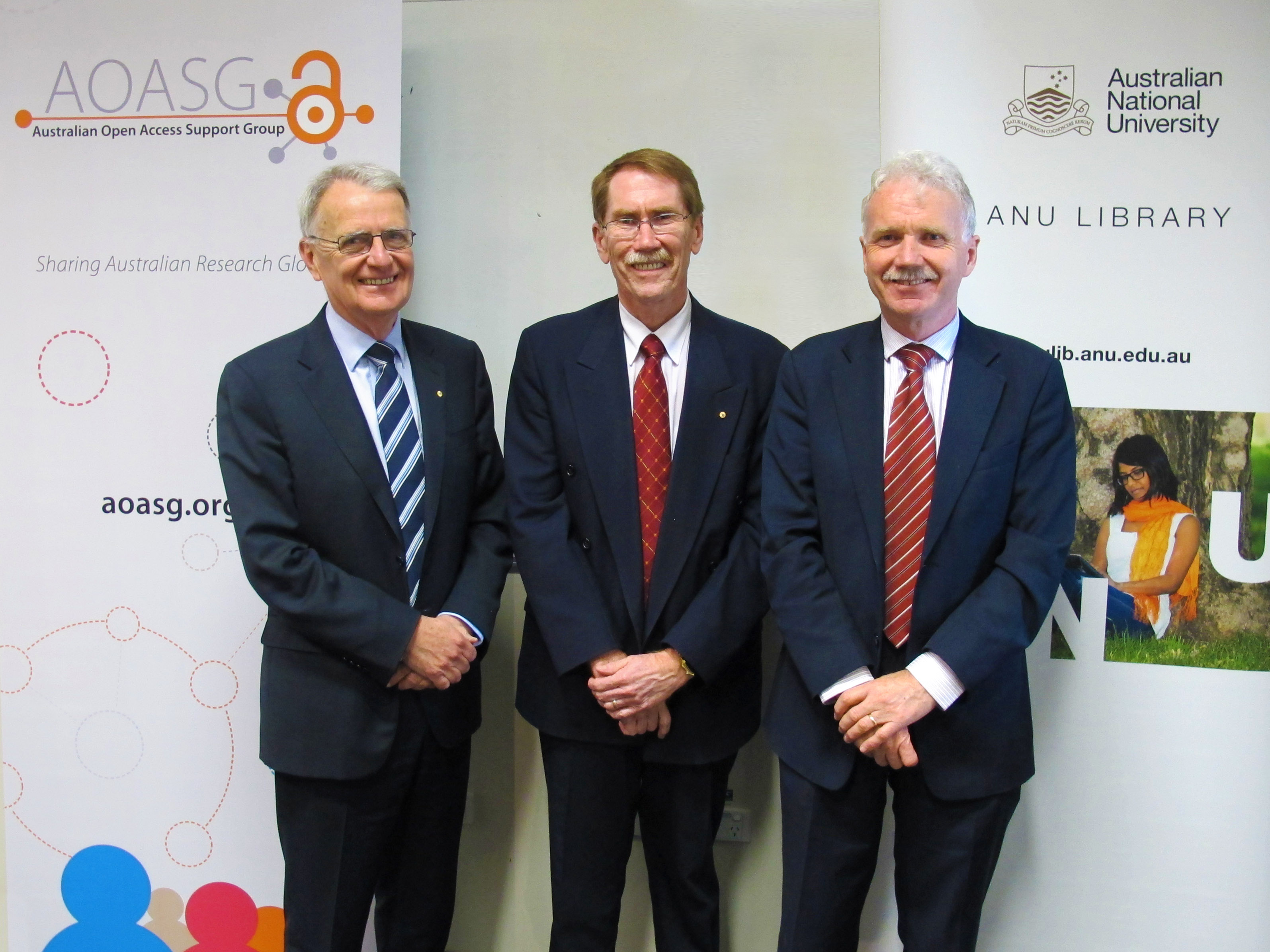
In celebration of Open Access Week, the Australian Open Access Support Group (AOASG) and the Australian National University (ANU) invited the Chief Executive Officers of the two government funding agencies to a panel discussion about their open access policies.
Professor Aidan Byrne, CEO of the Australian Research Council (ARC), and Professor Warwick Anderson, CEO of the National Health & Medical Research Council (NHMRC) spoke about their open access policies, and then participated in a Q&A session that was moderated by ANU Vice Chancellor, Professor Ian Young.
The session was recorded and is available on the ANU You Tube Channel (see below for time stamps of different parts of the recording). The slides and an audio recording are also available (note the recording goes for the whole event but there were only slides from Professor Anderson’s presentation).
Summary of the discussion
The presentations covered the broader international open access landscape and how much this has changed in the past year. Both Professor Anderson and Professor Byrne discussed how, given the speed of change in scholarly communication, it is almost impossible to know what the open access agenda will look like in five years time. For this reason, neither the NHMRC nor the ARC wish to be prescriptive about how to implement their policies.
The presentations underlined that neither policy advocates a particular method of achieving open access, or specifically requires payment for open access. However, the NHMRC considers the cost of publishing journal articles a legitimate Direct Cost of Research, and the ARC is progressively removing the caps on the percentage of research funds that can be used for publication.
One of the questions that arose was the issue of monitoring compliance to the policies. Both organisations are working on the premise that as researchers make their work open access they will see the benefit of having work available. Professor Anderson noted the NHMRC’s Research Grant Management System now allows Chief Investigators to list publications linked to grants and these will be checked next year. While there are no current plans to withhold future grants from researchers that do not comply with the policies, this could become the case into the future.
More than one researcher noted the challenges with making creative works, or culturally sensitive research freely available. Professor Byrne reiterated that these were examples of why the ARC was not expecting 100% compliance to their policy.
Time points during the recording:
(Note: 2:34 means 2 minutes and 34 seconds into the recording etc)
2:34 – Professor Anderson’s presentation on the NHMRC policy
20:24 – Professor Byrne’s presentation on the ARC policy
28:48 – Question session begins
28.54 – The first question referred to elements of image copyright in particular in the visual arts, given this is an area where people rely on the images for their livelihood
30:49 – The second person asked if there were particular things we should be doing in Australia to comply with the policies and whether we should be positioning ourselves in terms of the international context?
34:36 – This question referred to issues of monitoring compliance, and asked about the tagging proposal from CAUL for harvesting articles and where that proposal is going
40:00 – There was a statement about Australia being a leader in open access monographs
40:26 – A technical question followed about grant applications and asked how compliant researchers had to be in their applications
43:21 – This was a discussion about the dissemination of culturally sensitive research materials
46:36 – The question related to data, and noted that the policies have been shaped and informed by changed expectations of an open society but how have they been shaped and formed by processes in government to make data more open for the taxpayers?
49:01 – The question referred to the cost associated with publication, in particular when groups are disadvantaged because they do not have the resources to come up with the page charges to publish
57:40 – The final question asked about where the country is going in terms of major infrastructure for research
Case study: Implementing DSpace at Ballarat Heath Services
This blog by Gemma Siemensma, Library Manager at Ballarat Health Services describes the thinking and processes behind the introduction of their DSpace repository, the Ballarat Health Services Digital Repository.
Ballarat Health Services (BHS) is the major hospital for western Victoria. Located an hour west of Melbourne it is the principal referral centre for the Grampians region, which extends from Bacchus Marsh to the South Australian border, covering a catchment of 48,000 square kilometres, and providing services to almost 250,000 people.
Why a digital repository?
There were two reasons why we decided to head down the repository path:
- The BHS Library kept hardcopy folders of research publications. There was no access or knowledge of what hospital staff had produced except the occasional mention in an Annual Report. Using an Endnote library was not an option as the organisation doesn’t license it.
- Piles and piles of “historical stuff” was dumped in the library. People didn’t want to throw out anything of value so they kindly gave it to us. We had no idea what we had and were often asked if we had old photos etc. that were of past staff or old buildings.
I liked the idea of a repository as I could chase the copyright for researchers and make the items freely and publicly available. A repository was clearly in line with my organisation’s values as it would allow staff to be recognised as researchers and enhance the research reputation of the organisation.
Where I started…
It didn’t take me long to realise that I needed to go down the repository path. I had explored the functionality of our existing catalogue but it wouldn’t suffice. I spoke with several vendors to hear about their products and had a bit of a play with these online. For me (and my miniscule budget) the costs were extremely prohibitive. I also spoke to repository staff at universities to garner their ideas and opinions (thanks to staff at the University of Ballarat and Swinburne University of Technology whom I pestered on several occasions).
I put a call out to the aliaHEALTH e-list to see what other hospitals were doing. There were few responses however one did mention that they were heading in the same direction and were looking at using DSpace which could be hosted externally by Prosentient Systems based in Sydney. Hospital IT Departments can be restrictive and Prosentient could provide the support and training I would require. I also read lots and lots about different repositories and played around with them to see if they would suit our needs.
DSpace
We decided to use DSpace for a variety of reasons. It was a lot cheaper than other systems and Peninsula Health were also looking to head down this path so we figured we could work in tandem. DSpace (through Prosentient Systems) would come configured and hosted and they would look after the technical side. These are skills that no one is our library (EFT of 3.2) possessed at a high end level. This included helping us set up an IT sub-domain; configuring the site; Handle registration; Google analytic set up; indexing on Trove; training; and helping to test, re-test and tweak the system. It also included on-going support and maintenance which we pay for annually. We had worked with Prosentient before (they look after Gratisnet ILL system for health libraries) so we were confident in their abilities to help us. DSpace was also very popular with universities so for me it had credibility and lots of support out there which I could tap into when required.
What’s included?
Our repository is divided into two sections:
- Research – this contains published journal articles, books, book chapters, conference papers and theses. We chase copyright from publishers for all completed works. We are yet to chase authors for pre-publication versions as we are still getting a feel for how this all works. This is something we hope to do more of in 2014. We currently sit at about 20% of full text research but expect this to rise.
- Historical content – so far this includes Annual Reports from BHS. These have been scanned and indexed in Trove. In the future we aim to add in newspapers articles, photographs, internal reports and recordings.
Promotion
Before beginning the repository it was put to both the BHS & St John of God Human Research and Ethics Committee (HREC) and the BHS Research Advisory Committee to garner support. Both were keen to see the repository implemented as it highlighted what research was undertaken within BHS and the region. The repository was also added to organisation wide policies. This included the “Rules for Publication/Presentation” policy as well as embedding it in HREC documentation. Each year BHS hold a Research Symposium and I am asked to speak about where we are up to and encourage people to deposit works into the repository. I also promote the repository in the internal staff newsletter. There is also the possibility for external promotion in the local newspaper in relation to the historical documents. The historical components also open up opportunities to work with local historical groups, the research room at the local public library and other local archives.
Response
The BHS Digital Repository has just ticked over its first birthday. In that time we have managed to add just over 400 items. Three-quarters of these relate to research and we have many more to add. The researchers we worked closely with in the initial stages of the project are very keen to alert us to new publications and we are finding that when we approach staff about publications they are happy to give us a list of all their work for inclusion.
Library value
In its vision to provide excellence in health care, BHS is strongly committed to the values of research, continuing education and collaboration with other service providers and is committed to sharing its knowledge and experiences to build a better health system. The BHS Library supports these values through a number of library initiatives (literature searching; database training; electronic journals and books etc.)
Over the last three years, the majority of health libraries have remained static or experienced a decrease in their budget, staff hours and space. As a manager I know that I need the library to add value to the organisation for them to recognise that we are a resource worth keeping. I feel that implementing a repository has done this. Not only has it shown us that we have transferable skills, but it has opened up professional visibility for both the organisation and the library. We communicate more widely across the organisation and in doing so are promoting the library and showing staff that we are more than just books. When we talk to researchers it puts the library in their head space and they approach us more frequently for help. It’s a win-win situation.
Gemma Siemensma
Library Manager
gemmas@bhs.org.au
This is a version of a paper being presented at the 10th HLi conference: #vital on October 18th 2013
BIS Report part two – Information & observations
The BIS report Open Access: Fifth Report of Session 2013–14 was heavily researched and offers a wide-ranging insight into the current state of open access. This blog cherry picks some of the useful aspects of the report with additional commentary if relevant.
This blog is the second of two looking at the BIS Report. The other – “BIS Report part one: Finding & implications” – is available here.
The blog covers under the headings: Supporting arguments for open access, Amount of research being made available, and Does green open access threaten subscriptions?
We would like to note that the AOASG has had some (indirect) input to the BIS report. The report referred to “reports of a UK publisher in social sciences switching from a zero embargo policy to require a 24 month embargo, citing its accordance with the recent change to UK open access policy” (par 46).
That evidence was the Richard Poynder article ‘Emerald’s green starts to fade‘ which in turn was triggered by the AOASG blog ‘Walking in quicksand keeping up with copyright agreements’ Heady days indeed.
Supporting arguments for open access
The report contains some useful information that could be employed in various discussions around open access.
The first was the statement that public funds are used three times in the research process:
• “to pay the academics who conduct the research
• to pay the salaries of the academics who conduct the peer review process, and finally
• to pay for access to this research through institutional journal subscriptions, which is the dominant business model in the scholarly publishing market”. (par 12)
There is also a very useful graph comparing the growth of serials expenditure mapped against the consumer price index from 1986 – 2010:
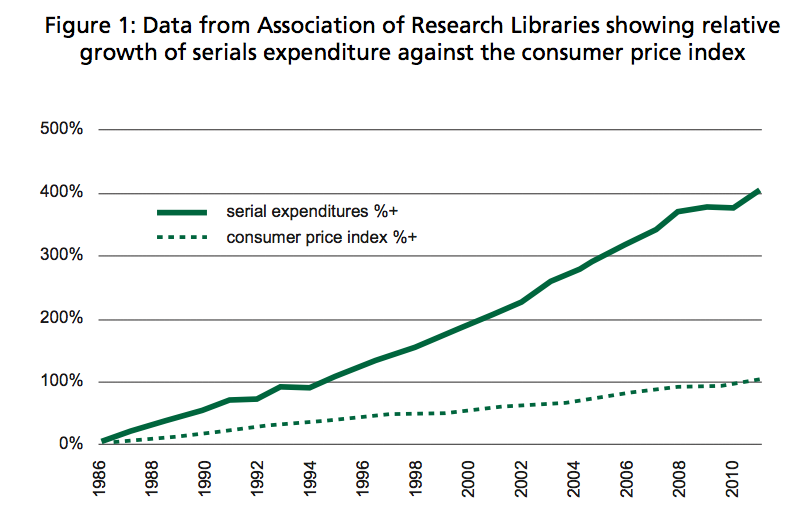
Given the concern that the money being invested by the government in research is being diverted into publisher profits, the report notes the increase in Elsevier’s profit margin, which was 34% at the time of the original 2004 House of Commons Science and Technology Committee Report on open access. It was 37% by the time of this BIS report. (par 15)
Amount of research being made available
There were some interesting facts and figures relating to the percentage of work available open access in the UK.
The first fact was that compared to a worldwide average of 20% of research available open access, “the proportion of the UK’s total annual research output that was available through open access in 2012 was about 40%” (par 20).
COMMENT: This is excellent for the UK. We do not have comparative information in Australia, although we are working on a method for determining this. Currently there is information collected that indicates the total number of items that are available, but this does not answer the question: ‘what percentage of work published in the previous year is available in a repository open access the following year’.
Even more illuminating was the fact that “Green currently provides seven-eighths of the 40% of the UK’s research outputs that are open access” (par 22).
COMMENT: This is very interesting. We have known for a while that more research is being made available open access thro ugh green rather than gold open access – the 2010 Bjork study concluded 11.9% of research is available through green as opposed to 8.5% via gold http://www.plosone.org/article/info:doi/10.1371/journal.pone.0011273. That study showed that of the work being made available open access 58% was through green open access.
The BIS report is stating that 87.5% of UK research is being made available in this manner. It also states that the Committee: “received strong evidence that Green is dominant internationally, with the latest data showing that Green accounts for about 75% of all open access worldwide” (par 33). This is a dramatic and impressive endorsement for the efficiency of green open access.
Note the UK numbers are dwarfed by the “University of Liège in Belgium (collecting 83% of its annual outputs in its OA repository)” (par26). This is because the university has directly aligned open access to their promotion system. The report noted that compliance with mandates is higher if it is “a condition of funding compliance and if deposit is linked to institutional performance evaluation, research grant applications and research assessment” (par 26).
Does green open access threaten subscriptions?
Far from threatening subscriptions, it might be the case that having work in a repository acts as a promotional tool for the subscription journal: “The €4 million EU funded PEER (Publishing and the Ecology of European Research) project (2012) showed that traffic to journal websites increased when articles were made available through a publicly accessible repository, possibly because interest grew as articles were disseminated more widely” (par 44).
The BIS report noted that “there is no available evidence base to indicate that short or even zero embargoes cause cancellation of subscriptions” (par 44).
COMMENT: Indeed, the only ‘evidence’ to support the claim that immediate green open access threatens the ‘sustainability’ (read: profit) of commercial publishers comes in the form of the exceptionally questionable ALPSP survey sent out early last year to librarians http://www.publishingresearch.net/documents/ALPSPPApotentialresultsofsixmonthembargofv.pdf . Heather Morrison wrote a piece on the methodological flaws with that survey http://poeticeconomics.blogspot.com.au/2012/06/publishers-association-survey-on.html
And yet, when questioned earlier this year by Richard Poynder, this is what Springer referred to as their ‘evidence’.
There are, however currently two clear opportunities for the industry to collect some actual evidence either way (as opposed to opinions on a badly expressed hypothetical):
1. Taylor & Francis have decided to indefinitely expand their trial of immediate green permissions to articles in their Library & Information Science journals. If they were to run a comparison of those titles against the titles in, say , three other disciplinary areas over two to three years they would be able to ascertain if this decision has made any difference to their subscription patterns.
2. Earlier this year (21 March) SAGE changed their policy to immediate green open access – again this offers a clean comparison between their subscription levels prior to and after the implementation of this policy.
If it is the case that immediate green open access disrupts subscriptions then we can have that conversation when the evidence presents itself. Until then we are boxing at shadows.
Dr Danny Kingsley
Executive Officer
Australian Open Access Support Group
 Australasian Open Access Strategy Group