CAUL and AOASG welcome open access to scholarly content during the COVID-19 pandemic

A joint statement from CAUL & AOASG

The COVID-19 pandemic is highlighting the crucial role that free, open and immediate access to research plays in combating this threat to human life, society and our way of life.

CAUL and AOASG welcome moves by commercial publishers to open up their content at this critical time. The rapid development of tests, potential treatments and vaccines to clinical trials has been made possible by the frictionless and immediate sharing of new and early stage research and data by researchers and access to previously paywalled content being provided by publishers.

The speed with which many publishers have enabled open access to COVID-19 related content is commendable, and some have also taken the significant step of relaxing access restrictions to content more generally.

It also demonstrates that open access to research should be the new norm.  The time has come to make free and open access to all research a reality. It is critical that once the pandemic is over, in order to accelerate the global transition to free and open access, publishers do not once again restrict access to COVID-19 content. This will be especially crucial in light of the economic challenges all sectors of society will be facing, including universities dealing with constrained scholarly content budgets.

Therefore, we urge publishers to make a commitment to:

  • Ongoing open access to COVID-19 related research publications and data  – the 2002-2004 SARS epidemic, the 2010-11 Christchurch earthquakes in New Zealand and the 2014-2016 Ebola epidemic has shown that access to this critical research has not been long term. There exists now an opportunity for this to change for the better.
  • FAIR terms of use – the terms under which most research is being made free and open access in the current crisis is unclear and this means that it could be withdrawn at any time. There is also a significant difference between ‘free to read’ and free to use and reuse. We encourage publishers to make the research available according to FAIR principles enabling research to be Findable, Accessible, Interoperable and Reusable, ideally with an associated Creative Commons open licence.
  • Seamless open access to scholarly content – the most effective way to do this is to make content openly available at the publisher’s site. However, the current requirement for many libraries to negotiate access on a case by case basis is adding unnecessary logistical and administrative burdens.

It is crucial that the advances gained from sharing of information at this difficult time are not lost once the emergency is over. An open scholarly publishing environment that ensures FAIR and seamless sharing, access and use of research and data will put humanity in the strongest possible position to face future global challenges.

Download a copy of the media release (PDF)

For comment:

Jill Benn, President of CAUL, caul@caul.edu.au, (02) 6125 2990 &
Virginia Barbour, Director AOASG, eo@aoasg.org.au 07 3138 0623

In OA, local news trumps international

With more than 750 individual and many more institutional subscribers here at the AOASG we feel we have a pretty good idea about what sort of news piques the interest of our regular AOASG newsletter readers.

Looking at our readership stats, it’s comforting that our most frequently clicked links are those in the Australia & New Zealand news section. Given the global nature of open access, this level of engagement on the local scale warms the cockles of our hearts. Also noteworthy is that the newsletter is increasingly being read by those outside university sector which shows how Open Access is becoming a matter of public interest in the wider community.

Of much interest to readers (11.8% of all clicks) in our most recent newsletter was an Open Access ‘cookbook’ – Engaging Researchers with Data Management. This freely available online book is a collection of case studies from around the world showing how to engage researchers with managing their data. We hope that by sharing these types of resources, as well as the blogs and scholarly writing we are reading, we can continue to keep the scholarly community informed. Australia is by far the most common location for our newsletter readership with around 81% of all readers, then the US with around 7%, New Zealand with 5%, the UK 2.5% and Switzerland with around 1%.

Those who do read the newsletter will be aware that we cover Open Access news from around the globe, and over past 18 months have provided a regular section on the Plan S initiative, along with our other areas of interest including Preprints, Reports, Data & upcoming Conferences. If there is any other news you think we should be covering, we would love your feedback is appreciated so please contact us. And if you don’t subscribe to the newsletter already, you can sign up here.

OPEN ACCESS FOR PUBLIC HEALTH


By Mandy Henk, CEO Tohatoha (AOASG affiliate member)

I’m writing this as the medical and scientific community are working toward creating the knowledge we need to face a serious global public health emergency.

Unfortunately, as the number of cases of the novel coronavirus in China (COVID-19) rises, so has the spread of misinformation, disinformation, and confusion. As a community of people who care about sharing information, this is a time for us to step forward and work towards doing our bit to promote the spread of accurate and useful knowledge over false news designed to encourage hate, racism, and chaos. I wish you all the best as you work within your communities to educate and share the knowledge that will keep us all healthy and well.

But it’s also a time for us to rejoice in the realisation of the benefits of open access to scholarship and data. Open access is so crucial in times like these. Accurate, widely available information is how we will work together to make each other safe and healthy.

Leading on this is the Wellcome Trust and the 91 signatories have committed to ensure wide access to scientific and medical knowledge during this public emergency. Specifically, they have committed to work together to help ensure:

  • All peer-reviewed research publications relevant to the outbreak are made immediately open access, or freely available at least for the duration of the outbreak
  • Research findings relevant to the outbreak are shared immediately with the WHO upon journal submission, by the journal and with author knowledge
  • Research findings are made available via preprint servers before journal publication, or via platforms that make papers openly accessible before peer review, with clear statements regarding the availability of underlying data
  • Researchers share interim and final research data relating to the outbreak, together with protocols and standards used to collect the data, as rapidly and widely as possible – including with public health and research communities and the WHO
  • Authors are clear that data or preprints shared ahead of submission will not pre-empt its publication in these journals

Open access communities can take real pride in our work today. Knowledge matters and sharing matters. The groundwork that we have laid is helping make the world a better place. We deserve a pat on our collective backs.

Please stay well and remember to look after those who are targets of hate and racism during this crisis. As the Director General of the World Health Organisation put it, “This is the time for facts, not fear. This is the time for science, not rumours. This is the time for solidarity, not stigma.”

Let’s hope the rest of 2020 brings more sharing, more knowledge, and most of all, solidarity and care for each other.

This blog originally appeared in the Tohatoha newsletter

OA Week success continues

While much of our International Open Access Week activities have concluded here in Oz, our New Zealand cousins are continuing through November with more activities and advocacy.  This year’s theme of Open for Whom?  Equity in Open Knowledge has been the focus of many university activities with guest lectures, roadshows, workshops, and the creation of resources for academics and researchers the chief ways of getting the Open = Equity message across.

In October, Tohatoha launched a campaign for greater openness, sharing, and equity in the digital world, including open access and open reuse of government, scholarly, and scientific knowledge.  CEO Mandy Henk presented at the annual internet community talkfest NetHui, and spoke on Radio NZ’s afternoon program, and this week she spread the good OA word on 95bFM about democratising our digital world.  This was a great complement to the OA work of CONZUL.  Massey University live streamed a presentation:  Open Knowledge mātauranga Māori: contradictory or consistent and  the University of Otago ran a series of blogs around citation advantage for open access articles,  and the importance of depositing manuscripts in open repositories.

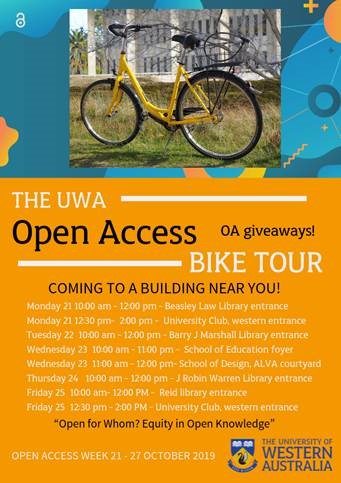
uwabikeOAweek

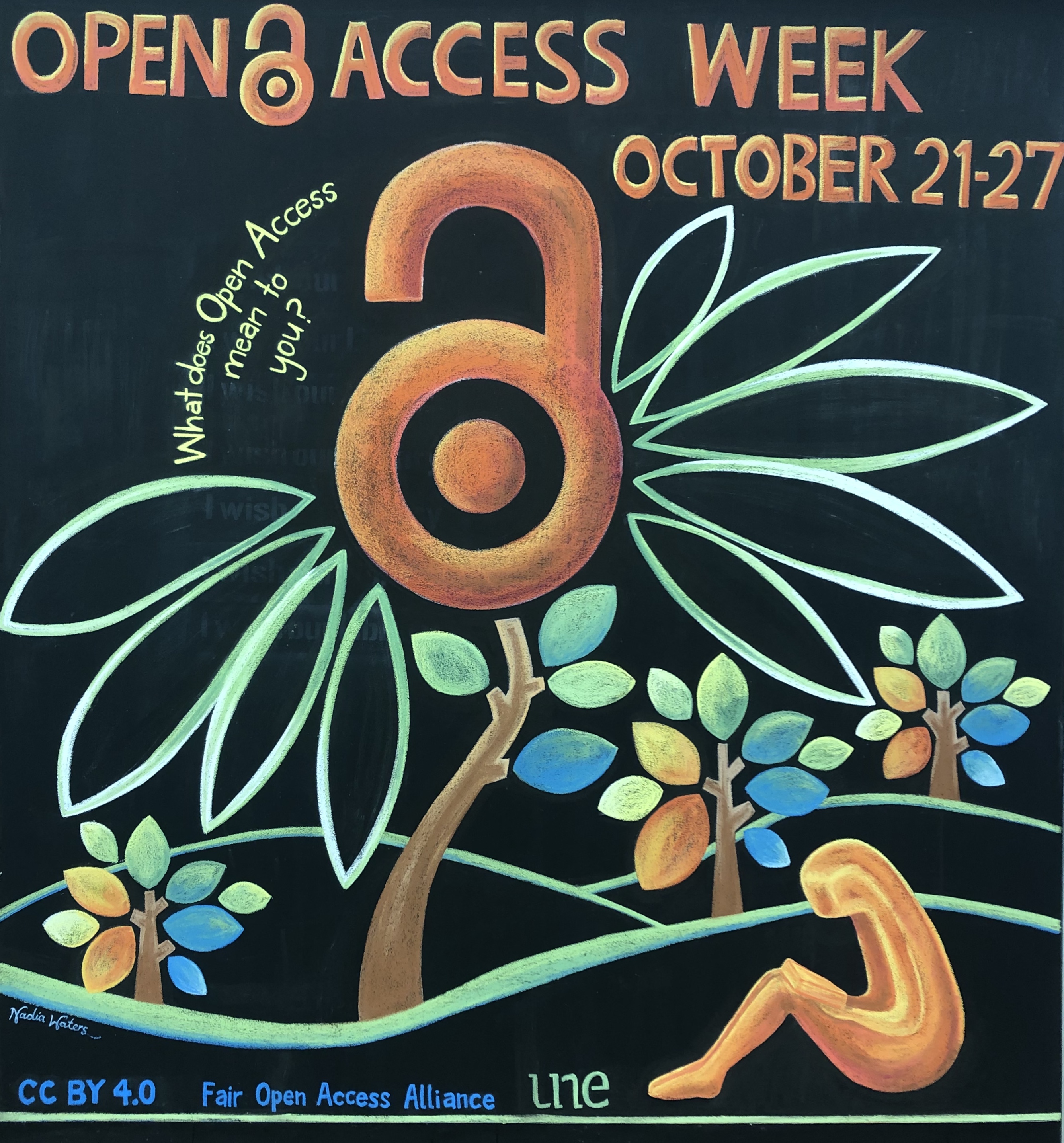
Some of our favourite activities in Oz have been the commissioned chalk art work by Armidale artist Nadia Waters at the University of New England (UNE) library, and its race to 100 challenge to get 100 new Open Access outputs into its RUNE repository during October.  University of Western Australia got on its bike with a pedal-powered tour with stops around campus everyday with OA giveaways.   Southern Cross University library ran a panel on Access and Indigenous Knowledge.  QUT and the University of Newcastle each ran a series of “Five things about Open Access” blogs.   La Trobe University ran a series of events, including a tweet chat on OA and activism. Charles Sturt and Flinders ran Open Access workshops for staff and researchers.  James Cook University created two great videos of academics advocating for Open Access.

une_oa2019chalkboard_nadiawaters

Last chance to comment – Hong Kong Principles for Assessing Researchers: Fostering Research Integrity

You are invited to comment on the third draft of “The Hong Kong Principles for Assessing Researchers: Fostering Research Integrity” posted on the conference website here

Please send your feedback by completing the feedback form and returning it to Dr David Moher (dmoher@ohri.ca) by September 13, 2019.  

“Open for Whom? Equity in Open Knowledge”: Open Access Week 2019

Re-post from Nick Shockey (SPARC) on behalf of the 2019 Open Access Week Advisory Committee

As the transition to a system for sharing knowledge that is open by default accelerates, the question “open for whom?” is essential—both to consider and to act upon. Whose interests are being prioritized in the actions we take and in the platforms that we support? Whose voices are excluded? Are underrepresented groups included as full partners from the beginning? Are we supporting not only open access but also equitable participation in research communication? These questions will determine the extent to which emerging open systems for research will address inequities in the current system or replicate and reinforce them.

This year’s theme will build on the groundwork laid last year when discussions focused on “Designing Equitable Foundations for Open Knowledge.” The 2018 theme highlighted the importance of making a central commitment to equity as we transition toward new systems for sharing knowledge, and the past twelve months have only seen the pace of that transition increase. Because of this, the Open Access Week Advisory Committee decided it was important to focus on equity again in 2019—to deepen our conversations about being inclusive by design and to turn those conversations into action.

We find ourselves at a critical moment. The decisions we make now—individually and collectively—will fundamentally shape the future for many years to come. As open becomes the default, all stakeholders must be intentional about designing these new, open systems to ensure that they are inclusive, equitable, and truly serve the needs of a diverse global community. Asking ourselves and our partners “open for whom?” will help ensure that considerations of equity become and remain central in this period of transition.

Established by SPARC and partners in the student community in 2008, International Open Access Week is an opportunity to take action in making openness the default for research—to raise the visibility of scholarship, accelerate research, and turn breakthroughs into better lives. This year’s Open Access Week will be held from October 21st through the 27th; however, those celebrating the week are encouraged to schedule local events whenever is most suitable during the year and to utilize themes that are most effective locally.

The global, distributed nature of Open Access Week will again play a particularly important role in this year’s theme. Strategies and structures for opening knowledge must be co-designed in and with the communities they serve—especially those that are often marginalized or excluded from these discussions altogether.

International Open Access Week is an important opportunity to catalyze new conversations, create connections across and between communities that can facilitate this co-design, and advance progress to build more equitable foundations for opening knowledge—discussion and action that must continue throughout the year, year in and year out. Diversity, equity, and inclusion must be prioritized year-round and integrated into the fabric of the open community, from how our infrastructure is built to how we organize community events.

For more information about International Open Access Week, please visit www.openaccessweek.org. The official twitter hashtag for the week is #OAWeek, and we encourage those having discussions around this year’s theme in the lead up to the week to use the hashtag #OpenForWhom.

Graphics for this year’s Open Access Week theme are available at http://www.openaccessweek.org/page/graphics

About SPARC
SPARC®, the Scholarly Publishing and Academic Resources Coalition, is a global coalition committed to making Open the default for research and education. SPARC empowers people to solve big problems and make new discoveries through the adoption of policies and practices that advance Open Access, Open Data, and Open Education. Learn more at sparcopen.org.

About International Open Access Week
International Open Access Week is a global, community-driven week of action to open up access to research. The event is celebrated by individuals, institutions and organizations across the world, and its organization is led by a global advisory committee. The official hashtag of Open Access Week is #OAweek.

Global Open Infrastructure Initiative launched

The AOASG welcomes, and is thrilled to be a part of this exciting new global initiative Invest In Open Infrastructure.

We have been vocal in calling for the need for infrastructure for open scholarship including following the Australian Federal Budget and ahead of the recent Australian election and we hope that this new initiative will provide a further global push for open infrastructure. Workshops and webinars on this initiative are listed here – the first on May 28.


Invest In Open Infrastructure (IOI) is a global initiative to increase the availability and sustainability of open knowledge infrastructure.

The needs of today’s diverse scholarly communities are not being met by the existing largely uncoordinated scholarly infrastructure, which is dominated by vendor products that take ownership of the scholarly process and data without appropriate governance and oversight from the communities they serve. We imagine a world in which communities of researchers, scholars, and knowledge workers across the globe are fully enabled to share, discover, and collaborate using tools and platforms that are designed to interoperate and complement one another rather than compete and exclude.

IOI will consist of two functions, one is an assessment and recommendation framework that will regularly survey the landscape of open scholarly infrastructure with respect to its functionality, usage, health and financial needs and make funding recommendations for that infrastructure.

IOI’s second function will coordinate funds to follow the recommendations of the framework. Coordinating financial resources from institutions, agencies and foundations, we will work to increase the overall funding available to emerging and critical infrastructure.

IOI grew out of last year’s Joint Roadmap for Open Scholarly Tools (JROST) and within the context of Plan S, the European Open Science Cloud, the US NAS Open Science by Design effort, SCOSS, AmeliCA, and the UC Declaration of Rights and Principles to Transform Scholarly Communication. It’s clear that while the advances of digital scholarship have resulted in many benefits, that scientists and scholars who generally work in the public interest have a need for more open infrastructure which mirrors their social focus.

As Geoffrey Bilder, Jennifer Lin and Cameron Neylon put it in 2015: “Everything we have gained by opening content and data will be under threat if we allow the enclosure of scholarly infrastructures.”

IOI is a collaboration between many, including the Joint Roadmap for Open Scholarly Tools (JROST), SPARC Europe, SPARC, Mapping the Scholarly Communication Infrastructure, Open Research Funders Group (ORFG), OPERAS, and the Open Platforms Group.

IoI’s steering committee includes Ginny Barbour (Australasian Open Access Strategy Group), Arianna Becerril (Universidad Autónoma del Estado de México), Leslie Chan (University of Toronto Scarborough), Raym Crow (SPARC), Peg Fowler (Hypothesis), Heather Joseph (SPARC), Pierre Mounier (OPERAS), Cameron Neylon (Curtin Univ), David Lewis (Mapping the Scholarly Communications Infrastructure), Lucy Ofiesh (Center for Open Science), Vanessa Proudman (SPARC Europe), Kristen Ratan (Coko Foundation), Danielle Robinson (Code for Science and Society), Mike Roy (Middlebury College), Katherine Skinner (Educopia), Ina Smith (Academy of Science of South Africa), Greg Tananbaum (Open Research Funders Group), Evviva Weinraub (Northwestern), Dan Whaley (Hypothesis), and Maurice York (University of Michigan).

This is the beginning of a process for which community feedback, a truly global perspective, and participation by all stakeholders will be critical to its success.

With this announcement, IOI:

As next steps we will be securing funding to support several leadership positions, and will be recruiting in both Europe, the United States and beyond. Prospective candidates or those with recommendations should email info@investinopen.org.

We appreciate the various voices who have shared their perspective about this effort:

Chris Bourg, Director of Libraries, MIT

“With the right infrastructure, created and sustained by and for the scholarly community, we have the potential to fully unleash our cumulative knowledge on solving the world’s greatest challenges and addressing growing information inequality. Global, collective investment in open community owned infrastructure is essential to the future of open science.

Creating a future where ‘enduring, abundant, equitable, and meaningful access to information serves to empower and inspire humanity’ (our vision at MIT Libraries) requires global collaboration and new means of collective investment in infrastructure that reflects and supports the values we hold dear in academia and knowledge-producing communities everywhere.”

Dr. Virginia Barbour, Director Australasian Open Access Strategy Group (AOASG)

“The Australasian Open Access Strategy Group recognises the critical need for sustainable, open infrastructure to support open scholarship. The increasing consolidation of scholarly infrastructure in the hands of commercial organisations poses a substantial threat to the future of open scholarship and its transformative potential, and risks mirroring the position we currently see in the ownership of journals. We therefore welcome the formation of the Invest In Open Infrastructure initiative, supports its aims and look forward to collaborating in future.”

Professor Etienne Ehouan Ehile, Secretary General of the Association of African Universities

“The African Higher Education Institutions and the communities of researchers, scholars, and other global knowledge workers need products, tools and infrastructure to fully enable them to share, discover, and work together. The ownership of the scholarly process and data must remain with the researchers who produce it. The Association of African Universities supports the creation of open infrastructure systems to enable research and knowledge communities to work in more integrated, collaborative and strategic ways.”

David Prosser, Executive Director, RLUK (Research Libraries United Kingdom)

“In the UK we have long recognised the value of open infrastructure for open scholarship — for example, though our long-term funding of resources such as the SHERPA/RoMEO database or Directory of Open Access Journals. However, we also recognise the challenges in building and maintaining these resources in a sustainable manner. As UK funders further refine their open access policies having signed Plan S, open infrastructure becomes ever more important for our authors and institutions. We therefore very much welcome further coordinated efforts to provide the basic underpinnings of a fair and equitable open system of scholarly communications.”

Karina Batthyány, CLACSO’s Executive Secretary, and Dominique Babini, CLACSO’s Open Access Advisor

“The Latin American Council of Social Sciences (CLACSO) — a network of 680 research institutions in 52 countries — welcomes and congratulates the Invest in Open Infrastructure (IOI) initiative. In Latin America, where research and scholarly communications are mainly publicly-funded, community-led, free to read and publish, and has active regional open infrastructures, there is a strong need for international coordination to raise our governments awareness of the need of public investment in open science/open access/open evaluation indicators infrastructures. And global collective investment is needed to strengthen the existing regional initiatives in our region to adapt its infrastructure and procedures to comply with growing demands of open science and evaluation review, and to be able to contribute to the advancement of community-controlled open science infrastructure worldwide.”

David W. Lewis, Dean Emeritus of the IUPUI University Library

“Digital technology, if it is open, has the potential to make the results of research and scholarship freely and easily available to everyone anywhere who wishes to use them. To make this possible requires an open infrastructure to support the discovery, access, evaluation, and preservation of research results. Today the available open infrastructure is underfunded and uncoordinated. It is simply not up to the task. It requires more and wiser investment. This is what the IOI initiative seeks to provide. It is a critical step in creating the system of scholarly communication the world, with all the challenges we face, needs.”

Cameron Neylon, Co-author of the Principles for Open Scholarly Infrastructures

“Infrastructure can be the great leveller. This was our core motivation in writing the Principles, that infrastructure built by the community, for the community, and with broader communities has the potential to solve existing problems, enable new classes of solution, and most importantly create value that is harnessed by the community and stays within it. The IOI initiative is a step towards reshaping what we are capable of in scholarly communications, by enabling the maintenance and building of platforms that enhance our collective capacity to build knowledge.”


There will be a webinar on

Joint CAUL-AOASG Election Statement: Developing a strategic approach to open scholarship in Australia

Australia needs a national strategy for open scholarship.

We are at a stalemate in improving access to scholarly research because of the tension between the needs of research institutions, which want to disseminate their research outputs as widely as possible, and commercial publishers, who dominate academic publishing, and who primarily serve the needs of their shareholders.

Australian universities alone pay more than $280 million each year for access to academic research publications, yet that access is limited to only those who work in universities. In the 2018 Excellence for Research Australia (ERA) exercise universities reported that only 32% of articles submitted for ERA evaluation are openly available.

The Council of Australian University Librarians (CAUL) and the Australasian Open Access Strategy Group (AOASG), which are led by experts in access to knowledge, have been advocating for many years for open scholarship: making the outputs of publicly-funded Australian research openly available in alignment with the F.A.I.R. (Findable, Accessible, Interoperable, Reusable) principles to ensure that anyone can find, read, use and reuse research outputs.

Widening access to academic research increases opportunities for collaboration among researchers[1] and industry, especially internationally; increases the pace of discovery[2]; increases the trust of the public and their engagement with research; and supports a stronger evidence base for the development of policy[3].

Over the past ten years Australia has gone from being a world leader in widening access to research outputs, mainly through the establishment of a national set of institutional repositories, to lagging behind international initiatives in open scholarship policies and practices.

Plan S, a relatively new initiative, initially from a European-led coalition but now global in scope, intends to make research from coalition partners open by 2020. Plan S offers the opportunity to catalyse a discussion on how Australia can match the rest of the world — a discussion that would involve Australian researchers, research funders, industry partners, government and academic publishers.

A re-invigorated commitment to open scholarship will help ensure that Australian researchers can continue to collaborate with international colleagues, access international funding programs, and contribute to major global projects.

To achieve these goals, Australia needs a national strategy for open scholarship.

In its 2018 inquiry into the Australian Government Funding Arrangements for non-NHMRC Research, the House of Representatives Standing Committee on Employment, Education and Training recommended “that the Australian Government develop a more strategic approach to Australia’s open scholarship environment”. CAUL and AOASG supported this recommendation[4].

It is now time to implement that approach through the establishment of a cross-sectoral body charged with developing and implementing, within three years, a national action plan for open scholarship – a plan that would include recommendations on changes to the policy and funding framework for Australian higher education. Open scholarship should also be included in the terms of reference for any post-election reviews or inquiries on Australian higher education and research.

Achieving fair and open access to Australian research outputs would be a realistic and significant accomplishment for a new or re-appointed Minister after the election, and a priority for government. CAUL and the AOASG are ready to offer their experience, expertise and knowledge to the goal of open scholarship.

More information on open scholarship, the F.A.I.R. principles, and CAUL and AOASG can be found in our joint background briefing.

[1] http://opensourcemalaria.org/

[2] https://wellcome.ac.uk/funding/guidance/open-access-policy

[3] https://apo.org.au/

[4] https://www.caul.edu.au/sites/default/files/documents/media/open-scholarship2018joint-statement.pdf

caul aoasg

Support Academic Publishing Day on February 7th

Academic-Led Publishing Day is a global digital event to foster discussions about how members of the scholarly community can develop and support academic-led publishing initiatives. Academic-Led publishing refers to scholarly publishing initiatives wherein one or more academic organisations control decisions pertaining to copyright, distribution, and publishing infrastructure.

Its aim is to create an open dialogue about academic-led publishing programs and funding models – both current and potential – and to raise awareness about the roles and capabilities of different stakeholders in this space.

Many Australian and New Zealand Universities publish journals under these principles, for example Queensland University of Technology’s eJournals and Auckland University of Technology’s Tuwhera.

How to get involved

Join the Public Forum for scholarly publishing reform towards Fair Open Access

Follow updates from the Open Access Tracking Project (OATP) and volunteer to help tag relevant news items. Click “About” at the top of the page to learn how to get involved!

Show public support for Fair Open Access Principles

Learn how to launch and support academic-led journals.

Sign public statement against author-facing charges by journals

Open Access Scholarly Publishers Association (OASPA) is hosting a free webinar on February 7th at 3pm GMT – while it’s not a sleep friendly time for those of us in the Southern Hemisphere – presenters include world experts at the forefront of publishing initiatives that promote Open Access and Open Scholarship at institutions:

Paul Ayris – Chief Executive UCL Press

Kathleen Shearer –  Executive Director of Confederation of Open Access Repositories

Charles Watkinson – Director, University of Michigan Press).

Catriona MacCallum Director of Open Science, Hindawi

Claire Redhead – Executive Director, OASPA (will chair the discussion).

Full details and information on how to register for the webinar can be found here.

#ALPubDay