AOASG response to Productivity Commission Intellectual Property Arrangements, Draft report

aoasgAOASG response to Productivity Commission Intellectual Property Arrangements, Draft report

Prepared by Dr Virginia Barbour, Executive Director, on behalf of the Australasian Open Access Strategy Group, (AOASG), June 2, 2016

General comments

The AOASG (https://aoasg.org.au/) welcomes the Productivity Commission report. We limit our response to Chapter 15: IP and Public Institutions, though we note the comment on p4 that “Open access repositories can further assist in the dissemination of ideas generated through publicly‑funded initiatives.”, which we agree with for all outputs of research.

We particularly welcome:

DRAFT Recommendation 15.1

“All Australian, and State and Territory Governments should implement an open access policy for publiclyfunded research

We also believe there is an opportunity with this report to bring some clarity to the issues surrounding copyright and license as applied to research outputs.

Specific comments

Page 401

Paragraph entitled “Key points”

Response

The dissemination of research findings does not have to be limited by IP applied on the work that it reports.

We agree that journals remain an important mechanism of dissemination, but they are now just one part of a rapidly evolving ecosystem of publishing and the same issues apply to all outlets for dissemination of research, and which include not just research articles but also data, code, software, etc.

Copyright per se does not limit dissemination – it is the retention of copyright, coupled with restrictive licenses as applied by subscription publishers that limit dissemination. We feel it is essential to separate out these two issues.

Page 404

Paragraph beginning “The key relevant questions for this inquiry relate to:

  • where the IP system frustrates the achievement of the underlying goal for public funding
  • changes to the IP system that would accentuate the benefits of such public funding.

Response

For scholarly publishing we already have the tools to hand to ensure that authors retain rights to and get credit for their work while allowing for maximum dissemination. The two tools required are proper application of copyright in conjunction with Creative Commons Licenses.

However, the current inconsistent and largely publisher-driven application of these tools does “frustrate the achievement of the underlying goal for public funding”.

This is to be expected when publishers are operating under a subscription model. In this situation the long term practice has been to require the transfer of copyright to journals, and also require that restrictive licenses agreements are signed.

However, restriction of author rights is not now limited to subscription publications.  For articles that are apparently open access, Elsevier, for example, requires that authors grant Elsevier an exclusive license (https://www.elsevier.com/about/company-information/policies/copyright) to publish for article published under a CC BY license (intended to be the most liberal of the licenses). This is direct contradiction of both the spirit and the letter of the Creative Commons license (http://creativecommons.org/licenses/by/4.0/).

Furthermore, a number of publishers are seeking to assert rights over earlier versions of articles, an area where they have no jurisdiction. Rights being asserted include requirements for citation of articles to which a preprint may relate http://media.wiley.com/assets/7320/85/eOAA-CC-BY_sample_2015.pdf). This is an example of a meaningless and probably unenforceable requirement, but which may nonetheless have a stifling effect on authors seeking to share research before formal publication.

Page 405

Paragraph beginning “A major mechanism for diffusion of ideas is through academic journals”

Response

The models of dissemination of scholarly outputs are changing very substantially and though journals remain at the core, as above we note that there are other important mechanisms now such as preprint servers, repositories (for data as well as for research manuscripts) etc. Despite the diverse array of outputs and their routes of dissemination the issue in relation to IP are largely the same.

  • Copyright needs to remain with the generators of the work (if work is not owned by the Government or is otherwise in the public domain);
  • Generators of work must be credited for that work;
  • Licenses applied to the work should maximize its discoverability, dissemination and reuse.

Copyright does not per se limit reuse, but it will do if coupled with restrictive licenses. For example, an author may retain copyright but grant an exclusive license to a journal which could then restrict reuse (see above); conversely an author may assign copyright to another body (e.g. their institution) but if that is coupled with a non-exclusive license that allows reuse, dissemination is not impeded.

We therefore suggest that the Commission separates out the issues of copyright and licenses and makes the following recommendations

  1. Authors (or their institutions) should retain copyright to research outputs.
  2. Outputs should be licensed under the most appropriate, usually the least restrictive, internationally accepted license from Creative Commons, preferably CC BY.
  3. Publisher-specific licenses, even supposedly “open access” ones such as those from Elsevier (https://www.elsevier.com/about/company-information/policies/open-access-licenses/elsevier-user-license), should not be supported as they lead to further confusion.
  4. These terms should apply to all research outputs wherever they are stored and wherever they are in the lifecycle of the research including but not limited to; preprint, author’s accepted manuscript, published article, data etc.

Page 406

Page beginning Copyright for publically funded research

Response

We believe copyright over research articles should not be mixed up with IP rights over the subject of the research itself. In particular, copyright itself, whether held by authors or publishers, does not limit the visibility or accessibility or reusability of articles or associated data. What does limit accessibility and reusability is the license associated with those works (see above) and which was previously most commonly denoted as “All rights reserved”

With the technology now available to us, the role of copyright has changed. As Jan Velterop said in 2005, (http://www.budapestopenaccessinitiative.org/pdf/open_access_publishing_and_scholarly_societies.pdf) “copyright can [now] be used for what it is meant to in science, not to make the articles artificially scarce and in the process restrict their distribution, but instead, to ensure that their potential for maximum possible dissemination can be realised”

Page 407

Paragraph beginning “universities and some publishers”

Response

The fact that universities are able to provide access to journals may be seamless, but it is at great cost. In fact the vast majority of research journals require a subscription. In 2014, Australian universities paid AUD 221 million (data from the Council of Australian University Librarians, CAUL) for access to electronic journals. While it is true that open access journals are increasing, currently they remain in the minority and the proportion of work that is fully open access is around 12-15%, though many more articles are free to access at some point.

Page 407

Paragraph beginning “Recognising that further incentives”

Response

This is indeed a hugely active area of policy development globally. It is clear that there is a number of different approaches to open access, with some countries favouring it via journals primarily (e.g. the UK and most recently the Netherlands) and others such as the US and Australia approaching it via the route of repositories – usually institutional. What is currently unclear, however, is the copyright and license status of much of the material within institutional repositories and this has led to difficulties in promoting seamless dissemination via these venues.

Page 408

Paragraph beginning “A similar trend”

Response

We agree that there is no one policy now covering all publicly funded research and we therefore support Recommendation 15.1 on page 409. We particularly welcome the insightful comment on page 409 that precedes it: “It is important when crafting policy in relation to open access to delineate exactly what is meant by the term” As noted above, the interchangeable use of phrases open access and free access, without clear indication of what these terms mean with regard to copyright and licenses has led to much confusion among authors in particular. We would urge caution therefore in the use of these terms, including in this recommendation. We do not recommend the development of different policies at national, state and territory levels. Rather, we believe the opportunity should be taken to craft one overarching policy that is applicable nationally.

Page 408

Paragraph beginning “encouragement of different ways”

Response

We welcome the recognition that new models of publishing will need to be supported and that funds must be allocated for this purpose as the transition occurs. However, a fundamental aim of a transition to new publishing models must be that costs are lowered. Schimmer and colleagues (https://www.mpg.de/9202262/area-wide-transition-open-access) have modelled this (via the “flipping” of journals from subscription to open access for three countries, including Germany. Whether this can be replicated elsewhere remains to be seen. It is not yet clear the flipping projects will reduce costs over a sustained period if pricing decisions remain in the hands of the established vendors. What will be crucially important is the encouragement of a diversity of publishing models from a variety of players, not just the five large publishers (http://journals.plos.org/plosone/article?id=10.1371/journal.pone.0127502) who currently dominate scholarly publishing.

Furthermore, such innovation and openness should be specifically rewarded – not just “treated neutrally” as on the bottom of page 408.

AOASG May 2016 Newsletter: Australian Productivity Commission & US VP on OA; OA week theme & what “open” really means

17 May 2016: in this month’s newsletter

What’s new in OA & scholarly publishing in AU & NZ
What’s new in OA & scholarly publishing globally
Upcoming events in OA & scholarly publishing
OA week is back!
Recent writing & resources on OA


What’s new in OA & scholarly publishing in AU & NZ

The Productivity Commission of the Australian Government issued its Draft Report on Intellectual Property Arrangements.

One of its recommendations was:
“15.1 All Australian, and State and Territory Governments should implement an open access policy for publicly-funded research. The policy should provide free access through an open access repository for all publications funded by governments, directly or through university funding, within 12 months of publication. The policy should minimise exemptions. The Australian Government should seek to establish the same policy for international agencies to which it is a contributory funder, but which still charge for their publications, such as the Organisation for Economic Cooperation and Development.” 

Among a range of other comments was this: it is “important when crafting policies relating to open access to delineate exactly what is meant by the term.”

The report garnered a lot of positive comment, internationally, including from TechDirt – “the Productivity Commission, released one of the most amazing reports on copyright that you’ll see out of a government body.”

Responses are invited by June 3, 2016.

A second consultation is on Data Availability and Use for which an issues paper was released on 18 April  to assist anyone wanting to prepare a submission to the public inquiry. It outlines a range of issues about which the Commission is seeking information. Initial submissions are due by Friday 29 July 2016. Further comment will be sought upon release of the draft report in November 2016.

An International Alliance of Research Library Associations, including CAULendorsed an Accord on Open Data

Richard White, the University of Otago’s copyright officer, took a look at the recent revelations about Sci-Hub usage (see more below).

Jane McCredie at the Medical Journal of Australia wrote on OA in this blog: Open access, the modern dilemma.

What’s new in OA & scholarly publishing globally

US Vice-Presidential support for open access
In speech to the AACR US Vice-President Joe Biden  came out strongly in support of OA, data sharing and collaboration as part of the $1 billion Cancer Moonshot initiative. SPARC reported on this here.

How do researchers access scholarly publications?
There was even more discussion about Sci-Hub following an article in Science  (Who’s downloading pirated papers? Everyone). along with a feature on its founder and a responsefrom the Editor-in-Chief of Science.

To continue the theme of the ways in which academics access research, a paper which surveyed how students access the resources they need found only one in five obtain all resources legally.

Creative Commons and rights statements
Ryan Merkely, CEO of Creative Commons, wrote in ForbesYou Pay to Read Research You Fund. That’s Ludicrous.  And in the courts, a judgement (Court Correctly Interprets Creative Commons Licenses) on Creative Commons was hailed as an important  interpretation of the issues.

RightsStatements.org – an initiative of Europeana and the Digital Public Library of America – announced the provision of 11 standardized rights statements for online cultural heritage.

Meetings on open scholarship

The European Union Presidency Conference on Open Science  was held on April 4 and 5. The conference preamble noted that “Open Science is a key priority of the Dutch Presidency. The Netherlands [who hold the presidency currently] is committed to open access to scientific publications and the best possible re-use of research data, and it would like to accelerate the transition this requires.” The output of that conference was the  Amsterdam Call for Action on Open Science,  which feedback was solicited on (the AOASG gave feedback  on this). The final version of this document is not yet released. The draft document proposed ambitious goals around open access and data sharing and reuse in science, ie:
Two pan-European goals for 2020
  • Full open access for all scientific publications.
  • A fundamentally new approach towards optimal reuse of research data.
 Two flanking policies
  • New assessment, reward and evaluation systems. ‘
  • Alignment of policies and exchange of best practices.
There were then twelve concrete actions proposed as a result of these goals.
Danny Kingsley reported on the first OSI workshop in this blog Watch this space.

The Force 11 meeting covered many forward looking discussions. A specifically interesting one was reported here Working Beyond Borders: Why We Need Global Diversity in Scholarly Communications

Policy and more
JISC in the UK outlined released its OA Publisher Compliance document.

A paper defending hybrid journals by the Publishers Association triggered a strong response from RLUK.

COAR and UNESCO issued a Statement on Open Access, responding to European initiatives focused on gold OA. They note: “This statement highlights a number of issues that need to be addressed by organizations during the large-scale shift from subscription-based to Open access mode of publishing”

News from OA publishers
The DOAJ announced it had removed more than 3000 journals from its database for failing reapply by the deadline. This is part of a long-term project to curate the DOAJ list of journals.

Two new manuscript submissions systems for open access publishing  were launched. From eLife there was Continuum, a new open-source tool for publishing and from the PLOS journals, Aperta was launched on PLOS Biology. In other journal newsCanadian Science Publishing announced the launch of FACETS, Canada’s first and only multidisciplinary open access science journal.

An analysis of two publishers, Springer Open  and de Gruyter,  have shown that they are developing a model whereby institutions sponsor a journal, that then has no article processing charge for authors.

OA papers and data in particle physics 
In news from CERN, the SCOAP3 initiative was extended for three more years and CERN put 300TB of data from the Large Hadron Collider online.

Costs of publishing now more transparent than ever
More and more data on costs in publishing are being released, with  the Austrian Science Fund (FWF) publishing its Publication Cost Data 2015

In the annual Periodicals Price Survey 2016 the authors  found an “average e-journal package price increase of 5.8% to 6.3%, down slightly from last year’s average of 6.6%. this year’s feature examines pricing for 18,473 unique titles, our largest sample to date. Increasing the sample makes the results more reliable”

Preprints
Preprints and their place in scholarly communication are a hot topic for discussion. Hilda Bastian dissected some of the issues in her blog, Breaking Down Pros and Cons of Preprints in Biomedicine – where she also draws the cartoons.

But in further new of their increasing acceptability, Crossrefannounced that members will soon be able to assign Crossref DOIs to preprints.

Growth of OA
Heather Morrison continues her excellent  regular summary, Dramatic Growth of Open Access  with a March 31, 2016 update. More controversially, she noted that Elsevier is now the worlds largest publisher of OA journals (by number of journals) which is prompted discussion on twitter about what that really means for OA .

Repositories
The COAR annual meeting had a theme of The Role of Collaboration in Building a Global Knowledge Commons. Following the meeting, COAR announced a new initiative – the COAR Next Generation Repositories Project “to position repositories as the foundation for a distributed, globally networked infrastructure for scholarly communication, on top of which layers of value added services will be deployed, thereby transforming the system, making it more research-centric, open to and supportive of innovation, while also collectively managed by the scholarly community.”

Book publishing

The HathiTrust Research Center announced that it had expanded its services to support computational researchon the entire collection of one of the world’s largest digital libraries, held by HathiTrust.

And finally… prizes!
In Phase I of the Open Science Prize, an initiative from the Wellcome Trust, US National Institutes of Health and Howard Hughes Medical Institute, six winning teams received prizes of $80,000 to develop their prototypes. Winners included MyGene2: Accelerating Gene Discovery with Radically Open Data Sharing, a collaboration between researchers at the University of Washington, United States, and the Garvan Institute of Medical Research, Sydney.

Want more OA news?

We can’t cover everything here! For daily email updates the best ways to keep up to date is the Open Access Tracking Project. Our Twitter account has posts throughout each day and our curated newsfeed on the website is updated daily.

The newsletter archive provides snapshots of key issues throughout the year.

Upcoming events in OA & scholarly publishing

11th Annual Conference on Open Repositories takes place at Trinity College Dublin (TCD) from the 13th – 16th June 2016.

The theme for this years’ aaDHDigital Humanities Australasia Conference in Hobart, 20-23 June  is  “Working with Complexity“.

Open Con will be on 12-14 November in Washington, DC, with satellite events hosted around the world. From the website Open Con describes itself as  “a platform for the next generation to learn about Open Access, Open Education, and Open Data, develop critical skills, and catalyze action toward a more open system for sharing the world’s information—from scholarly and scientific research, to educational materials, to digital research data.”

OASPA’s 8th Conference on OA Scholarly Publishing (COASP) will be on 21st & 22nd September, 2016. at Westin Arlington Gateway, Virginia.

OA week is back!

SPARC has announced that the theme for this year’s 9th International Open Access Week, to be held October 24-30, will be “Open in Action.” Details below.

International Open Access Week has always been about action, and this year’s theme encourages all stakeholders to take concrete steps to make their own work more openly available and encourage others to do the same. From posting pre-prints in a repository to supporting colleagues in making their work more accessible, this year’s Open Access Week will focus on moving from discussion to action in opening up our system for communicating research.

Established by SPARC and partners in the student community in 2008, International Open Access Week is an opportunity to take action in making openness the default for research—to raise the visibility of scholarship, accelerate research, and turn breakthroughs into better lives. This year’s Open Access Week will be held from October 24ththrough the 30th; however, those celebrating the week are encouraged to schedule local events whenever is most suitable during the year.

The “Open in Action” theme will also highlight the researchers, librarians, students, and others who have made a commitment to working in the open and how that decision has benefitted them—from researchers just starting their careers to those at the top of their field.

Recent writing & resources on OA

The Open Access Directory listing of social medial sites about OA has been updated and revised. You can help improve it by suggesting edits.

In Fifty shades of open Jeffrey Pomerantz and Robin Peek take  an entertaining and highly informative trip through “open” everything – from open beer and puppies to open code and open access

AOASG response to Amsterdam Call for Action on Open Science

The EUNL Conference on Open Science, convened during the Netherland’s presidency of the EU, last week proposed ambitious goals around open access and data sharing and reuse in science.

These are listed below – and at the bottom is the AOASG response, which is included on this public page along with other comments

https://wiki.surfnet.nl/display/OSCFA/Amsterdam+Call+for+Action+on+Open+Science

Amsterdam Call for Action on Open Science

There are two pan-European goals for 2020

  1. Full open access for all scientificpublications.This requires leadership and can be accelerated through new publishing models and compliance with standards set.
  2. A fundamentally new approach towards optimal reuse of research data.Data sharing and stewardship is the default approach for all publicly funded research. This requires definitions, standards and infrastructures.

Two flanking policies

To reach these goals by 2020 we need flanking policy:

  1. New assessment, reward and evaluation systems. New systems that really deal with the core of knowledge creation and account for the impact of scientific research on science and society at large, including the economy, and incentivise citizen science.
  2. Alignment of policies and exchange of best practices. Practices, activities and policies should be aligned and best practices and information should be shared. It will increase clarity and comparability for all parties concerned and to achieve joint and concerted actions. This should be accompanied by regular monitoring-based stocktaking.

Twelve action items with concrete actions to be taken


Twelve action items have been included in this Call for Action. They all contribute to the transition towards open science and have been grouped around five cross-cutting themes that follow the structure of the European Open Science Agenda as proposed by the European Commission. This may help for a quick-start of the Open Science Policy Platform that will be established in May 2016. Each action item contains concrete actions that can be taken immediately by the Member States, the European Commission and the stakeholders:

Removing barriers to open science
1. Change assessment, evaluation and reward systems in science
2. Facilitate text and data mining of content
3. Improve insight into IPR and issues such as privacy
4. Create transparency on the costs and conditions of academic communication

Developing research infrastructures
5. Introduce FAIR and secure data principles
6. Set up common e-infrastructures

Fostering and creating incentives for open science
7. Adopt open access principles
8. Stimulate new publishing models for knowledge transfer
9. Stimulate evidence-based research on innovations in open science

Mainstreaming and further promoting open science policies
10. Develop, implement, monitor and refine open access plans

Stimulating and embedding open science in science and society
11. Involve researchers and new users in open science
12. Encourage stakeholders to share expertise and information on open science


AOASG response to Amsterdam Call for Action on Open Science

Submitted on behalf of Australasian Open Access Strategy Group (AOASG http://aoasg.org.au/)  by Virginia Barbour

General comments:

We welcome the initiative being taken by the EU on open science.

Like other commentators, we would urge the consideration that these principles should apply to all of forms of scholarly outputs across all disciplines, not just science.

Specific comments below:

We recognize the need for global, not just pan-European collaboration on many of these action items, in particular for action items1.  Change assessment, evaluation and reward systems in science and also item 6. Set up common e-infrastructures

  1. Changing the reward system, to incentivize openness and sharing is the core to any wholesale transformation of scholarly communication towards openness. This change needs to happen not just at the level of individual departments or institutions or even countries, but needs to be truly international and become part of the assessment of institutions, not just individual academics. For example, many of the current university league tables are heavily reliant on the publishing as it exists now. Unless alternatives are available there will not be any substantial buy in globally.

6. Common infrastructure will underpin whether or not openness fulfils its promise. Rather than common “e-infrastructures” it may be better phrased as common international standards which facilitate inter-operability, reuse, citability, reproducibility and linking. Without interoperable structures globally we risk repeating the current situation with silos of open research outputs, rather than silos of closed outputs, as we have now. We note that in the detailed explanation of this point  the need is  stated to “Align practices in Europe and beyond” and we urge that this is considered early in any developments.

We believe further clarification of the intentions and extent of the recommendations around items 2, 3 and 5 are needed. Specifically, text and data mining rights should be extended to research publications as well as data. Furthermore, reuse should extend to other uses beyond TDM.

7. and 8. We very much support the stated intentions to “Provide a framework for developing new publishing models” and “Encourage the development of publishing models that provide free access for readers/users.” We suggest that the publication in such new models should be specifically rewarded under any new incentive structures that are developed.

AOASG April 2016 newsletter

In this month’s newsletter

What’s new in OA & scholarly publishing in AU & NZ
What’s new in OA & scholarly publishing globally
Has academic publishing reached its Napster moment?
Are funders of OA getting good value for money?
Upcoming events in OA & scholarly publishing
Recent writing & resources on OA

What’s new in OA & scholarly publishing in AU & NZ

It was Open Data Day on March 5 and as part of that the Queensland Government Science Division of the Department of Science, Information Technology and Innovation highlighted a number of data sets that are available for use and re-use through the Queensland Government Open Data Portal,

In an article for the Conversation, Roxanne Missingham from ANU discussed the cost of textbooks and how an open access model could be the answer.

Linda O’Brien from Griffith University  highlighted the need for access to research to support the Australian government’s Innovation and Science Australia agenda.

What’s new in OA & scholarly publishing globally

March 7-11 was Open Education Week . A nice visualisation of initiatives is shownhere. One specific one worth calling out is Poland’s national program of open textbooks.

An analysis written for the Smithsonian Institution on The impact of open access on galleries, libraries, archives, and museums concluded that “A strengthened institutional brand, increased use and dissemination of collections, and increased funding opportunities have been some of the benefits associated with open-access initiatives.”

The Open Library of the Humanities expanded with all eleven sites of the University of California Library system joining its Library Partnership Subsidy scheme.

Knowledge Unlatched launched a new German branch and announced it will be scaling up more in 2016.

Europe

The European Union Presidency Conference on Open Science kicks off on April 4. The conference preamble notes that “Open Science is a key priority of the Dutch Presidency. The Netherlands [who hold the presidency currently] is committed to open access to scientific publications and the best possible re-use of research data, and it would like to accelerate the transition this requires.”

The follow up to the Berlin 12 meeting was launched in March. The initiative, called OA2020 has as its aim “the swift, smooth and scholarly-oriented transformation of today’s scholarly journals from subscription to open access publishing.”  The site is worth looking at with its suggestion of the steps needed for such a transition, which include crucially “a better understanding of publishing output and cost distribution.” Thus far theexpression of interest has 39 signatories, most from Europe.

Meanwhile, it seems that France is heading towardsgreen open access

The UK’s HEFCE OA policy began on 1st April 2016. The policy requires that to be eligible for submission to the next Research Excellence Framework, (REF), authors’ final peer-reviewed manuscripts that have been accepted for publication must have been deposited in an institutional or subject repository.

At the Research Libraries UK conference OA was a prominent topic including a presentation from  Gerard Meijer of Radboud University, Nijmegen on the OA transformation in the Netherlands.

The Open Data button launched – a follow up to the Open Access Button.

USA

The review commissioned by Harvard University’s Library Office for Scholarly Communication on Converting Scholarly Journals to Open Access: A Review of Approaches and Experiences – more informally known as “Journal-flipping” opened for public comment.

A draft code of conduct for altmetrics providers & aggregators has been launched and is available for comment on the NISO site.

Japan

A new open science site for Japan launched with links to policies, events and updates.

Want more OA news?

We can’t cover everything here! For daily email updates the best ways to keep up to date is the Open Access Tracking Project. Our Twitter account has posts throughout each day and our curated newsfeed on thewebsite is updated daily.

The newsletter archive provides snapshots of key issues throughout the year.

Has academic publishing reached its Napster moment?

Last month we reported on debate around Sci-Hub. Since then the debate has reached the mainstream media in a big way with discussions in the New York Times, and Washington Post. Whatever comes next it is clear that the site has stirred up much debate and has re-focussed attention on the problem of lack of access to academic papers.

Meanwhile an interesting parallel debate has been provoked by the two recent global health crises of Ebola and Zika virus. Again, as we discussed last month scientists have committed to sharing data and science publishers have committed to make access to this research free – at least for the duration of the epidemics, not necessarily long term. The Economist reported on how new models of publishing are desperately needed in such settings, but as yet are slow to catch on. Meanwhile,NPR reported on the concern that many who work in countries affected by these epidemics have when western scientists “parachute in” to do all the interesting analyses which may or may not be shared, and rarely includes local scientists in a meaningful way.

Are funders getting good value for money?

The Wellcome Trust published its 2014/5 analysis of where its money goes in OA. It’s worth comparing with last year’s analysis. All the data are on Figshare.

Points to note include:

  • As in 2014 hybrid publishing is the most expensive model.
  • OA journals published by subscription publishers tended to have higher APCs then their “born digital” counterparts.
  • Elsevier is the most expensive publisher
  • 392 articles for which the Wellcome paid an APC were not available OA – ie in PMC or Europe PMC. As they say “In financial terms this equates to around £765,000.  Spending this level of money – and not having access to the article in the designated repository – is clearly unacceptable.”
  • 50% of Wiley papers were non-compliant with the policy
  • There were  many examples of papers where the licence cited on the PMC article  was different to the licence cited on the publisher web site.

The blog ends by noting that the Wellcome will be developing “a more detailed set of principles and requirements which have to be met before we regard a journal to be compliant.  Journals which confirm that they can meet these will be compliant with our policy; those which don’t, will not.” They add that they will still fund hybrid journals for now but “If hybrid publishers are unable to commit to the Wellcome Trust’s set of requirements and do not significantly improve the quality of the service, then classifying those hybrid journals as “non-compliant” will be an inevitable next step.”

A critical issue in the acceptance of OA via the APC route has to be that it guarantees OA and hence the Wellcome’s statement on what it is doing in compliance is important. It’s worth noting that SCOAP3 has > 99% compliance for its OA model – which has now published more than 10,000 articles.

A useful briefing paper on costs in scholarly publishing was released by Alma Swan on behalf ofPasteur4OA. This is one of a series of Pasteur4OA resources.

Upcoming events in OA & scholarly publishing

The FORCE11 FORCE16 conference will be in Portland Oregon on April 17 -19, 2016. 

OASPA’s  8th Conference on Open Access Scholarly Publishing (COASP) will be held on the 21st & 22nd September, 2016.

Recent writing & resources on OA

Peter Suber’s book Knowledge Unbound: Selected Writings on Open Access, 2002–2011 was published  and is OA to read.

Creative Commons launched its 2016-2020 strategy

Australasian Libraries Needed to Help Scale Knowledge Unlatched

Lucy Montgomery writes about the need for new models in humanities publishing and the second round of Knowledge Unlatched. Other models include Open Library of the Humanities.

Contact: @KUnlatched

Specialist scholarly books, or monographs, are a vital form of publication for Humanities and Social Sciences (HSS) scholars globally. Monographs allow HSS researchers to develop and share complex ideas at length, and to engage with international communities of peers in processes of knowledge creation. However, library spending on books hasn’t kept pace with growth in the number of researchers required to publish a book in order to secure tenure and promotion. Dramatic increases in the costs of maintaining journal subscriptions have left libraries with little to spend on other areas. As a result monograph sales have declined by as much as 90% over 20 years.

Although a growing number of librarians, authors, research funders and publishers would like to see books transition to OA, book-length scholarly works pose unique challenges. This is because the fixed costs of publishing a 70,000 — 100,000-word book are much higher than they are for a 5,000 – 10,000 word journal article. High costs mean that ‘gold’ routes to OA are not a practical option for most authors. Monograph publishers, many of whom are not-for-profit University Presses and already dependant on subsidies, are struggling to find funding to support OA experimentation. Creative approaches to enabling positive change across the system are needed.

ku_mark_facebookAustralasian Libraries are playing a key role the development of one such model. In 2014 Australasian libraries took part in the global pilot of a revolutionary OA book experiment: Knowledge Unlatched (KU). Libraries from around the world were invited to share the costs of making a 28 book Pilot Collection OA.  The collection, which included globally relevant topics such as Constructing Muslims in France and Understanding the Global Energy Crisis, has now been downloaded more than 40,000 times by readers in 170 countries. In addition to demonstrating the viability of KU’s global library consortium approach to supporting OA for books, the award-winning Pilot also allowed KU to demonstrate the power of OA to increase the visibility of specialist scholarly books in digital landscapes. In 2015 KU helped to secure the indexing of monographs in Google Scholar.
The 2014 KU Pilot confirmed that Australasian libraries are important change-makers in the global scholarly communications landscape.  KU is widely regarded as a strongly Australasian project, thanks in no small part to the three Founding Libraries that provided additional cash support for the development of the KU model: UWA, University of Melbourne and QUT. Australasia also punched well above its weight in sign-up rates for the Pilot Collection. 28 libraries from Australia and New Zealand took part, joining a global community of close to 300 libraries that contributed to making the 28 book Pilot Collection OA.

Libraries are now invited to support the next phase of the project by signing up for Round 2. Round 2 is a key step in scaling the KU model and ensuring that the project delivers on its promise to create a sustainable route to OA for large numbers of scholarly books.

As the end of the year fast approaches, we encourage you to consider signing up. Libraries have until 31 January 2016 to pledge, but we’d be happy to assist with earlier invoicing for those that would prefer to support the project from a 2015 budget. KU Round 2 is an opportunity for libraries from around the world to share the costs of making 78 new books from 26 recognised publishers OA.  The 78 new books are being offered in 8 individual packages. Libraries must sign up for at least six in order to participate.

As with the Pilot Collection, books in Round 2 will also be hosted on OAPEN and HathiTrust with  Creative Commons licences, preserved by CLOCKSS and Portico, and MARC records will be provided to libraries.

If models like KU are to succeed it will be because libraries have made a conscious effort to move beyond established work-flows to support new innovative approaches to OA and publishing generally.  At this stage in its development the support of Australian libraries remains key to the capacity of KU to scale and operate sustainably.

Competing interests: Lucy Montgomery is Deputy Director (an unpaid voluntary position) of Knowledge Unlatched.

About the author: Associate Professor Lucy Montgomery is Deputy Director of Knowledge Unlatched and Director of the Centre for Culture and Technology at Curtin University.


Open Access, and why it matters to medical students.

David Jakabek on new ways that medical students get information & the role of Open Access

Email: d.jakabek@amsj.org

Facebook: https://www.facebook.com/amsj.org/

Twitter: @AMSJteam

Medical students are consumers of research output, but are also under increased requirements to become producers of research content. Open Access (OA) has clear advantages from both perspectives.

Students access research literature across both pre-clinical and clinical phases. In both instances, students are encouraged to consult a variety of sources, ranging from traditional textbooks to more current journal articles, with the aim of forming a solid and current knowledge base. Additionally, medical school curricula feature assignments where students are required to gain skills in searching and evaluating research literature. Since medical students encounter research output in a variety of ways, any methods which facilitate these process are encouraged.

OA allows medical students to draw on a wider array of research output than would otherwise be possible. Increasing journal numbers mean that university libraries are unable to afford subscriptions to quality indexed journals. Frequently a “perfect” article is found, only to soon realise it’s behind a paywall with no library journal subscription. The option of paying $US30-40 for access to single paper is rarely palatable for a student budget. For the same reason that OA is said to bring knowledge to developing nations, local medical students can have access to a wider array of research to incorporate into their knowledge base.

Moreover, newer developments in OA are quickly gaining momentum. Some OA resources such as Wikipedia are not completely reliable, and alternatives such as Free Open Access Meducation (FOAM) resources are gaining popularity. The fantastic and heavily-Australian contributed Life In The Fastlane has quickly become a go-to reference for up to date information into emergency medicine and critical care; in some cases it surpasses even traditional textbooks. These developments provide access to new research, or new ways of looking at existing research. Without the open access component it’s unlikely such a resource would have gained the popularity and support of senior clinicians to generate quality content.

Not only is research important for medical students as consumers, but it is also important for medical students as burgeoning clinician-researchers. The majority (if not all) medical curricula contain some research component, where students carry out and report on their own research projects. This element is only set to expand with the introduction of MD-titled masters-level medical degrees. These MD degrees have as a requirement a substantial research project. With such a growth in medical student research, there is wide scope to encourage OA publication.

Poised to take advantage of this increased research focus, the Australian Medical Student Journal is approaching its 7th volume and has utilised the OA model (though not currently with CC  licenses) from its inception. The OA model has brought with it some challenges, but predominantly there is a benefit for students.

The reward for students is primarily one of access. We are a small journal and a subscription model is unlikely to be successful given the competition for library subscription fees. By being OA, our articles are able to be read worldwide, and thus student work is able to be cited and incorporated into the global scientific discussion. Our citation rate is gradually increasing over time, judging by the citations on Google Scholar, and this would not be possible without an OA model.

In addition, the journal has adopted the OA ethos of expanding access to information by accepting papers of more specialist scientific interest. This is beneficial to students since medical student research projects are more focused on demonstrating competent and sound research design and conduct, with a lower importance of the impact of results. As such, we are able to accept publications which would be typically rejected from subscription journals due to a lack of general interest. In contrast, a subscription model would place a greater focus on selecting higher impact publications, which in turn would conflict with the primary aim of medical student research.

We do not charge article processing charges for publishing and one major difficulty for us being OA has been the absence of revenue from these (or subscriptions). At times it has been challenging to run the journal with a volunteer staff and a budget primarily derived from advertising. However, it has meant that all medical students are easily able to submit their work for consideration without additional financial burdens. Ultimately we aim to encourage research and publication, and the more barriers which we can remove, the better we will achieve this aim.

Medical students have much to gain from OA; both as authors providing access to their scientific developments to a broad audience, to readers needing to gain large amounts of current information from a wide variety of sources. By utilising OA at the Australian Medical Student Journal we hope to demonstrate the benefit of OA and encourage its uptake to future generations of our clinician-researchers.

Competing interests: David Jakabek is the Editor in Chief of the Australian Medical Student Journal

 About the author: David is currently a final-year medical student at the University of Wollongong

Australasian startups: part of a movement towards making peer review open and free

Lachlan Coin writes on how peer review is changing

Contact: twitter @lachlancoin

Peer review is not open.  Passing peer review asserts to scientists and the public alike that the methodology was sound; that the conclusions are correct; that the experimental protocols work ;  that policy should be written; that medical  interventions should, or should not be made.   When some of these claims are later retracted, both scientific and public trust in peer review  and the scientific method is eroded.   Imagine then, if the entire peer review literature were open, as it already is in a handful of journals including  BMJ Open, Gigascience and PeerJ.  Journalists, scientists, policy-makers, doctors and patients could assess how rigorously the peer-review process was applied and how well the authors were able to address the issues raised. Rather than seeing the scientific literature as uniformly correct, we could begin to accept  that every  manuscript has limitations as well as strengths.

Publons is a start up from New Zealand which is making huge in-roads towards making peer review more open.  Publons has enabled reviewers to publish ~10,000 reviews under a CC-BY license. The vast majority of these are pre-publication peer review (although the reviews are not made public until the article is itself published) and are now cross-referenced to the original articles via Europe PubMed Central.    Publons also provide the option for reviews to be registered but not shared publicly,  enabling reviewers to be credited for their reviewing activity.

The “slow, cumbersome and distorting practice of pre-publication peer review”  has led PLOS co-founder Mike Eisen to advocate abandoning pre-publication peer review altogether and switching to a  model in which papers are published without review and subsequently evaluated openly by the community post-publication.  Such  services are now provided by F1000, ScienceOpen and The WinnowerPubMed Commons  is an National Institute of Health run service which enables any academic (listed as an author on a PubMed-indexed paper) to comment on another PubMed listed paper.  PubPeer allows anyone to comment anonymously on any published paper, which has on several occasions led to retractions.

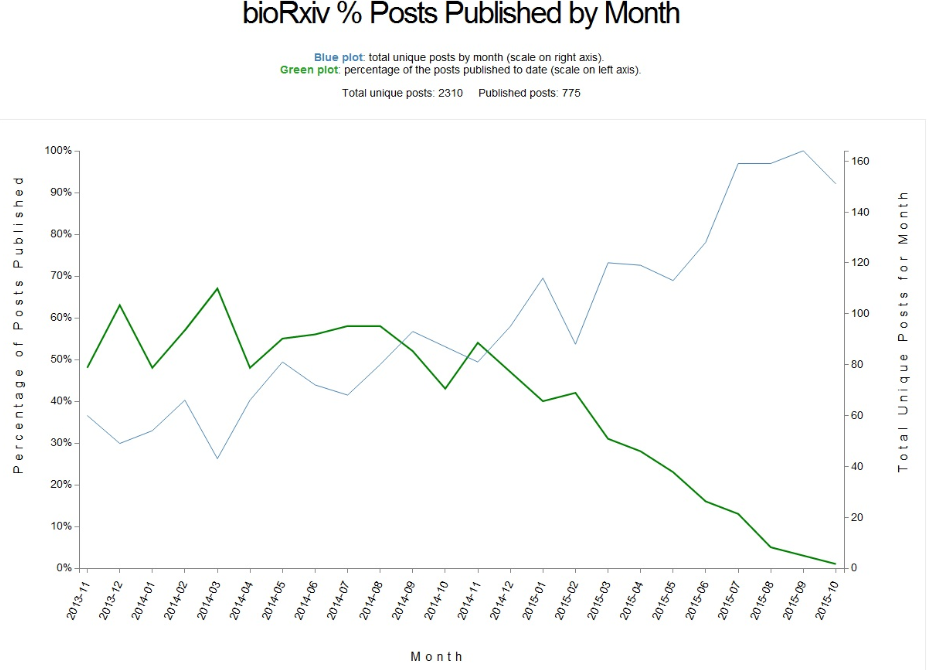
A more popular form of the ‘publish-first-get-reviewed-second’ model is provided by preprint servers. Posting preprints to arXiv  is common practice in mathematics and physics.  With the launch of bioRxiv  this is gaining traction in biological sciences. The majority of preprints submitted to bioRxiv are published in a peer-reviewed journal within 12 months.  Preprint servers have essentially made sharing scientific manuscripts a free service. The operating costs for arXiv are estimated to be US$826,000 p.a, which is supported by a membership model in which participating universities contribute up to US$3000 p.a.

Peer review, however,  is still not free, both in the sense that it costs money, and also that the ways in which it can be accessed are limited.  As an author, I can choose to give up my copyright and  restrict who can access my work by submitting to a subscription journal, or I can choose to pay an Article Processing Charge (APC)  of anywhere between US$695  and US$5200 by submitting to an open-access journal.  Both types of journals ultimately access the same pool of reviewers to provide peer review.  Either way, publishers make lucrative operating margins by controlling access to peer review.  It is ironic that the only sense in which peer review is free is that the reviewer is not paid by the publisher for their effort.

I am co-founder of another Australasian startup (Academic Karma) whose mission is to  make peer-review free as well as open.  We  envisage a ‘1. post-preprint; 2. get peer-reviewed and 3.  submit to a journal’  model of scientific publishing.  In order to achieve this, we have launched a pilot ‘global peer review network’ together with librarians from The University of Queensland, Imperial College London, The Australian National University and Cambridge University.   Any auhor from one of these universities can use this network to access peer review  for a arXiv or bioRxiv listed preprint outside the journal system. The reviews, together with an editorial summary of the strengths and limitations of the paper are collated into a document which can be submitted together with the manuscript for consideration at an  open-access journal.  The reviews will be published ( at http://academickarma.org/reviews) once the manuscript is published.The author pays for peer review not in dollars, but with ‘karma’ they earned by reviewing for others. While there is no penalty for a karma debt, we hope this system helps remind reviewers to try to perform as much review as they consume – an absolute necessity for the system to be self regulating.

Although it has been almost 15 years  since the open-access publishing movement was launched in earnest with the establishment of the  Budapest Open Access Initiative,  the founding of  BiomedCentral, PLOS’s open letter to scientific publishers and then the launch of PLOS as an open access publisher, publishing in open access journals is still a long way from reaching 100% penetration.   Perhaps one of the main remaining reasons for this is cost – many researchers, particularly junior researchers face tough choices in deciding between paying to publish or paying for other lab expenses to further their research.   Co-ordinating peer review has been estimated to make up from 25%, to almost all the running costs of an online open access journal  We hope that providing high quality open peer review for free prior to journal submission will enable open-access journals to drop their APCs, thus making open access publishing more accessible to all.

About the author: Lachlan Coin is Group Leader, Genomics of Development and Disease Division
Deputy Director, Centre for Superbug Solutions at the University of Queensland

Conflict of interests:  Lachlan Coin is the founder of Academic Karma

OA week wrap for 2015: what’s next?

5 days of frenetic  #OAweek activity and then OA can go back in the closet for the rest of the year? That doesn’t seem a good use of the momentum that the week generates. Below are some snapshots of the week and some thoughts for what’s next. There is a lot more on the OATP. Did we miss anything important? Let us know.

OA events in Australia and New Zealand

A lot went on in #OAweek across the region – much of which was compiled here before the week started.
Highlights included the Tuesday NZ/AU tweetchat – see tweet reach analysis, above, There was good discussion, including how the timing of the event works (or doesn’t) in this part of the world.
The Brisbane tri-university event on Back to the Future day was, as  Sue Hutley from QUT noted, extremely eclectic, with examples of best practice in “openness” being shared across disciplines. And that seemed like a particularly important theme overall.

UTS had a blog updated each day of OA week Other events to highlight (not already on the AOASG page) were Charles Darwin University’s event which included Professor Lawrence Cram, Pro Vice Chancellor, Research and Research Training and Georgina Taylor, Co-lead, Open Access Button – as well as the presentation of an OA prize.
In support of Open Access Week the University of Newcastle Library offered UON staff and RHD students the chance to win an iPad. Simply by submitting a copy of their full-text, peer-reviewed manuscript (Final accepted version) to the NOVA repository during the promotion period they were entered into the iPad draw. All entrants also received a free coffee. The promotion was well received by current repository users as well as encouraging new open access supporters (approximately 25% of entrants this year had not previously archived).

The University of Queensland had librarians fanning out across the university to talk to researchers about OA in an OA Awareness campaign. And UWA library did a set of tweets of OA facts

OA videos and audio

If you haven’t already seen them – take a look at  these videos produced for OA week from Griffith UniversityUWA Curtin Library. All are also listed on the AOASG video page. You can also listen to Designing for serendipity on ABC RN and how OA fits in.

Open Science Prize Announced

Big news of the week was that the Wellcome Trust has teamed up with the US National Institutes of Health and the Howard Hughes Medical Institute to launch a new prize that will seek to unleash the power of open content and data to advance research and its application for health benefit. The prizes are substantial and are specifically aimed at stimulating international collaboration. Closing date Feb 29 (yes, it’s a leap year) 2016.

Australasian Open Research Video Competition

Our OA week competition was to partner with thinkableon a competition to highlight OA work.   The Australasian Open Research Video Competition will showcase the best video abstracts, as voted by the community. It is open to any researcher based in Australia or New Zealand, of work published in an open access journal or which is made freely available via an open access repository. The competition is open for submissions for another month – so get making your video.

Open Access roundups


In addition to the OA events from across across the world, there were some good roundups of the  history and state of play in OA notably from – Creative Commons Aotearoa, JISC in the UK, and also in the UK, the Wellcome Trust produced a timeline of its 10 years in OA – and released the code so anyone can use it. Stephen Pinfield reflected on the State of OA in 18 Statements Peter Suber posted his suggested readings for OA week

 New resources for Open Access

Creative Commons Australia produced a handy new resource on CC licenses “Know your rights“. Pasteur4OA project produced a set of OA advocacy resourcesORCID officially partnered with OA week and had some new graphics to link the two. SPARC launched an OA Spectrum Evaluation tool which quantitatively scores journals’ degrees of openness.

Open Access and why it is important –  quotes from across the region

Alex Holcombe, University of Sydney “I’ve had friends at small tech companies ask, jealously, how they can get the access to thousands of pay-walled scholarly journals that I enjoy. It’s often the engineers at a small start-up company, or a suffering medical patient, who would get the most use out of a published paper, not we academics.”
Alice Williamson from Open Source Malaria.  “The Open Source Malaria Consortium publishes all research data and results online so that anyone can read about, contribute to or use the data generated. This has effectively lowered any barriers to participation in the project and means that we can collaborate with scientists from very different backgrounds – from highly experienced medicinal chemists to high school students!” 

David Jakabek, Editor in Chief, Australian Medical Student Journal

“Open access is exciting for medical students for both academic study and research projects. With increasing journal numbers, fewer library subscriptions, and limited finances, Open Access allow medical students to draw on a wider array of research output than would otherwise be possible. From a publishing point of view, Open Access at the Australian Medical Student Journal reduces barriers for medical student work to be accessible to the wider scientific community. Students and colleagues can see medical student work being read and cited, which encourages further medical research in our future doctors.”

Roxanne Missingham, ANU

“Open for collaboration gave the opportunity for Dr Dan Andrews and Dr Julia Miller to give terrific presentations to more than 60 at the ANU providing very important insights into the complex nature of genomic and language data, the important of managing data well, the importance of considering the role of researchers in curating rather than owing data and the challenging of working towards national and international alliances to make data open.  Globally sharing data as openly as possible, with appropriate protections,  is essential for the creation of new research within both science and the social sciences and humanities.”

Open Access (and open data – the next “open” week?) in the news

The week started off in the Conversation with an article on the “Battle for OA” which has attracted many comments  – and rounded off the week with a Q & A featuring Lucy Montgomery from Curtin and Knowledge Unlatched and Tom Cochrane from QUT. Alex Holcombe reflected back on the week in a piece which asked whether we need an open data week

OA Quiz

and finally.. test your knowledge with the 15 question quiz on OA from BMC.

Why the Open Science Prize is important

Fabiana Kubke reflects on the launch on the Open Science Prize

Contact Twitter: @Kubke

Screen Shot 2015-10-22 at 9.51.08 pmIt gave me great pleasure to see the launch of the Open Science Prize in the middle of this year’s Open Access Week. Sponsored by the Wellcome Trust, the National Institutes of Health and the Howard Hughes Medical Institute, this prize provides a great incentive for international collaborations that help foster Open Science.

Science should be Open and collaborative – anything else just creates barriers for the application of or challenges to the findings, which are at the core of how science works and moves forward. As researchers we have, however, managed to build communities that tend to disincentivise this open collaboration. We have traded the Mertonian values for a form of commodified science that does not take advantage of the opportunities offered by the technologies of today (cue in Internet, digital technologies). As our individual ability to openly and freely communicate our science increases, so do the forces that fight to control the knowledge increase.

It is in this context that the Open Science Prize is important. Backed by three major international funding agencies the Open Science Prize sends a clear signal to researchers about what the Science enterprise should be expected to look like and puts their money where their mouth is. This prize is not just about celebrating successes in Open Science, it is also about specifically funding it. It brings Open Science into the mainstream, and, I hope, will get people thinking (and talking) about why it is important.

At the end of the day, Open Science should not be seen as some odd peripheral way of doing things or contrasted against mainstream science – but rather as a synonym of Science itself.  I look forward to the day when we frame the conversation around contrasting Science to ‘Closed Science’ instead.

I am honoured to have been invited to join a great panel of expert advisors, and of course to bring a ‘down under’ perspective to the process. I look forward to working on the rest of the process with the rest of the team.

Fabiana Kubke is a neu­ro­science researcher and teacher at the Uni­ver­sity of Auck­land. She is an Academic Editor for PLOS ONE and PeerJ and Chair of the Advisory Board of Creative Commons Aotearoa New Zealand.

She is on the panel of Expert Advisors for the Open Science Prize

Everything you wanted to know about OA updates in #OAweek – without having to leave your desk

The focus of this post is OA week – the global (and local) event on all things Open Access. The  global list of events is here  and you can follow events throughout the week on twitter #OAweek

OA events in Australia and New Zealand

Screen Shot 2015-10-08 at 12.43.38 pmThere’s lots going on in #OAweek across the region. A list of events is here. Tell us if we missed anything & let us know about events you attend: tag on twitter –  #oaweek #AOASG or contact us via the website.

OA videos

Screen Shot 2015-10-18 at 3.30.05 pm

UWA researchers talk about OA

Several institutions across the region are featuring researchers talking on what  Open Access means to them. Check out videos from Professors Andrew Brown and Sydney Dekker from Griffith University and Professors Paul Low, Robyn Carroll, and Christopher Vernon from UWA.  Curtin Library has a new video on an introduction to open access.
And for Open Access as Shakespeare would have written it, don’t miss “Sherpa Romeo and Juliet”  from Southern Cross University Library   Got videos you’d like to share? Let us know.

#OAweek #AOASG tweetchat

If you do nothing else this OA week, tune in for an hour of tweetchat from across the region on Tuesday. Everyone is welcome. Just use the #OAweek and #AOASG on tweets

#OAweek competition on Thinkable

To encourage researchers to spread the word about their research we have partnered with thinkable on a competition to highlight OA work.  Video abstracts can increase the reach of open research. The Australasian Open Research Video Competition aims to create an engaging forum to showcase the best video abstracts, as voted by the community. It is open to any researcher based in Australia or New Zealand, of work published in an open access journal or which is made freely available via an open access repository.

Open Access content on Wikipedia

This year’s focus of OA week is to expand open access content on Wikipedia – without question the world’s largest free resource. The need for accuracy is highlighted by what happens when you type pretty much any scientific term into Google – your top hit will be Wikipedia. Having accurate information displayed at this first point is essential.
More information is available from the OA week site – highlights excerpted below.The edit-a-thon will aim to accomplish three goals during the week:

  • to improve already existing Open Access-related pages,
  • to create new content where it needs to be added,
  • to translate Open Access-related pages into languages where they don’t yet exist.

You don’t need to be an expert Wikipedia editor to contribute.  In fact, you don’t need any editing experience at all!   All you need is an interest in Open Access and willingness to share your knowledge by adding it to an article or translating information into a new language.  Training for new editors will be provided as part of the event.

A homepage for the Open Access Week Edit-a-thon has been setup on the Wikimedia website at:
https://meta.wikimedia.org/wiki/The_Wikipedia_Library/OA_week.  On this page, you’ll find everything you need to participate, including:

  • Detailed instructions for creating, improving, and translating Open Access-related articles
  • Lists of Open Access-related articles that need to be improved
  • Suggestions for relevant articles that need to be created
  • Information of daily check-ins and training events
  • Links to tutorials on how to edit Wikipedia for beginners

Blogs on the AOASG website

We have a line up of blogs for OA week. You can also check out recent posts, including why ORCiD is so important in OA and how hard it can be to collect solid data on APCs from an institution.

Resource of the month: Open Access Tracking Project – OATP

Without question, there is a LOT of daily news about OA. The Open Access Tracking Project is the best source of this news OATP for daily updates. It works as follows- “The goal is for the primary project feed to include all new OA-related developments. In practice, it includes the new OA developments noticed and tagged by participating taggers.” If you think it is missing something you can “Become a tagger and tag items yourself. Recruit other taggers.”

Highlights from the past month include:

Open Access in the news

The Conversation – especially in its science & education sections, has covered many aspects of open access and the wider publishing landscape over the past few years. It is running
Your Questions Answered on open access research” during OA week and has a post at the beginning of OA week from AOASG on the “battle for open access“.
The Australian Higher Ed section has also covered hot topics, including discussions about Elsevier’s embargo periods earlier this year.
Open Access has also been on the radio with a Background Briefing programme on those who seek to exploit new developments in publishing and conferences and features in this week’s edition of Future Tense with the wonderful topic of “Designing for Serendipity“.

Open Access across the world


This week is a great time to get a view of local initiatives from across the world. Many have associated webcasts to follow or resources that can be watched later – so you don’t have to leave your desk.

Open Access week resources

Screen Shot 2015-10-18 at 8.16.29 pm

Finally, if you need materials to promote OA or OA week, take a look at the OA week resource page.