OA week wrap for 2015: what’s next?

5 days of frenetic  #OAweek activity and then OA can go back in the closet for the rest of the year? That doesn’t seem a good use of the momentum that the week generates. Below are some snapshots of the week and some thoughts for what’s next. There is a lot more on the OATP. Did we miss anything important? Let us know.

OA events in Australia and New Zealand

A lot went on in #OAweek across the region – much of which was compiled here before the week started.
Highlights included the Tuesday NZ/AU tweetchat – see tweet reach analysis, above, There was good discussion, including how the timing of the event works (or doesn’t) in this part of the world.
The Brisbane tri-university event on Back to the Future day was, as  Sue Hutley from QUT noted, extremely eclectic, with examples of best practice in “openness” being shared across disciplines. And that seemed like a particularly important theme overall.

UTS had a blog updated each day of OA week Other events to highlight (not already on the AOASG page) were Charles Darwin University’s event which included Professor Lawrence Cram, Pro Vice Chancellor, Research and Research Training and Georgina Taylor, Co-lead, Open Access Button – as well as the presentation of an OA prize.
In support of Open Access Week the University of Newcastle Library offered UON staff and RHD students the chance to win an iPad. Simply by submitting a copy of their full-text, peer-reviewed manuscript (Final accepted version) to the NOVA repository during the promotion period they were entered into the iPad draw. All entrants also received a free coffee. The promotion was well received by current repository users as well as encouraging new open access supporters (approximately 25% of entrants this year had not previously archived).

The University of Queensland had librarians fanning out across the university to talk to researchers about OA in an OA Awareness campaign. And UWA library did a set of tweets of OA facts

OA videos and audio

If you haven’t already seen them – take a look at  these videos produced for OA week from Griffith UniversityUWA Curtin Library. All are also listed on the AOASG video page. You can also listen to Designing for serendipity on ABC RN and how OA fits in.

Open Science Prize Announced

Big news of the week was that the Wellcome Trust has teamed up with the US National Institutes of Health and the Howard Hughes Medical Institute to launch a new prize that will seek to unleash the power of open content and data to advance research and its application for health benefit. The prizes are substantial and are specifically aimed at stimulating international collaboration. Closing date Feb 29 (yes, it’s a leap year) 2016.

Australasian Open Research Video Competition

Our OA week competition was to partner with thinkableon a competition to highlight OA work.   The Australasian Open Research Video Competition will showcase the best video abstracts, as voted by the community. It is open to any researcher based in Australia or New Zealand, of work published in an open access journal or which is made freely available via an open access repository. The competition is open for submissions for another month – so get making your video.

Open Access roundups


In addition to the OA events from across across the world, there were some good roundups of the  history and state of play in OA notably from – Creative Commons Aotearoa, JISC in the UK, and also in the UK, the Wellcome Trust produced a timeline of its 10 years in OA – and released the code so anyone can use it. Stephen Pinfield reflected on the State of OA in 18 Statements Peter Suber posted his suggested readings for OA week

 New resources for Open Access

Creative Commons Australia produced a handy new resource on CC licenses “Know your rights“. Pasteur4OA project produced a set of OA advocacy resourcesORCID officially partnered with OA week and had some new graphics to link the two. SPARC launched an OA Spectrum Evaluation tool which quantitatively scores journals’ degrees of openness.

Open Access and why it is important –  quotes from across the region

Alex Holcombe, University of Sydney “I’ve had friends at small tech companies ask, jealously, how they can get the access to thousands of pay-walled scholarly journals that I enjoy. It’s often the engineers at a small start-up company, or a suffering medical patient, who would get the most use out of a published paper, not we academics.”
Alice Williamson from Open Source Malaria.  “The Open Source Malaria Consortium publishes all research data and results online so that anyone can read about, contribute to or use the data generated. This has effectively lowered any barriers to participation in the project and means that we can collaborate with scientists from very different backgrounds – from highly experienced medicinal chemists to high school students!” 

David Jakabek, Editor in Chief, Australian Medical Student Journal

“Open access is exciting for medical students for both academic study and research projects. With increasing journal numbers, fewer library subscriptions, and limited finances, Open Access allow medical students to draw on a wider array of research output than would otherwise be possible. From a publishing point of view, Open Access at the Australian Medical Student Journal reduces barriers for medical student work to be accessible to the wider scientific community. Students and colleagues can see medical student work being read and cited, which encourages further medical research in our future doctors.”

Roxanne Missingham, ANU

“Open for collaboration gave the opportunity for Dr Dan Andrews and Dr Julia Miller to give terrific presentations to more than 60 at the ANU providing very important insights into the complex nature of genomic and language data, the important of managing data well, the importance of considering the role of researchers in curating rather than owing data and the challenging of working towards national and international alliances to make data open.  Globally sharing data as openly as possible, with appropriate protections,  is essential for the creation of new research within both science and the social sciences and humanities.”

Open Access (and open data – the next “open” week?) in the news

The week started off in the Conversation with an article on the “Battle for OA” which has attracted many comments  – and rounded off the week with a Q & A featuring Lucy Montgomery from Curtin and Knowledge Unlatched and Tom Cochrane from QUT. Alex Holcombe reflected back on the week in a piece which asked whether we need an open data week

OA Quiz

and finally.. test your knowledge with the 15 question quiz on OA from BMC.

Why the Open Science Prize is important

Fabiana Kubke reflects on the launch on the Open Science Prize

Contact Twitter: @Kubke

Screen Shot 2015-10-22 at 9.51.08 pmIt gave me great pleasure to see the launch of the Open Science Prize in the middle of this year’s Open Access Week. Sponsored by the Wellcome Trust, the National Institutes of Health and the Howard Hughes Medical Institute, this prize provides a great incentive for international collaborations that help foster Open Science.

Science should be Open and collaborative – anything else just creates barriers for the application of or challenges to the findings, which are at the core of how science works and moves forward. As researchers we have, however, managed to build communities that tend to disincentivise this open collaboration. We have traded the Mertonian values for a form of commodified science that does not take advantage of the opportunities offered by the technologies of today (cue in Internet, digital technologies). As our individual ability to openly and freely communicate our science increases, so do the forces that fight to control the knowledge increase.

It is in this context that the Open Science Prize is important. Backed by three major international funding agencies the Open Science Prize sends a clear signal to researchers about what the Science enterprise should be expected to look like and puts their money where their mouth is. This prize is not just about celebrating successes in Open Science, it is also about specifically funding it. It brings Open Science into the mainstream, and, I hope, will get people thinking (and talking) about why it is important.

At the end of the day, Open Science should not be seen as some odd peripheral way of doing things or contrasted against mainstream science – but rather as a synonym of Science itself.  I look forward to the day when we frame the conversation around contrasting Science to ‘Closed Science’ instead.

I am honoured to have been invited to join a great panel of expert advisors, and of course to bring a ‘down under’ perspective to the process. I look forward to working on the rest of the process with the rest of the team.

Fabiana Kubke is a neu­ro­science researcher and teacher at the Uni­ver­sity of Auck­land. She is an Academic Editor for PLOS ONE and PeerJ and Chair of the Advisory Board of Creative Commons Aotearoa New Zealand.

She is on the panel of Expert Advisors for the Open Science Prize

What are the benefits of sharing grant data openly?

Marta Poblet and Amir Aryani talk about the importance of open sharing of grant data – a topic not often brought into the OA debate

Contacts on twitter: @mpoblet @amir_at_ands

Every year, the Australian Commonwealth and the State governments spend billions of dollars in grants to individuals, small business, communities, not-for-profits, universities, corporations, etc. Philanthropy organisations, nearly 5,000 in Australia, are giving approximately an extra billion dollars in grants.

Yet, to date the total, combined value of grants from the Commonwealth, the States, and the philanthropy sector can only be estimated. In 2014, the Australian National Audit Office noted that “the precise number and value of grants made by the Commonwealth Government in any one year is difficult to establish as details are contained in individual entity documents”. It also warned that  “the Commonwealth may be providing very significant subsidies for particular services or outcomes without a good understanding of the level of subsidy provided and consequently value for money”.

Monies from government, philanthropy, and corporate grants fuel research, innovation, and social change, but duplication, over or underinvestment are likely outcomes of a system that keeps confining grant data into organisational silos. Opening up access to grant information across the whole sector would certainly help maximise its efficiency and social impact.

Every year, public and private grant programs generate large volumes of data throughout the different stages of the grantmaking cycle (from publication of the call to final assessment). This grant data should not be considered as a mere by-product of the process. In addition to its organisational value, grant data can also contribute to a common good: linking grant data to recipients, and outputs (including publications, if available) improves the discoverability of the programs and increases the transparency of the overall system.

In Australia, the Australian National Data Service (ANDS) sees the value in connecting grants with grant outputs like data and publications, so the ANDS data discovery service includes open research grant data. The service currently includes grant data from the National Health and Medical Research Council (NHMRC) and the Australian Research Council (ARC) Some of these data are also linked to project outputs such as datasets and publications.

But discoverability and transparency are not the only benefits of open grant data. As Rachel Wharton from NPC puts it, “accurate and timely data allows funders to learn quickly about a strategy or area in which they are interested. It encourages them to think strategically about their giving and to communicate and collaborate with others in the sector.”

When it comes to philanthropy grants, there is a growing number of international initiatives embracing openness. Examples are the International Aid Transparency Initiative (IATI), Glasspockets and Washfunders by the Foundation Center, PoweredbyData or the recently released GrantNav by the 360 Giving initiative in the UK. This initiative has also developed a data standard which is compatible with the IATI standard and the Foundation Center hGrant standard. More innovations in the philanthropy sector can be found in this report.

Generally, the barriers to creating a comprehensive open framework linking grantmakers with grant programs, grantees, and grant outputs (including publications) are a combination of technical and legal challenges.

A technical challenge, for instance, is how to connect grantmakers and grantees. Researchers in academia are increasingly using author identifiers, unique numbers identifying them so that their names are properly linked to their publications and/or grants. ORCID, ISNI, or ResearchID are the most widely adopted identifiers. This technology could be extended to all types of grants to disambiguate the names of both grantmakers and grantees.

Likewise, an open grant data framework needs to connect grant programs with the outputs produced with those grants. When these outputs are academic publications, platforms such as FundRef or OpenAIRE enable to link who funded what to whom, but the lack of unique and persistent identifiers for grants hinders significantly the visibility of such programs.

The technical barriers need to be addressed hand in hand with the legal and ethical issues associated with openly releasing grant data. Privacy, data protection, and confidentiality principles and rules need to be carefully weighed to protect all stakeholders from potential threat or harm. Intellectual property and licensing issues will also emerge through the process. A balanced approach needs to be translated into appropriate policies, guidelines and procedures to help building a trusted process to share grant data for the public interest.

About the authors

Marta Poblet is a Vice-Chancellor’s Senior Researcher at RMIT University (Graduate School of Business and Law) @mpoblet

Amir Aryani is a project manager in Australian National Data Service and technology lead for the Research Data Switchboard (RD-Switchboard.org) @amir_at_ands

They declare no conflicts of interest


Know your rights with Creative Commons licenses

Nerida Quatermas @NeridaQuatermas on a new resource to help navigate Creative Commons licenses

Reposted from Creative Commons Australia  – read original post here.

This week is International Open Access Week.

In A Very Brief Introduction to Open Access written for this week Peter Suber identifies open access literature as “digital, online, free of charge, and free of most copyright and licensing restrictions“.

The definitions of open access provided by the founding meetings for open access to scholarly research were deep and broad. For example, the Budapest Open Access Initiative declared that open access to literature meant:

free availability on the public internet, permitting any users to read, download, copy, distribute, print, search, or link to the full texts of these articles, crawl them for indexing, pass them as data to software, or use them for any other lawful purpose, without financial, legal, or technical barriers other than those inseparable from gaining access to the internet itself. The only constraint on reproduction and distribution, and the only role for copyright in this domain, should be to give authors control over the integrity of their work and the right to be properly acknowledged and cited.

Availability of the public internet looks to many like open access. Works on the internet are not necessarily free of copyright or open. The internet is a distribution method but it does not make scholarly works ‘open’.

Open-ness is assessed by the extent to which content can be accessed free of charge and then re-used. Reuse is maximised when a work is freed from most copyright restrictions through open licensing.

Creative Commons offers the legal framework that enables a scholarly work to be free to share while protecting the moral rights of authors. The Creative Commons Attribution licence which is the most permissive of the CC licences enables all the uses identified by the BOAI.

The Directory of Open Access Journals (DOAJ) gives a Seal of Approval to journals which achieve a high level of open-ness based on a number of conditions. More restrictive CC licences meet the licensing condition so long as the licence granted to users enables them to “read, download, copy, distribute, print, search, or link to the full texts of these articles”. The licences which meet this condition are CC BY, CC BY-SA, CC BY-NC and CC BY-NC-SA. The only CC licences not acceptable to the DOAJ are those which include the No Derivatives condition which means that a user cannot adapt or change a work in any way.

Image of Creative Commons Australian Know your rights webpage

What do these licences mean to authors in terms of exercising their rights over their works, and, to users in terms of re-use? Compared with traditional closed access publishing authors retain and users are given more rights in open access publishing.

In celebration of OA Week we have “launched” a new page on the Creative Commons Australia website called Know your rights. It shows the extent of rights that can be exercised for each of the Creative Commons licences.

Everything you wanted to know about OA updates in #OAweek – without having to leave your desk

The focus of this post is OA week – the global (and local) event on all things Open Access. The  global list of events is here  and you can follow events throughout the week on twitter #OAweek

OA events in Australia and New Zealand

Screen Shot 2015-10-08 at 12.43.38 pmThere’s lots going on in #OAweek across the region. A list of events is here. Tell us if we missed anything & let us know about events you attend: tag on twitter –  #oaweek #AOASG or contact us via the website.

OA videos

Screen Shot 2015-10-18 at 3.30.05 pm

UWA researchers talk about OA

Several institutions across the region are featuring researchers talking on what  Open Access means to them. Check out videos from Professors Andrew Brown and Sydney Dekker from Griffith University and Professors Paul Low, Robyn Carroll, and Christopher Vernon from UWA.  Curtin Library has a new video on an introduction to open access.
And for Open Access as Shakespeare would have written it, don’t miss “Sherpa Romeo and Juliet”  from Southern Cross University Library   Got videos you’d like to share? Let us know.

#OAweek #AOASG tweetchat

If you do nothing else this OA week, tune in for an hour of tweetchat from across the region on Tuesday. Everyone is welcome. Just use the #OAweek and #AOASG on tweets

#OAweek competition on Thinkable

To encourage researchers to spread the word about their research we have partnered with thinkable on a competition to highlight OA work.  Video abstracts can increase the reach of open research. The Australasian Open Research Video Competition aims to create an engaging forum to showcase the best video abstracts, as voted by the community. It is open to any researcher based in Australia or New Zealand, of work published in an open access journal or which is made freely available via an open access repository.

Open Access content on Wikipedia

This year’s focus of OA week is to expand open access content on Wikipedia – without question the world’s largest free resource. The need for accuracy is highlighted by what happens when you type pretty much any scientific term into Google – your top hit will be Wikipedia. Having accurate information displayed at this first point is essential.
More information is available from the OA week site – highlights excerpted below.The edit-a-thon will aim to accomplish three goals during the week:

  • to improve already existing Open Access-related pages,
  • to create new content where it needs to be added,
  • to translate Open Access-related pages into languages where they don’t yet exist.

You don’t need to be an expert Wikipedia editor to contribute.  In fact, you don’t need any editing experience at all!   All you need is an interest in Open Access and willingness to share your knowledge by adding it to an article or translating information into a new language.  Training for new editors will be provided as part of the event.

A homepage for the Open Access Week Edit-a-thon has been setup on the Wikimedia website at:
https://meta.wikimedia.org/wiki/The_Wikipedia_Library/OA_week.  On this page, you’ll find everything you need to participate, including:

  • Detailed instructions for creating, improving, and translating Open Access-related articles
  • Lists of Open Access-related articles that need to be improved
  • Suggestions for relevant articles that need to be created
  • Information of daily check-ins and training events
  • Links to tutorials on how to edit Wikipedia for beginners

Blogs on the AOASG website

We have a line up of blogs for OA week. You can also check out recent posts, including why ORCiD is so important in OA and how hard it can be to collect solid data on APCs from an institution.

Resource of the month: Open Access Tracking Project – OATP

Without question, there is a LOT of daily news about OA. The Open Access Tracking Project is the best source of this news OATP for daily updates. It works as follows- “The goal is for the primary project feed to include all new OA-related developments. In practice, it includes the new OA developments noticed and tagged by participating taggers.” If you think it is missing something you can “Become a tagger and tag items yourself. Recruit other taggers.”

Highlights from the past month include:

Open Access in the news

The Conversation – especially in its science & education sections, has covered many aspects of open access and the wider publishing landscape over the past few years. It is running
Your Questions Answered on open access research” during OA week and has a post at the beginning of OA week from AOASG on the “battle for open access“.
The Australian Higher Ed section has also covered hot topics, including discussions about Elsevier’s embargo periods earlier this year.
Open Access has also been on the radio with a Background Briefing programme on those who seek to exploit new developments in publishing and conferences and features in this week’s edition of Future Tense with the wonderful topic of “Designing for Serendipity“.

Open Access across the world


This week is a great time to get a view of local initiatives from across the world. Many have associated webcasts to follow or resources that can be watched later – so you don’t have to leave your desk.

Open Access week resources

Screen Shot 2015-10-18 at 8.16.29 pm

Finally, if you need materials to promote OA or OA week, take a look at the OA week resource page.

Follow the money: tracking Article Processing Charges at the University of Canterbury

Anton Angelo writes on how hard it can be to figure out who is paying what in Article Processing Charges

A thousand dollars, a hundred thousand or a million?  Peter Lund, the UC Research Support Manager and I asked ourselves that question last year as we tried to work out how much the University of Canterbury pays in Article Processing Charges (APCs).  We wanted to know how much we paid for articles to be published as Open Access, and it was turning out to be surprisingly hard to find out.  It was even difficult to ascertain what order of magnitude APCs were in.

Our first attempts – in an All the President’s Men ‘follow the money’ approach – were stymied. We talked to our finance department, but university financial systems were not granular enough to see what was being put into publisher’s hands out of research grants.  We were not even sure if research grants were the source of funds in the first place – any budget could conceivably be paying APCs.

A phase of heroic data-wrangling came next.  I grabbed the output of our Current Research Information System, “Profiler”, for the last few years, and popped it into MS Access.  That held all the details for articles submitted for the NZ research funding exercise Performance Based Funding Review (the PBRF), including the journal title for each research output.  Another table, sourced from the Directory of Open Access Journals included the title, and if the journal accepted APCs.

A bit of Structured Query Language later and I had a list of all the articles by Canterbury researchers for which APCs could have been paid for by one of the authors.

Then, came the figures. I looked up the APC rates of the 10 top journals Canterbury scholars published in, multiplied them up and got an answer:  tens to hundreds of thousands of NZ dollars.  This back of an envelope method didn’t give us actionable figures, but it did sharpen our minds.  Canterbury is still suffering the effects of a major natural disaster, as well as the twin prongs of fiscal austerity and a demographic shift leading to fewer undergraduate age students.  In short, we’re strapped for cash.

Our first question, knowing the magnitude of the sum, led, of course to more questions.  Could we refine that figure further?  We decided that we needed harder figures.   From our first investigation we now had a list of Canterbury researchers that might have paid APCs to enable their research to become Open Access.  Problems with the data were that fees could have been waived, or co-authors at other institutions might have paid them (a good reason to collaborate with someone in the UK, and their block grants) so we decided to do the hard thing, and go out and ask them.

Like all academic librarians, we are leery of putting extra workload on researchers and teachers.  With all the traditional roles, they are suffering Herculean amounts of extra administration – reports, copyright reviews, applications for research funding, and these tasks are increasing regularly.  We spent time with questionnaire designers creating something that would give us the most wisdom for the least input.  The result was a 50% response rate of a population of 100 researchers we knew had published in OA journals charging APCs.  Our results, published in our repository the University of Canterbury Research Repository [1] and the data in figshare [2] had some startling implications.

  • We were correct that the magnitude of APCs was in the hundreds of thousands of dollars.
  • The source of funds for APCs was varied, including in some cases the researcher’s personal funds.
  • Researchers were paying APCs to support Open Access, but more importantly because they believed that Open Access journals were the best places to publish that specific research.
  • Researchers expected to pay more APCs in the future.

So, this confirmed that there was a problem: funding was required to pay for APCs. The next question was how to fund these fees.  Our approach was to suggest a central fund for those who may not be able to draw on other sources, and the story of how that has developed, dear readers, is in the next episode.

 Anton Angelo is Research Data Co-ordinator, University of Canterbury.

[1] Angelo, A., & Lund, P. (2014). An evolving business model for scholarly publishing: exploring the payment of article processing charges (APCs) to achieve open access. Retrieved from http://ir.canterbury.ac.nz/handle/10092/9730

[1]      Angelo, A., & Lund, P. (2014, September 2). Raw dataset for University of Canterbury APC study. Retrieved from http://figshare.com/articles/Raw_dataset_for_University_of_Canterbury_APC_study/1157870

ORCID: giving new meaning to “open” research

At the beginning of peer review week, Natasha Simons writes on ORCID – an essential tool throughout academia now.

Contact: Twitter @n_simons

Have you ever tried to search for the works of a particular author and found that there are literally hundreds of authors with the same name? Or found that your name has been misspelt on a publication or that it is plain wrong because you changed your name when you got married (or divorced) a few years back? Well, you are not alone. Did you know that the top 100 surnames in China account for 84.77% of the population or that 70% of Medline names are not unique? So receiving credit where credit is due is badly needed by researchers the world over and in solving this problem, we can also improve the discoverability of their research. But to solve a global problem, we need a global solution. Enter ORCID – the Open Researcher and Contributor Identifier.

orcid_128x128ORCID provides individual researchers and scholars with a persistent unique identifier which links a researcher with their works and professional activities – ensuring the work is recognised and discoverable. Sure, there are many other researcher identifiers out there but ORCID has the ability to reach across disciplines, research sectors, and national boundaries. ORCID distinguishes an individual researcher in a similar way to how a Digital Object Identifier (DOI) uniquely identifies a scholarly publication. It lasts for a lifetime and remains the same whether you move institutions, countries or (heaven forbid) change disciplines. If you’ve not seen one before, check out the ORCID for Nobel Prize laureate and Australian of the Year Peter C. Doherty.

ORCID works as a solution to name ambiguity because it is:

  • Widely used;
  • Embedded in the workflows of submission systems for publishers, funders and institutions;
  • The product of a global, collaborative effort;
  • Open, non-profit and researcher-driven.

There are over 300 ORCID members (organisations or groups of organisations) from every section of the international research community. Over 1.5 million ORCID identifiers for individual researchers have been issued since its launch in October 2012. In Australia, the key role of ORCID has been recognised in two Joint Statements and – as is the case in many other countries – plans for an ORCID Consortium are well underway.

From its very beginning, ORCID has embraced “open” – it is free for researchers to sign up, open to any interested organisation to join, releases software under an Open Source Software license, and provides a free public API. Institutions who wish to embed ORCID into their workflows are advised to join ORCID and this membership fee (for service) in turn supports ORCID to continue to function as a non-profit entity.

A key activity of ORCID at the moment is completing the metadata round trip. It sure doesn’t sound exciting but it is actually. Really! It works like this: when a researcher submits an article to a publisher, a dataset to a data centre, or a grant to a funder, they include their ORCID iD. When the work is published and the DOI assigned, information about the work is automatically connected to the researcher’s ORCID record. Other systems can query the ORCID registry and draw in that information. This will save researchers a lot of time currently spent updating multiple data systems, and ensures correct credit and discoverability of their research. See? Exciting, huh!

Another great thing ORCID is doing is Peer Review Week (28 September – 2 October), which grew out of informal conversations between ORCID, Sense about Science, ScienceOpen, and Wiley. The week highlights a collaborative effort in finding ways to build trust in peer review by making the process more transparent and giving credit for the peer review activity. ORCID have also been collaborating with Mozilla Science Lab, BioMed Central, Public Library of Science, The Wellcome Trust, and Digital Science, among others, to develop a prototype for assigning badges to individuals based on the contributor role vocabulary developed by Project CRediT earlier this year.

It’s great news that this year and for the first time ever, ORCID are officially joining the Open Access Week celebrations. OA Week runs from October 19-26 and their goal is to sign up 10,000 new ORCID registrants and increase the number of connections between ORCID iDs and organisation iDs. They hope you can help! So go on, why not go sign up for an ORCID iD now? You’ll be helping to ensure your scholarly work is discoverable, correctly attributed to you, and you’ll save time in the bargain.

About the author

Natasha Simons is a Research Data Management Specialist with the Australian National Data Service

Publish or perish culture encourages scientists to cut corners

Reposted from The Conversation, 23 Sept 2015
Last week there was another very public case of a journal article being retracted as a result of academic misconduct. This time it was in the Journal of the American Medical Association (JAMA), with the lead author – Dr Anna Ahimastos, working at Melbourne’s Baker IDI – reportedly admitting she fabricated data.

Sadly, the story is all-too familiar. But this is not to say that science is imperiled, only that we need to ensure the reward and support structures in academia promote the best practices rather than corner cutting.

We have only recently begun looking closely at how the scientific literature could function better, and what can go wrong. And there are conflicting opinions on how to handle underlying problems.

Peer review is currently the primary tool we have for assessing papers prior to publication. Although it has its strengths, especially when overseen by skilled editors, it can’t pick up all instances of fraud or sloppy scientific practices.

In the past these errors may have lain hidden for many years, or never come to light. Now, post publication scrutiny is picking up more and more papers with questionable data. This is leading to corrections, or even retractions. Websites such as Retraction Watch have sprung up to document these retractions.

Peerless research

To non-academics, this might all seem rather surprising. Isn’t science governed by strict protocols for performing and reporting research?

Well, no. Unlike industrial processes, for example, which have standard operating procedures and oversight, science is usually organised locally. Expert laboratory heads typically have the responsibility for the oversight of their laboratories’ work.

Many laboratories work as part of larger collaborations, which may have their own checks and balances in place, as do the academic institutions to which they belong. Even so, ultimately the researchers and individual laboratories are responsible for their own work.

The medical sciences have developed their own standards of reporting studies, including clinical trials. But even these standards are not employed universally.

The system of rewards within science is possibly even more perplexing. Academia is a highly competitive profession. The basic training in science is a PhD, with more than 6,000 awarded each year in Australia alone, which is many more than can ever end up as career researchers, even at the lowest level.

The situation gets worse the more senior a researcher gets. According to a 2013 discussion document less than 5% of those who were originally awarded PhDs find permanent academic positions. Even these senior researchers rarely have permanent positions, but are instead expected to compete for funding every few years.

And the primary way academics compete is in the number of papers they publish in peer reviewed journals, especially the handful of what are considered to be top journals, such as Science, http://www.nature.com/link text and The Lancet.

Under pressure

Why does this all matter? Doesn’t this competition lead to selection of the best of the best in research and a faster pace of advancement of science? In fact, the reverse may be the case.

In a seminal paper published in 2005, provocatively titled Why Most Published Research Findings are False, John Ioannidis discussed a number of reasons why research may be unreliable. One finding was that papers in highly competitive areas were more likely to be false than papers in less competitive fields.

In 2014, the Nuffield Council on Bioethics probed these issues among UK researchers in a year long study. What they found was alarming.

Researchers stated that there was strong pressure on them to publish in a limited number of top journals, “resulting in important research not being published, disincentives for multidisciplinary research, authorship issues, and a lack of recognition for non-article research outputs”. Even worse was that the need to get into these top journals led to “scientists feeling tempted or under pressure to compromise on research integrity and standards”.

What can be done? Increasingly, groups of scientists are coming together to develop standards in reporting, conduct and reproducibility. Organisations such as the Committee on Publication Ethics (COPE), which I chair, advise editors on how to handle problem papers.

Perhaps most interestingly, a number of technological innovations have arisen that could lead to more reliable science, if adopted widely. Probably the most important innovation is that of Open Science, i.e. open access to research publications, and open access to the data and methodology that underpins those publications.

But we also need to develop ways to reward scientists who do make their publications, data and methodology open for scrutiny, and don’t just pursue publication in top journals.

Research data organisations, such as the Australian National Data Service (ANDS), are developing the infrastructure for systematic and standardised ways of linking to data, but as yet funders and institutions do not routinely reward such behaviour.

In the end, science is a human endeavour. And like humans everywhere, those who work in it will do what they are rewarded for, for better or for worse. So we need to make sure those reward structures are encouraging good quality research, not the opposite.

The Conversation

Virginia Barbour, Executive Officer, Australasian Open Access Support Group, Australian National University

This article was originally published on The Conversation. Read the original article.

AOASG Submission to the Review of Research Policy and Funding Arrangements for Higher Education

September 2015

Background

The Australasian Open Access Support Group (AOASG) was established in 2013 by nine Australian universities that were committed to ensuring that the research outputs of Australia were made available openly with the ultimate aim of optimising the return on investment in research done in Australian Universities

Over the past three years the AOASG has worked to assist researchers, funders, research organisations and libraries by sharing knowledge about and assisting in building capacity for Open Access.

The AOASG now includes all eight New Zealand universities as well as nine Australian universities.

AOASG welcomes the Review of Research Policy and Funding Arrangements for Higher Education, in particular the focus on increasing the impact of the significant investment made by the Commonwealth Government in universities.

Comments from the AOASG follow in relation to Sections 1,2, and 4 of the issues paper.

Comments

Section 1

To achieve industry impact and enable commercialisation, the research outcomes from universities need to be easily discoverable, free online with clear reuse rights, and with linked access to the data that underpins the research.

Recent years have seen the government launch some important initiatives to assist availability of research outputs. AOASG welcomes the policies of the Australian Research Council (ARC) and National Health and Medical Research Council (NHMRC)which recommend Open Access for research outputs from research funded by the Councils. We note that compliance is as yet, unmeasured.

The National Collaborative Research Infrastructure Strategy funded projects (eg ANDS) have significantly improved the infrastructure for access to data from research, although much remains to be done in order for data to consistently be made open. We note that research from Houghton and Gruen finds that:

“Conservatively, we estimate that the value of data in Australia’s public research to be at least $1.9 billion and possibly up to $6 billion a year at current levels of expenditure and activity. Research data curation and sharing might be worth at least $1.8 billion and possibly up to $5.5 billion a year, of which perhaps $1.4 billion to $4.9 billion annually is yet to be realized. Hence, any policy around publicly-funded research data should aim to realise as much of this unrealised value as practicable [1]”

There will be genuine financial benefit from making research outputs, including data, available on an open access basis.

Research [2] into the use of research by industry and business associations has found that major barriers include a lack of access to research findings and data. These barriers are compounded by inadequate discoverability of the research. Furthermore, there is as yet inconsistent linking via unique identifiers of researchers (such as ORCiD) to research publications and data

Australian Government policy is underdeveloped in this area, leading to inconsistent practices, limited availability of funded research outputs and sub-optimal industry impact.

mandated deposit

2010 – 2014

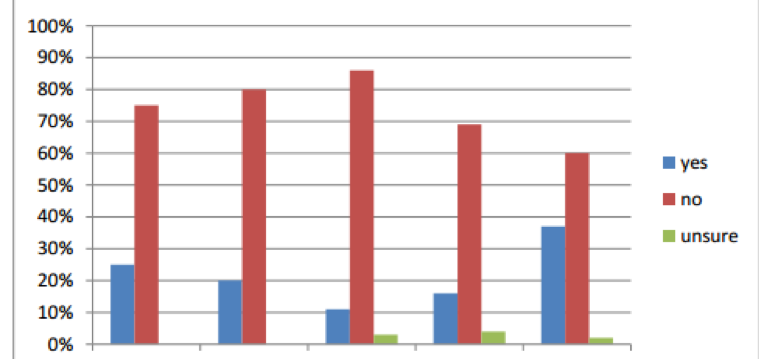
Figure 1. The percentage of Australasian Institutions with a mandated deposit for all research publications. There was a marked increase in the number of universities mandating deposit for all types of research publications, with the percentage rising from 16% in 2013 to 37% in 2014. [3]

In conclusion, factors impeding commercialisation of the research output of Australia’s universities (1.4.1), and barriers to improving research-industry collaboration (1.4.2) include:

  • a lack of policy frameworks to ensure research is published openly and is thus available
  • a lack of an overarching national discovery mechanism – for example the ability to search seamlessly across all research outputs, including published work and that deposited in repositories.
  • a lack of a service that would support industry awareness of new research (such as the SHARE initiative in the US) [4].
  • No entity which is responsible for the the collaboration required between policy makers, such as ARC and NHMRC, academic institutions, and those who can provide technology and infrastructure, such as Intersect and the National Library of Australia.

Section 2 and 4

One reliable measure of the use of research is by counting the number of citations to that work in other publications.  This is an important metric for researchers. There is substantial evidence that making research available via Open Access publications increases citations [5], ie researchers can improve their citation rate in this way.  However, it is important that such citations are measured at the article, not the journal level and are part of an overall programme of considered impact evaluation.[6]

In order to optimise accessibility, use and reuse of research outputs by industry measures (2.3.5) we recommend that award assessment and impact measurement (4.3.6) should include identification of and metrics for:

  • research outputs – number that have been made openly accessible and information on their use and reuse
  • research datasets – number that have been made openly accessible and information on their use and reuse
  • grant acquittals and reporting should include a requirement that outputs are reported in terms of those that are freely or openly accessible, and by what method and those that are behind a paywall

On the question of what can universities do to enhance collaboration (4.3.3) we believe that making universities’ research more discoverable via Open Access, either via universities’ repositories or through fully open access journals is a crucial first step. There is substantial evidence that industry – especially small and medium sized enterprises (SMEs) [3] – are not able to routinely and affordably access the research they need.

However, an important overarching barrier to improving accessibility and hence translation of both research publications and the associated data is financial – ie the cost of Open Access publication, repository infrastructure and data curation.

Full funding for the dissemination of results in the relevant grants, with specific line items associated with such funding would we believe substantially improve the use, reuse, impact and translation of Australian research.

1. Houghton, J., Gruen, N. (2014) Open Research Data Report to the Australian National Data Service (ANDS). November 2014  http://ands.org.au/resource/open-research-data-report.pdf

2. Houghton, Swan and Brown Access to Research and Technical Information in Denmark http://www.deff.dk/uploads/media/Access_to_Research_and_Technical_Information_in_Denmark.pdf

3. Council of Australian University Librarians (2014) 2014 Research Publications Repository Survey Report http://www.caul.edu.au/content/upload/files/surveys/repositories2014public.pdf

4. The Association of Research Libraries (ARL), the Association of American Universities (AAU), and the Association of Public and Land-grant Universities (APLU) jointly launched the SHARE initiative in 2013. http://www.share-research.org/

5. SPARC Europe The Open Access Citation Advantage Service http://sparceurope.org/oaca/

6. The Leiden Manifesto for Research Metrics http://www.leidenmanifesto.org/

A PDF version of this submission is available here:

Open data is good, because …

Belinda Weaver writes on the many benefits of open data

Contact: Twitter @cloudaus

Why should we advocate for open data? What benefits does it bring?

Transparency, for one.

Governments do stuff. We don’t always like it. It helps if we have the data to back up our objections. The Guardian datablog publishes and visualises a lot of information which helps pierce the opacity around government. Two examples – the costs of the post-GFC UK bank bailout and where UK spending actually goes. Both do a great job of communicating a message, and the data can be downloaded and reused.

The ABC’s FactCheck service is one way Australians can check on what governments are saying.

Open data makes things more efficient.

Disasters happen. In the helping phase, open data helps relief agencies get the information they need to direct operations on the ground. It helps governments get the plans and details of the infrastructure they need to fix. The New Zealand response to the Christchurch earthquake is a case in point. Crisis.net is a global source of information to help make disaster response quicker and more efficient.

Open data helps join things up.

Cities are complex beasts and making things work in synch requires a lot of planning and coordination. Plenar.io provides a platform for all kinds of data – transport, air quality – to be stored, interrogated and overlaid. Chicago and San Francisco in the US and Glasgow and Newcastle in the UK have all implemented Plenario for cities data. Data exists on a single map and a single timeline, making it easy to access multiple datasets at once, even those originally housed at different data portals.

Open data democratises access.

Codex Sinaiaticus, the Christian Bible in Greek, was handwritten more than 1,600 years ago, and is the oldest substantial book to survive antiquity. The manuscript contains the oldest complete copy of the New Testament.  Its text is of outstanding importance for the history of the Bible, and the manuscript is of supreme importance for the history of the book.  The MS is in four locations – London, St Petersburg, Sinai and Leipzig. Now the item has been fully digitised, scholars from anywhere can work on it. What was once accessible only to a privileged few is now open to all.

Open data enables new businesses.

The Go Brisbane app allows users to save favourite journeys and view timetables for them very quickly. This beats using official transport websites where getting the same information takes a whole lot longer. Open mapping information has created a range of new businesses – travel, holidays, restaurant guides, walking tours, direction finders … the possibilities are endless.

Open data saves lives.

‘Dr Internet’ is blamed for many false diagnoses, but it can also foster real ones. As more and more medical information becomes freely available, patients can investigate their problems and possibly find some answers, as this story shows

Have you got a good open data story? Share it here.

About the author

Belinda Weaver is eResearch Analyst Team Leader, Queensland Cyber Infrastructure Foundation.